Introduction
AI translation technology has become increasingly popular among businesses operating across multiple languages. With tools capable of translating content instantly, many companies now use AI translation to support communication, productivity, and international operations.
For businesses working with Vietnamese content, AI translation can offer speed and convenience. However, it also comes with limitations that companies should understand before relying on it for professional communication.
This guide explores the benefits, limitations, and best practices of Vietnamese AI translation, helping businesses decide how to use AI translation effectively while maintaining quality and accuracy.
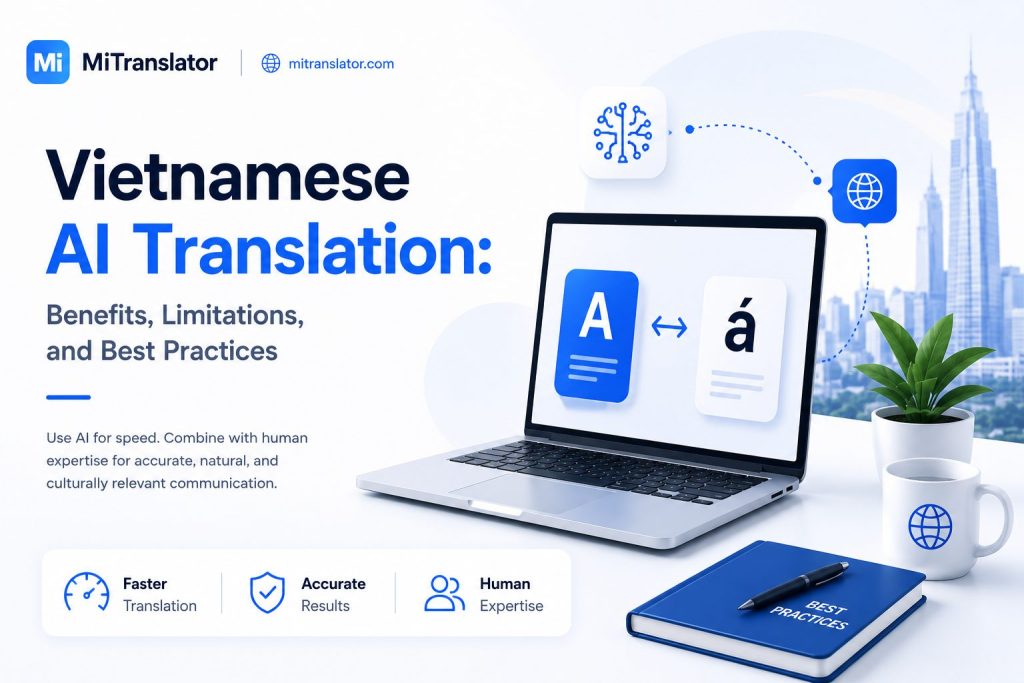
![Vietnamese AI Translation — modern corporate banner with AI technology, Vietnamese language, and multilingual business communication theme]
What Is Vietnamese AI Translation?
Vietnamese AI translation refers to the use of artificial intelligence and machine learning tools to automatically translate content between Vietnamese and other languages.
Popular AI translation platforms include:
- Google Translate
- DeepL
- Microsoft Translator
- AI-powered language models
AI translation systems are trained using large amounts of multilingual data to predict and generate translations automatically.
Businesses commonly use AI translation for:
- Internal communication
- Draft translation
- Quick multilingual support
- Large-volume repetitive content
- Basic content understanding
Benefits of Vietnamese AI Translation
Faster Translation Speed
AI translation can process large amounts of text almost instantly.
This helps businesses:
- Save time
- Improve workflow efficiency
- Handle high-volume content quickly
For companies managing multilingual operations, speed can be a major advantage.
Lower Initial Costs
AI translation tools are often more affordable than fully manual translation workflows.
Businesses may use AI to reduce costs for:
- Internal documents
- Temporary drafts
- Non-public content
- Repetitive text
Scalability
AI systems can translate thousands of words rapidly without increasing staffing requirements.
This is especially useful for:
- Product catalogs
- User-generated content
- Large databases
- Internal support materials
24/7 Accessibility
AI translation tools are available anytime and can support quick communication across different time zones.
Limitations of Vietnamese AI Translation
Lack of Cultural Understanding
AI translation may struggle with:
- Tone
- Context
- Humor
- Cultural nuance
- Local communication style
This can make Vietnamese translations sound unnatural or awkward.
Inconsistent Accuracy
Translation quality may vary depending on:
- Sentence complexity
- Industry terminology
- Writing style
- Context
Even advanced AI tools can generate incorrect or misleading translations.
Weak Performance in Specialized Industries
Legal, medical, financial, and technical content often require precise terminology.
AI translation may incorrectly interpret:
- Legal clauses
- Technical instructions
- Compliance language
- Industry-specific terminology
Brand Voice Problems
AI-generated content may fail to preserve:
- Brand personality
- Marketing tone
- Professional style
- Customer engagement quality
For customer-facing communication, this can affect brand image.
Confidentiality Concerns
Uploading sensitive business documents into public AI platforms may create security or privacy risks.
Businesses should carefully evaluate how confidential information is handled.
When Businesses Can Use AI Translation
AI translation may work well for:
- Internal communication
- Quick content review
- Draft translations
- Repetitive text
- Basic multilingual understanding
It can improve productivity when quality requirements are lower.
When Businesses Should Avoid AI-Only Translation
Businesses should avoid relying entirely on AI translation for:
- Legal documents
- Contracts
- Marketing campaigns
- Websites
- Technical manuals
- Official communication
- Customer-facing content
In these situations, professional human review is strongly recommended.
Best Practices for Using Vietnamese AI Translation
Combine AI with Human Review
The most effective approach is often:
- AI translation for speed
- Human editing and proofreading for quality
Human linguists help improve:
- Accuracy
- Natural phrasing
- Cultural relevance
- Terminology consistency
Use Industry-Specific Terminology Glossaries
Maintaining approved terminology helps improve translation consistency across projects.
Glossaries are especially useful for:
- Technical industries
- Manufacturing
- Legal translation
- Healthcare
- Finance
Localize — Don’t Just Translate
Businesses targeting Vietnamese customers should adapt:
- Tone
- Messaging
- Cultural references
- User experience
Localization improves customer engagement significantly.
Protect Sensitive Information
Avoid uploading confidential business documents into unsecured public AI platforms.
Businesses should use secure workflows and trusted translation providers when handling sensitive information.
Perform Quality Assurance Checks
Always review AI-generated translation before publication.
QA checks should include:
- Accuracy review
- Formatting review
- Terminology verification
- Cultural appropriateness
Human Translation vs AI Translation
| AI Translation | Human Translation |
|---|---|
| Fast and automated | More accurate and natural |
| Lower upfront cost | Better cultural understanding |
| Good for basic content | Better for business-critical communication |
| May produce awkward phrasing | Maintains professional tone |
| Limited context understanding | Strong localization capability |
Many businesses now combine both approaches to improve efficiency while maintaining quality.
How MITRANS Can Help
MITRANS Translation Services provides professional Vietnamese translation and localization solutions for businesses operating in Vietnam and international markets.
MITRANS helps businesses combine:
- AI-assisted workflows
- Human linguistic expertise
- Localization support
- Quality assurance processes
Services include:
- Business document translation
- Website localization
- Marketing translation
- Technical translation
- Certified translation
- Multilingual support in English, Vietnamese, Chinese, Japanese, and Korean
Why businesses choose MITRANS:
- Native professional translators
- Industry-specialized expertise
- Human quality assurance
- Fast turnaround times
- Confidential workflows
- Consistent terminology management
MITRANS helps businesses achieve accurate and professional multilingual communication while balancing efficiency and quality.
FAQ
Is Vietnamese AI translation accurate?
AI translation can be useful for basic understanding and internal communication, but quality may vary depending on context and content complexity.
Can AI translation replace professional human translators?
AI can support translation workflows, but professional human translators are still essential for high-quality business communication and localization.
What are the risks of AI translation?
Potential risks include inaccurate terminology, awkward phrasing, confidentiality concerns, and lack of cultural adaptation.
When should businesses use human translation instead of AI?
Human translation is recommended for legal documents, marketing materials, websites, customer-facing communication, and technical content.
Does MITRANS provide AI-assisted translation solutions?
Yes. MITRANS supports businesses with professional translation workflows that combine efficiency, human expertise, and quality assurance.
Need Professional Vietnamese Translation Support?
Looking for accurate, natural, and business-focused multilingual communication solutions?
Contact MITRANS today for professional Vietnamese translation and localization services tailored to your business needs.