
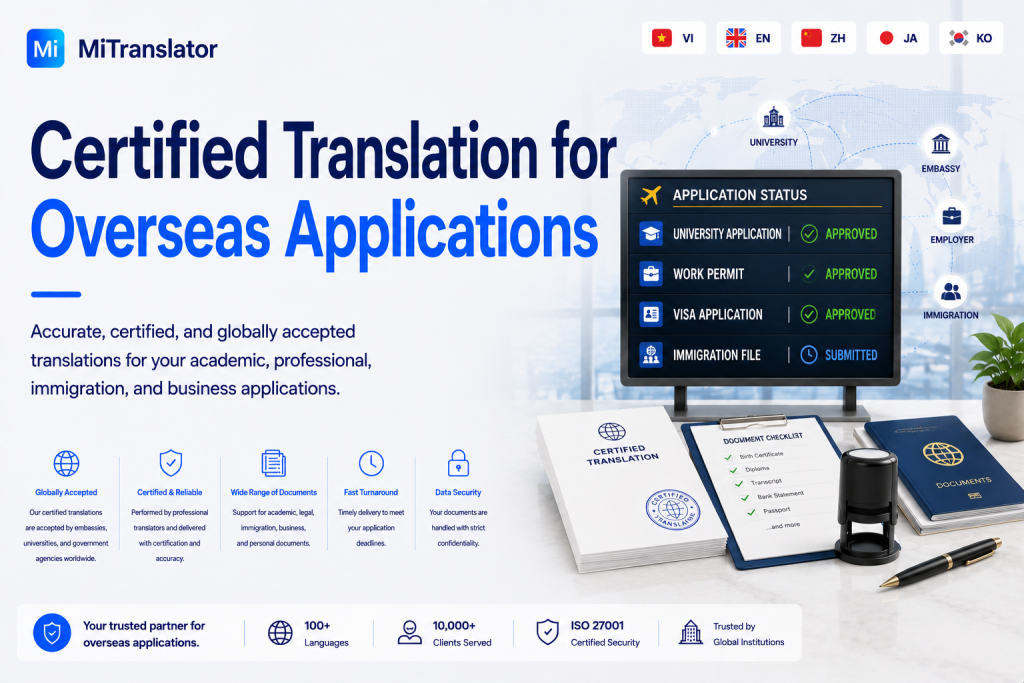
Applying to study, work, live, invest, marry, or immigrate abroad often requires the submission of official documents to foreign authorities. Whether dealing with embassies, universities, immigration departments, licensing bodies, employers, or government agencies, applicants are frequently asked to provide certified translations of documents issued in their home country.
Certified translation is often a mandatory requirement because overseas institutions need assurance that foreign-language documents have been translated accurately and completely. Errors in translated documents can result in processing delays, requests for additional information, application rejection, or legal complications.
Professional certified translation services help individuals and organizations prepare compliant documentation for international applications while ensuring accuracy, consistency, and acceptance by foreign authorities.
What Is a Certified Translation?
A certified translation is a professionally translated document accompanied by a formal certification statement confirming that the translation is a complete and accurate representation of the original document.
Depending on the requirements of the receiving country or institution, a certified translation may include:
- Translator certification statement
- Translation company certification
- Company seal or stamp
- Translator signature
- Notarization
- Sworn translation declaration
Certified translations are commonly required when translated documents are submitted for official, legal, academic, immigration, or governmental purposes.
Why Certified Translation Is Important for Overseas Applications
Ensuring Document Acceptance
Foreign authorities often require certified translations to verify the authenticity and accuracy of submitted documents.
Certified translations increase the likelihood that documents will be accepted without additional verification requests.
Supporting Legal and Administrative Processes
Many overseas applications involve legally significant records such as identity documents, civil status certificates, educational credentials, and employment records.
Certified translations help preserve the legal meaning of the original documents.
Reducing Processing Delays
Incomplete or inaccurate translations can trigger requests for corrections or additional supporting documentation.
Professional certified translations help minimize these risks.
Meeting Institutional Requirements
Universities, employers, immigration authorities, and licensing bodies often establish specific translation requirements that applicants must satisfy.
Building Confidence with Reviewing Authorities
Certified translations demonstrate that applicants have taken appropriate steps to ensure document accuracy and compliance.
Common Overseas Applications Requiring Certified Translation
Student Visa Applications
Students applying to foreign universities often need certified translations of:
- Academic transcripts
- Diplomas
- Degrees
- Birth certificates
- Financial documents
Work Permit Applications
Foreign workers commonly submit translated:
- Employment contracts
- Professional qualifications
- Criminal record certificates
- Identity documents
- Employment verification letters
Immigration and Permanent Residency Applications
Immigration authorities frequently require certified translations of official records to verify eligibility.
Citizenship and Naturalization Applications
Applicants may need translated documentation to establish identity, family relationships, residency history, and legal status.
Family Sponsorship Programs
Spouse visas, dependent visas, and family reunification programs often require certified translations of family-related documents.
Professional Licensing Applications
Professional bodies may require translated qualifications and supporting documentation before granting licenses or certifications.
Common Documents Requiring Certified Translation
Birth Certificates
Birth certificates are among the most frequently translated documents for overseas applications.
They are commonly used for:
- Immigration
- Education
- Citizenship
- Family sponsorship
Marriage Certificates
Marriage certificates often support:
- Spouse visa applications
- Family immigration
- Residency programs
- Overseas marriage registration
Divorce Certificates
Proof of marital status changes may be required by immigration authorities and foreign institutions.
Passports and Identity Documents
Identity verification often requires translation of:
- National identity cards
- Residence cards
- Household registration records
Criminal Record Certificates
Police clearance certificates are commonly required for:
- Work permits
- Immigration applications
- Permanent residency
- Professional licensing
Educational Records
Applicants frequently translate:
- Diplomas
- Degrees
- Academic transcripts
- Certificates
- Professional qualifications
Employment Documents
Employers and immigration authorities may request:
- Employment verification letters
- Work experience certificates
- Labor contracts
- Salary confirmation documents
Financial Documents
Financial evidence may include:
- Bank statements
- Tax returns
- Income certificates
- Sponsorship letters
Court Documents
Legal matters often require translation of:
- Court judgments
- Guardianship orders
- Custody decisions
- Name change certificates
Common Challenges in Certified Translation
Country-Specific Requirements
Every country may have different requirements regarding:
- Certification standards
- Notarization
- Sworn translation
- Translator qualifications
- Formatting requirements
Applicants should always verify the requirements of the receiving authority.
Consistency Across Multiple Documents
Names, dates, addresses, and identification numbers must remain consistent throughout all translated materials.
Legal and Administrative Terminology
Official documents often contain specialized terminology that requires expertise in legal and administrative translation.
Tight Application Deadlines
Applicants frequently need translations completed within strict visa, university, or immigration timelines.
Sensitive Personal Information
Official records often contain confidential information that must be handled securely.
Risks of Poor Translation
Translation errors can have serious consequences for overseas applications.
Potential issues include:
- Delayed processing
- Application rejection
- Additional document requests
- Embassy appointment delays
- Licensing complications
- Immigration issues
- Increased administrative costs
Even minor mistakes involving names, dates, or document numbers can create significant problems.
Best Practices for Certified Translation
Verify Requirements Before Translation
Applicants should confirm:
- Accepted languages
- Certification requirements
- Notarization requirements
- Submission formats
- Document validity requirements
Use Professional Translation Providers
Official documents should be translated by experienced professionals familiar with certification standards and legal terminology.
Provide High-Quality Document Copies
Clear scans help reduce errors and improve translation accuracy.
Review Personal Information Carefully
Applicants should verify that names, dates, and identification numbers match all supporting documents.
Allow Time for Certification and Quality Review
Translation projects should include sufficient time for editing, proofreading, certification, and final verification.
Who Commonly Requests Certified Translations?
Certified translations are frequently required by:
- Embassies
- Consulates
- Immigration authorities
- Universities
- Colleges
- Employers
- Government agencies
- Professional licensing boards
- Courts
- Financial institutions
These organizations often rely on certified translations to review foreign-language documentation accurately.
How MITRANS Supports Overseas Applications
MITRANS provides professional certified translation services for individuals and organizations preparing documents for overseas use.
Our services include translation of:
- Birth certificates
- Marriage certificates
- Divorce certificates
- Criminal record certificates
- Passports
- Identity documents
- Academic records
- Employment documents
- Financial records
- Court documents
- Immigration supporting materials
MITRANS follows rigorous quality assurance procedures to ensure that translations are accurate, complete, and suitable for official submission.
We support major language pairs including:
- English ↔ Vietnamese
- Chinese ↔ Vietnamese
- Japanese ↔ Vietnamese
- Korean ↔ Vietnamese
- English ↔ Chinese
- English ↔ Japanese
- English ↔ Korean
Our experienced team understands the requirements associated with overseas applications and helps clients prepare reliable certified translations for international use.
Frequently Asked Questions
What is a certified translation?
A certified translation is a professionally translated document accompanied by a statement confirming its accuracy and completeness.
Do all overseas applications require certified translation?
Not all applications require certified translations, but many immigration authorities, universities, employers, and government agencies do.
Can certified translations be used for visa applications?
Yes. Certified translations are commonly required for student visas, work permits, immigration programs, and residency applications.
Is notarization always required?
No. Some institutions require notarization, while others only require certification. Requirements vary by country and authority.
What documents are most commonly translated for overseas applications?
Birth certificates, marriage certificates, criminal record certificates, academic records, employment documents, and financial statements are among the most frequently translated documents.
Contact MITRANS for Professional Translation Services
Professional translation plays a critical role in ensuring accuracy, compliance, and effective communication across international business activities. Whether you require translation for legal, financial, technical, corporate, immigration, or regulatory documents, MITRANS is ready to help.
Contact MITRANS today for fast, accurate, and professional translation services tailored to your business and documentation requirements.