Introduction
As businesses expand into global markets, managing multilingual content becomes increasingly complex. Companies must translate websites, apps, product information, customer support materials, and internal communication across multiple languages — often at high speed and large scale.
This is where translation APIs can help.
Translation APIs allow businesses to integrate automated translation directly into websites, software platforms, apps, and workflows. They help companies streamline multilingual operations, improve efficiency, and support faster international communication.
This guide explains how translation APIs work, their business benefits, common limitations, and best practices for managing multilingual content effectively.
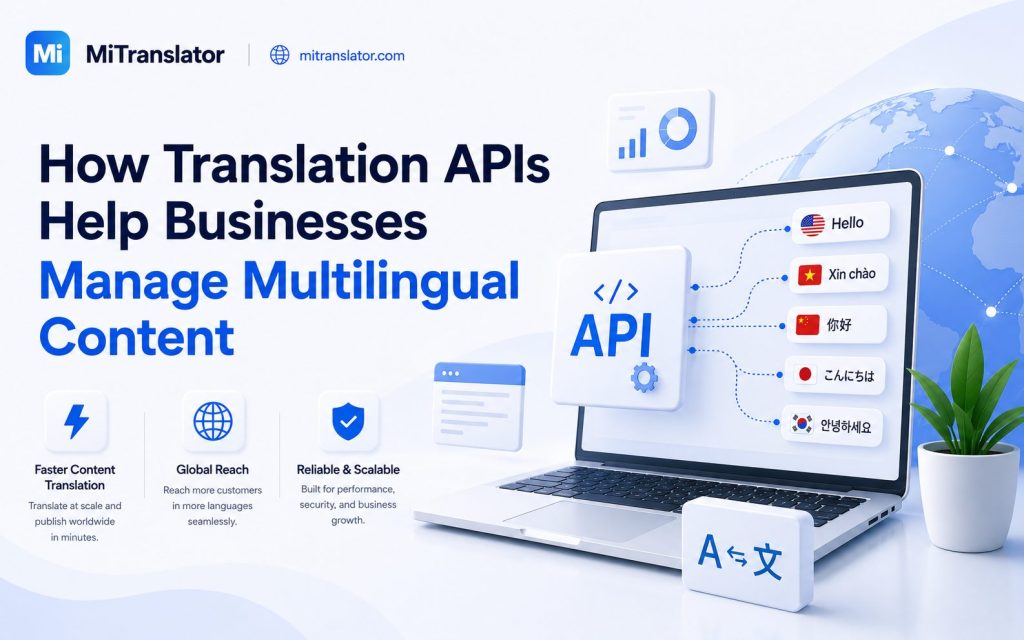
![How Translation APIs Help Businesses Manage Multilingual Content — clean corporate banner with API integration, multilingual workflow, and modern SaaS technology theme]
What Is a Translation API?
A translation API is a software interface that allows applications or systems to automatically send text to a translation engine and receive translated content instantly.
Popular translation APIs include:
- Google Cloud Translation API
- DeepL API
- Microsoft Translator API
- Amazon Translate
Businesses can integrate translation APIs into:
- Websites
- Mobile apps
- CMS platforms
- Customer support systems
- eCommerce platforms
- Internal business tools
Translation APIs help automate multilingual communication without requiring manual translation for every task.
How Translation APIs Work
Translation APIs typically follow a simple process:
- A system sends text to the API
- The API processes the translation
- The translated content is returned automatically
- The application displays or stores the translated result
For example:
- A multilingual website may automatically display Vietnamese content
- A customer support chatbot may instantly translate messages
- An eCommerce platform may localize product descriptions dynamically
This automation helps businesses manage large volumes of multilingual content efficiently.
Benefits of Translation APIs for Businesses
Faster Multilingual Content Management
Translation APIs can process content almost instantly.
This helps businesses:
- Launch multilingual content faster
- Reduce manual workload
- Improve operational efficiency
Scalability
Businesses managing large amounts of content benefit from automated workflows.
Translation APIs work well for:
- Product catalogs
- User-generated content
- Knowledge bases
- Internal communication systems
Better Integration Across Platforms
Translation APIs can integrate directly into existing systems such as:
- WordPress
- Shopify
- CRM platforms
- SaaS applications
- Customer support software
This creates smoother multilingual workflows.
Improved Global User Experience
Businesses can support customers in multiple languages more efficiently through:
- Multilingual websites
- Real-time translation
- Localized user interfaces
- Faster customer support responses
Cost Efficiency
For high-volume repetitive content, APIs may reduce translation costs compared to fully manual workflows.
Common Business Use Cases
Website Localization
Translation APIs help websites display content in multiple languages dynamically.
This is useful for:
- International corporate websites
- eCommerce stores
- SaaS platforms
- News portals
Customer Support Translation
Businesses use APIs to:
- Translate live chat messages
- Support multilingual help desks
- Improve international customer service
App & Software Localization
Translation APIs can support:
- App interface translation
- Multilingual onboarding
- User-generated content translation
Internal Business Communication
Global companies may use translation APIs to improve communication across international teams.
Limitations of Translation APIs
Limited Cultural Understanding
Translation APIs often struggle with:
- Tone
- Context
- Cultural nuance
- Brand messaging
Automated translation may sound unnatural in customer-facing communication.
Inconsistent Translation Quality
Accuracy may vary depending on:
- Language pair
- Sentence complexity
- Industry terminology
- Writing style
Business-critical content still requires human review.
Weak Localization Capability
Translation APIs focus primarily on language conversion, not full localization.
They may not properly adapt:
- Marketing tone
- Cultural references
- SEO keywords
- User experience
Confidentiality & Data Security Concerns
Businesses should carefully review:
- Data privacy policies
- API security standards
- Sensitive information handling
Confidential documents may require secure workflows and professional translation support.
Best Practices for Using Translation APIs
Combine APIs with Human Review
The best results often come from:
- API translation for speed
- Human translators for editing and localization
Human review improves:
- Accuracy
- Natural phrasing
- Brand consistency
- Cultural adaptation
Use Translation Memory & Glossaries
Terminology management helps maintain consistency across multilingual projects.
Glossaries are especially useful for:
- Technical industries
- Legal terminology
- Product naming
- Brand messaging
Avoid Fully Automated Customer-Facing Content
Marketing content, websites, and important communication should always be reviewed professionally before publication.
Localize — Don’t Just Translate
Businesses targeting Vietnamese audiences should adapt:
- Tone
- Messaging
- SEO keywords
- User experience
- Cultural communication style
Localization helps content feel natural and trustworthy.
Monitor Translation Quality Regularly
Businesses should regularly review:
- Translation accuracy
- Formatting
- Terminology consistency
- User feedback
Quality assurance helps improve long-term multilingual performance.
Translation APIs vs Professional Translation Services
| Translation APIs | Professional Human Translation |
|---|---|
| Fast and automated | More accurate and natural |
| Good for scalable workflows | Better cultural adaptation |
| Lower cost for repetitive content | Better for business-critical communication |
| Limited context understanding | Strong localization expertise |
| Best for operational efficiency | Best for branding and quality |
Many businesses now combine both approaches for optimal efficiency and quality.
How MITRANS Can Help
MITRANS Translation Services helps businesses manage multilingual communication through professional translation and localization solutions.
MITRANS supports:
- Website localization
- Business translation
- API-assisted translation workflows
- Technical translation
- Marketing localization
- Multilingual SEO content
- Human quality assurance
Languages supported include:
- Vietnamese
- English
- Chinese
- Japanese
- Korean
Why businesses choose MITRANS:
- Native professional translators
- Localization expertise
- Human QA processes
- Industry-specialized terminology
- Fast turnaround times
- Scalable multilingual support
MITRANS helps businesses combine technology and human expertise for accurate and professional multilingual communication.
FAQ
What is a translation API?
A translation API allows applications and systems to automatically translate text between languages using machine translation technology.
Are translation APIs accurate enough for businesses?
Translation APIs can be useful for operational efficiency and basic multilingual workflows, but professional human review is still recommended for important content.
Can translation APIs localize content?
Translation APIs mainly focus on language conversion. Full localization usually requires human expertise and cultural adaptation.
What industries use translation APIs the most?
Industries including eCommerce, SaaS, customer support, technology, and global enterprise operations commonly use translation APIs.
Does MITRANS support API-assisted translation workflows?
Yes. MITRANS supports businesses with professional translation, localization, and quality assurance solutions that can work alongside API-based multilingual systems.
Need Professional Multilingual Support for Your Business?
Looking to scale multilingual content while maintaining quality and professionalism?
Contact MITRANS today for professional translation and localization solutions tailored to your business operations.