Introduction
As businesses expand internationally, the demand for fast and cost-effective translation continues to grow. Today, many companies use AI translation tools to translate documents, websites, emails, and customer communication instantly.
However, while AI translation technology has improved significantly, it still cannot fully replace professional human translators in many business situations.
Choosing between AI translation and human translation depends on your business goals, content type, accuracy requirements, and customer expectations.
This guide explains the differences between AI and human translation, their advantages and limitations, and how businesses can decide which solution works best for their needs.
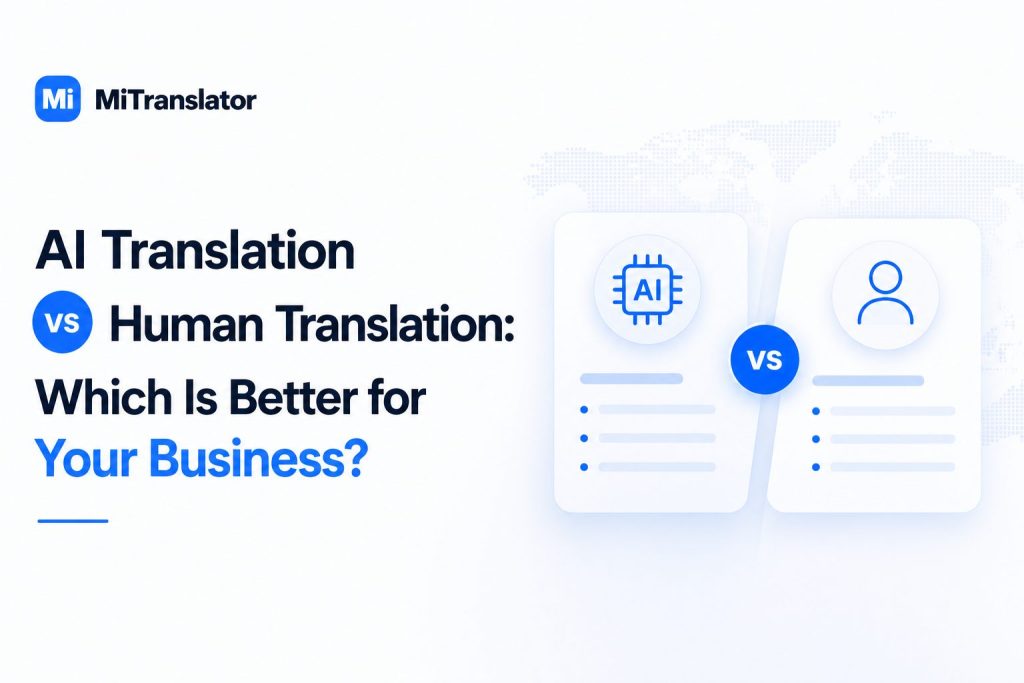
![AI Translation vs Human Translation — modern corporate banner with AI technology, professional translators, and multilingual business communication theme]
What Is AI Translation?
AI translation uses artificial intelligence and machine learning technology to automatically translate text between languages.
Popular AI translation tools include:
- Google Translate
- DeepL
- Microsoft Translator
- ChatGPT-based translation tools
AI translation is designed to:
- Translate content quickly
- Reduce manual work
- Handle large volumes of text
- Provide instant multilingual communication
Businesses often use AI translation for:
- Internal communication
- Basic content understanding
- Draft translations
- High-volume repetitive text
What Is Human Translation?
Human translation is performed by professional linguists who understand:
- Language nuance
- Cultural context
- Tone of voice
- Industry terminology
- Audience expectations
Professional human translators adapt content naturally while maintaining meaning, clarity, and professionalism.
Human translation is commonly used for:
- Legal documents
- Marketing materials
- Websites
- Technical documents
- Business communication
- Certified translation
- Customer-facing content
Key Differences Between AI Translation and Human Translation
| AI Translation | Human Translation |
|---|---|
| Fast and automated | More accurate and natural |
| Lower upfront cost | Higher quality and reliability |
| Limited cultural understanding | Strong cultural adaptation |
| May struggle with context | Understands tone and nuance |
| Best for basic/internal content | Best for business-critical communication |
| Can produce awkward phrasing | Produces natural communication |
In simple terms:
- AI focuses on speed
- Human translation focuses on quality and context
Advantages of AI Translation
Faster Turnaround
AI tools can translate large amounts of text almost instantly.
This is useful for:
- Internal communication
- Quick drafts
- Large repetitive datasets
- Basic multilingual support
Lower Initial Cost
AI translation can reduce costs for businesses handling:
- High-volume simple content
- Temporary internal materials
- Non-critical communication
Scalability
AI can process thousands of words quickly without increasing staffing requirements.
This may help businesses with:
- Product catalogs
- Internal databases
- User-generated content
Limitations of AI Translation
Lack of Cultural Understanding
AI often struggles with:
- Tone
- Humor
- Idioms
- Cultural nuance
- Brand messaging
This can create unnatural or inappropriate communication.
Inconsistent Accuracy
AI translation quality may vary depending on:
- Language pair
- Context
- Industry terminology
- Sentence complexity
Mistakes can create serious business risks.
Weak Industry Expertise
AI may incorrectly translate:
- Legal terminology
- Technical language
- Financial documents
- Medical terminology
For regulated industries, professional review is essential.
Confidentiality Concerns
Using public AI tools may create privacy or confidentiality risks for sensitive business documents.
Advantages of Human Translation
Higher Accuracy
Professional translators understand:
- Context
- Meaning
- Industry terminology
- Cultural expectations
This improves communication quality significantly.
Natural Communication
Human translators adapt content to sound:
- Professional
- Natural
- Persuasive
- Customer-friendly
This is especially important for marketing and branding.
Better Localization
Human translation supports localization by adapting:
- Tone
- Messaging
- Cultural references
- Customer expectations
Stronger Brand Reputation
Poor translation can damage credibility.
Professional translation helps businesses maintain a polished and trustworthy image.
When Businesses Should Use AI Translation
AI translation may work well for:
- Internal notes
- Basic understanding of foreign text
- Repetitive content
- Temporary drafts
- Non-public materials
However, AI-generated content should still be reviewed for accuracy.
When Businesses Should Use Human Translation
Human translation is strongly recommended for:
- Contracts and legal documents
- Marketing campaigns
- Websites and localization
- Technical manuals
- Customer-facing communication
- Official documents
- Brand messaging
For business-critical content, quality and clarity matter more than speed alone.
The Best Approach: Combining AI + Human Expertise
Many businesses now use a hybrid approach:
- AI translation for speed and draft generation
- Human translators for editing, localization, and quality assurance
This approach can improve:
- Efficiency
- Scalability
- Translation quality
- Cost management
Human review remains essential for professional communication.
How MITRANS Can Help
MITRANS Translation Services provides professional translation and localization solutions for businesses operating in Vietnam and international markets.
MITRANS supports:
- Business document translation
- Website localization
- Marketing translation
- Technical translation
- Certified translation
- Multilingual support in English, Vietnamese, Chinese, Japanese, and Korean
Why businesses choose MITRANS:
- Native professional translators
- Industry-specialized expertise
- Human quality assurance
- Confidential workflows
- Fast turnaround times
- Consistent terminology management
MITRANS helps businesses combine efficiency and accuracy through professional human translation and localization support tailored to real business needs.
FAQ
Is AI translation accurate enough for businesses?
AI translation can be useful for basic understanding and internal communication, but professional human translation is recommended for business-critical content.
Can AI translation replace human translators?
AI can support translation workflows, but it still struggles with cultural nuance, context, tone, and specialized terminology.
What types of documents require human translation?
Legal documents, marketing materials, technical manuals, websites, and official communication should typically be handled by professional human translators.
Is AI translation safe for confidential business documents?
Public AI tools may create confidentiality risks. Sensitive business documents should be handled carefully and reviewed by trusted professionals.
Does MITRANS provide professional human translation services?
Yes. MITRANS provides professional translation and localization services supported by experienced human translators and quality assurance processes.
Need Professional Translation Support for Your Business?
Looking for accurate, natural, and business-focused multilingual communication?
Contact MITRANS today for professional translation and localization services tailored to your business needs.