As organizations expand into international markets, the volume and complexity of multilingual content continue to grow. Enterprises regularly translate legal contracts, financial reports, technical manuals, compliance documentation, employee communications, marketing materials, and customer-facing content across multiple languages and regions.
While translation is a critical component of global communication, translation alone is not enough to ensure quality. Without a structured review process, errors, inconsistencies, terminology issues, and compliance risks can easily make their way into published or submitted content.
This is why many organizations implement translation review workflows. A well-designed review workflow helps enterprises maintain accuracy, consistency, regulatory compliance, and brand integrity while supporting efficient multilingual content management.
What Is a Translation Review Workflow?
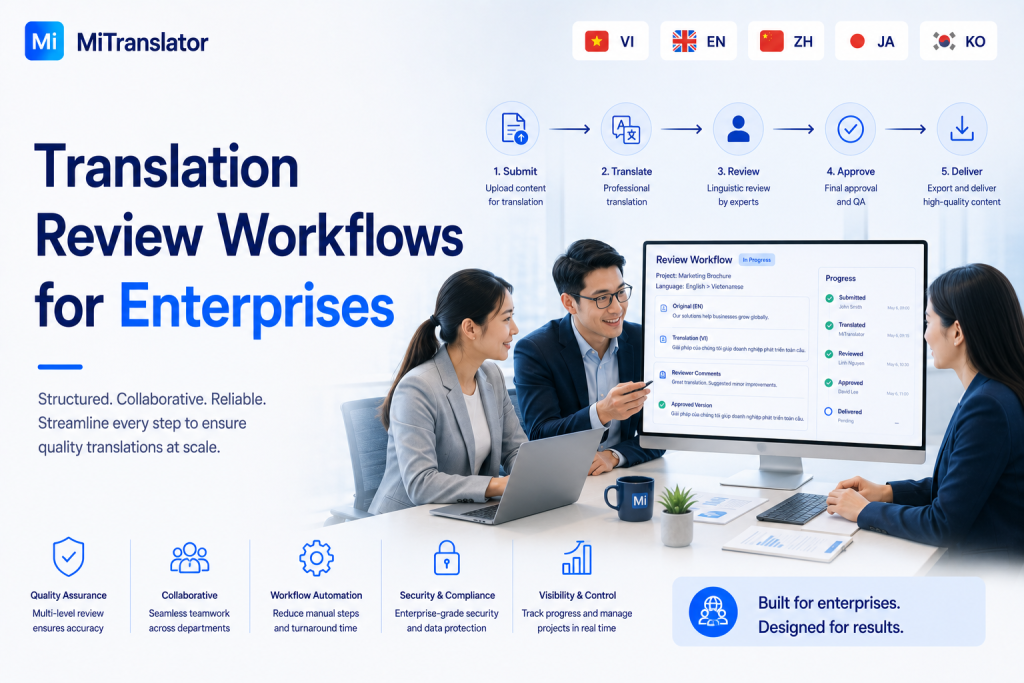
A translation review workflow is a structured process used to evaluate translated content before it is approved for publication, distribution, submission, or internal use.
The workflow typically involves multiple stakeholders who review the translation from different perspectives, including:
- Linguistic accuracy
- Terminology consistency
- Technical correctness
- Legal compliance
- Brand alignment
- Formatting quality
- Market appropriateness
Rather than relying on a single review stage, enterprise translation workflows often incorporate several layers of quality control.
Why Translation Review Workflows Matter
Maintaining Translation Quality
Even highly qualified translators can occasionally overlook errors or inconsistencies.
A structured review process provides an additional layer of verification before content is finalized.
Protecting Brand Reputation
Inconsistent messaging across languages can weaken brand credibility and create confusion among customers.
Review workflows help ensure that brand voice remains consistent across global markets.
Supporting Regulatory Compliance
Industries such as healthcare, finance, manufacturing, pharmaceuticals, and legal services often operate under strict regulatory requirements.
Translation reviews help identify compliance-related issues before documents are submitted or published.
Reducing Business Risks
Errors in legal agreements, technical documentation, financial reports, or compliance records can result in significant financial and operational consequences.
Review workflows help minimize these risks.
Improving Internal Collaboration
A formal review process creates clear responsibilities and communication channels among translators, reviewers, subject-matter experts, and business stakeholders.
Common Types of Enterprise Content Requiring Review
Legal Documents
Organizations frequently review:
- Contracts
- Corporate governance documents
- Compliance policies
- Litigation materials
- Intellectual property documentation
Legal translations often require specialized review by legal professionals.
Financial Documents
Common examples include:
- Financial statements
- Audit reports
- Annual reports
- Tax documentation
- Investor communications
Accuracy and consistency are particularly important in financial reporting.
Technical Documentation
Manufacturers and technology companies often review:
- Product manuals
- Engineering specifications
- Safety instructions
- Operating procedures
- Technical reports
Technical accuracy is essential to avoid operational and safety risks.
Human Resources Materials
HR-related content may include:
- Employment contracts
- Employee handbooks
- Training materials
- Internal communications
- Benefits documentation
Review processes help ensure consistency across global workforces.
Marketing and Customer Content
Marketing teams frequently review:
- Websites
- Product descriptions
- Advertising campaigns
- Social media content
- Promotional materials
Localization review is often necessary to ensure cultural appropriateness.
Key Stages of a Translation Review Workflow
Stage 1: Translation
The process begins with professional translation by a qualified linguist who has expertise in the relevant subject area.
The translator focuses on:
- Meaning accuracy
- Terminology usage
- Context preservation
- Cultural appropriateness
- Target-language readability
The quality of this initial stage significantly influences the efficiency of subsequent reviews.
Stage 2: Linguistic Editing
An editor reviews the translated content against the source text.
The objective is to verify:
- Translation accuracy
- Completeness
- Terminology consistency
- Grammar and style
- Proper interpretation of meaning
This step helps identify omissions, additions, and translation errors.
Stage 3: Subject-Matter Expert Review
For specialized content, enterprises often involve subject-matter experts (SMEs).
Examples include:
- Lawyers for legal documents
- Accountants for financial reports
- Engineers for technical manuals
- Medical professionals for healthcare content
SMEs verify technical correctness and industry-specific terminology.
Stage 4: In-Country Review
Organizations targeting specific regional markets may conduct in-country reviews.
Local reviewers evaluate:
- Cultural appropriateness
- Market relevance
- Regional language preferences
- Customer expectations
This step is particularly important for marketing and customer-facing content.
Stage 5: Compliance Review
Highly regulated industries often require compliance verification.
Reviewers assess whether translated content complies with:
- Industry regulations
- Government requirements
- Corporate policies
- Legal obligations
- Disclosure requirements
Compliance review helps reduce regulatory risk.
Stage 6: Formatting and Layout Review
Formatting reviews ensure that the translated content maintains the structure and appearance of the original document.
Reviewers check:
- Tables
- Graphics
- Numbering
- Headings
- Footnotes
- Charts
- Legal references
This stage is especially important for official submissions and technical documentation.
Stage 7: Final Approval
After all reviews are completed, the document undergoes final approval before publication or distribution.
The final approver may be:
- A project manager
- Department head
- Legal counsel
- Compliance officer
- Content owner
Approval confirms that the translation meets organizational requirements.
Common Challenges in Enterprise Translation Reviews
Multiple Stakeholders
Large organizations often involve several reviewers with different priorities.
This can create conflicting feedback and slow decision-making.
Inconsistent Terminology
Without centralized terminology management, reviewers may suggest different translations for the same term.
Long Review Cycles
Complex approval structures can delay project completion.
Version Control Problems
Managing multiple document versions across departments and languages can become difficult without proper systems.
Limited Reviewer Availability
Subject-matter experts and business stakeholders may have limited time to participate in reviews.
Best Practices for Translation Review Workflows
Define Roles Clearly
Each participant should understand their responsibilities within the review process.
For example:
- Translators focus on linguistic accuracy.
- Editors verify quality.
- SMEs review technical content.
- Compliance teams assess regulatory requirements.
Establish Review Guidelines
Clear review criteria help reviewers provide consistent and actionable feedback.
Maintain Terminology Databases
Approved glossaries help reduce inconsistencies across projects and reviewers.
Use Translation Management Systems
Modern Translation Management Systems (TMS) help automate workflows, manage versions, and track review progress.
Limit Unnecessary Review Layers
Excessive review stages can increase costs and delay project delivery without improving quality.
Organizations should tailor workflows based on project complexity and risk.
Track Reviewer Feedback
Maintaining records of approved terminology and reviewer preferences helps improve future translation projects.
Benefits of an Effective Translation Review Workflow
Organizations that implement structured review processes often experience:
- Higher translation quality
- Greater consistency
- Faster approvals
- Reduced compliance risks
- Improved stakeholder confidence
- Better multilingual communication
- Lower revision costs
- Stronger brand protection
These benefits become increasingly important as organizations expand into multiple markets and languages.
How MITRANS Supports Enterprise Translation Review Processes
MITRANS provides professional translation services supported by structured review and quality assurance workflows.
Our process may include:
- Professional translation
- Linguistic editing
- Subject-matter review
- Terminology verification
- Compliance-focused review
- Formatting checks
- Final quality control
We support a wide range of document types, including:
- Legal documents
- Financial reports
- Corporate records
- Technical manuals
- Human resources materials
- Regulatory documentation
- Marketing content
MITRANS combines experienced linguists, industry specialists, and rigorous quality assurance procedures to help enterprises maintain accurate and consistent multilingual communication.
We support major language pairs including:
- English ↔ Vietnamese
- Chinese ↔ Vietnamese
- Japanese ↔ Vietnamese
- Korean ↔ Vietnamese
- English ↔ Chinese
- English ↔ Japanese
- English ↔ Korean
Frequently Asked Questions
What is the purpose of a translation review workflow?
A translation review workflow helps ensure that translated content is accurate, consistent, compliant, and suitable for its intended audience.
Who should review translated content?
Depending on the document type, reviewers may include editors, subject-matter experts, legal advisors, compliance teams, marketing specialists, or local market reviewers.
Are review workflows necessary for all translations?
Not every project requires multiple review layers. However, legal, financial, technical, regulatory, and high-visibility content generally benefits from structured review processes.
How can enterprises reduce translation review delays?
Clear reviewer roles, centralized terminology management, and workflow automation can significantly improve efficiency.
What role does technology play in translation review?
Translation Management Systems help manage workflows, track revisions, maintain version control, and improve collaboration among stakeholders.
Contact MITRANS for Professional Translation Services
Professional translation plays a critical role in ensuring accuracy, compliance, and effective communication across international business activities. Whether you require translation for legal, financial, technical, corporate, immigration, or regulatory documents, MITRANS is ready to help.
Contact MITRANS today for fast, accurate, and professional translation services tailored to your business and documentation requirements.