
Embassies and consulates around the world frequently require applicants to submit official documents as part of visa applications, immigration procedures, citizenship requests, study abroad programs, work permits, family sponsorship cases, and other consular services. When these documents are issued in a language different from the one accepted by the receiving embassy, a certified translation is often required.
Because embassy submissions are subject to strict documentation standards, translation accuracy is critical. Even minor errors involving names, dates, legal status, or personal information can result in delays, requests for additional documents, or application rejection. Certified translation helps ensure that documents are accurately translated and meet the requirements established by embassies and consular authorities.
Whether applying for a student visa, work permit, permanent residency program, marriage registration, or citizenship process, applicants often rely on certified translations to support a smooth and successful submission.
What Is a Certified Translation?
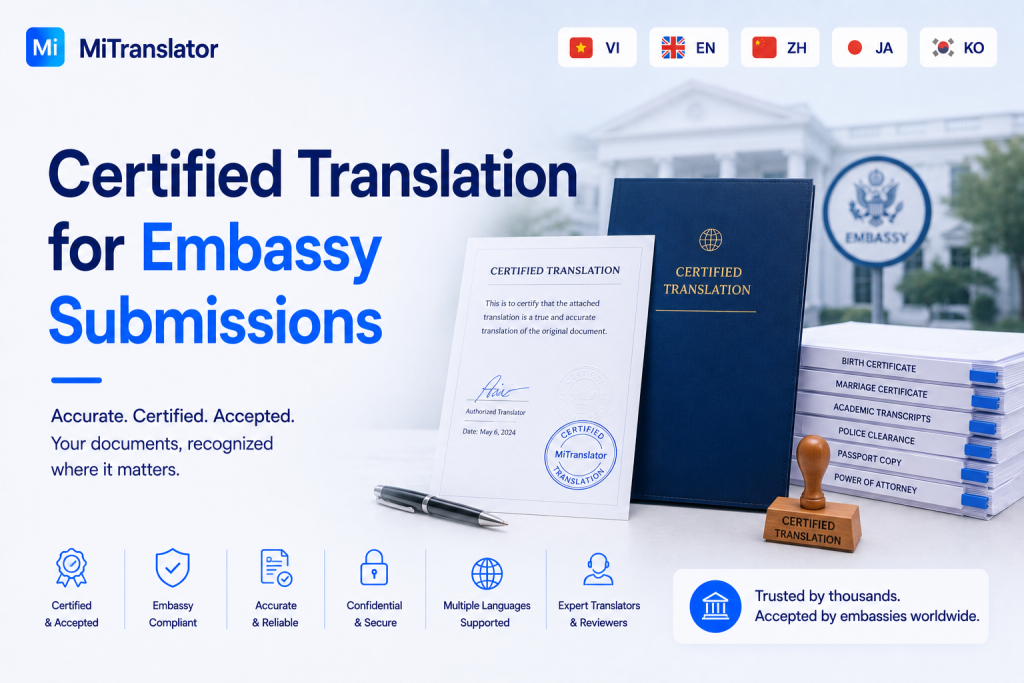
A certified translation is a professionally translated document accompanied by a signed statement confirming that the translation is complete and accurate to the best of the translator’s knowledge and ability.
Depending on the destination country and embassy requirements, certified translations may include:
- Translator certification statements
- Translation company certification
- Official company stamps
- Translator signatures
- Notarization (where required)
- Sworn translator declarations (in certain jurisdictions)
Certified translations are commonly requested when translated documents are used for official governmental, legal, educational, or immigration purposes.
Why Embassies Require Certified Translations
Verifying Document Accuracy
Embassies must ensure that foreign-language documents accurately reflect the original information.
Certified translations provide an additional level of assurance regarding translation quality and completeness.
Supporting Immigration Decisions
Visa officers often rely heavily on supporting documentation when evaluating applications.
Accurate translations help officials review documents efficiently and consistently.
Maintaining Legal Integrity
Many embassy submissions involve legally significant records such as birth certificates, marriage certificates, police clearances, and court documents.
Certified translations help preserve the legal meaning of these documents.
Reducing Fraud Risks
Certification requirements help reduce the risk of altered, incomplete, or inaccurate translations being submitted as official records.
Ensuring Administrative Consistency
Embassies process large volumes of applications from individuals around the world. Certified translation requirements help standardize document review procedures.
Common Documents Requiring Certified Translation for Embassy Submissions
Birth Certificates
Birth certificates are among the most frequently translated documents for immigration, visa applications, citizenship procedures, and family sponsorship programs.
Marriage Certificates
Marriage certificates are commonly required for:
- Spouse visas
- Family reunification applications
- Residency programs
- Marriage registration abroad
Divorce Certificates
Applicants may need to provide proof of marital status changes when applying for visas or immigration benefits.
Passports and Identity Documents
Some embassies require translations of identity documents issued in foreign languages.
Criminal Record Certificates
Police clearance certificates and criminal background checks are frequently required for:
- Work visas
- Permanent residency
- Citizenship applications
- Long-term immigration programs
Educational Documents
Student visa applicants often need translations of:
- Diplomas
- Degrees
- Academic transcripts
- Certificates of completion
Employment Documents
Work visa applications may require:
- Employment verification letters
- Labor contracts
- Professional references
- Salary confirmation documents
Financial Records
Applicants may need to submit translated:
- Bank statements
- Tax records
- Sponsorship letters
- Financial guarantees
Court Documents
Legal proceedings, custody arrangements, name changes, and other legal matters may require certified translation for embassy review.
Common Embassy Procedures Requiring Certified Translation
Student Visa Applications
Universities and embassies often require certified translations of academic and personal documents.
Work Visa Applications
Foreign workers typically submit translated employment and qualification records.
Family Sponsorship Cases
Family reunification and spouse sponsorship programs frequently require certified translations of civil status documents.
Permanent Residency Applications
Immigration authorities often require translated supporting documentation during residency assessments.
Citizenship and Naturalization Applications
Applicants may need certified translations to establish identity, family history, and eligibility.
Marriage Registration Abroad
Individuals marrying overseas often provide translated civil status and identification documents.
Common Challenges in Embassy Document Translation
Country-Specific Requirements
Each embassy may establish different requirements regarding:
- Certification standards
- Translator qualifications
- Notarization requirements
- Sworn translation requirements
- Formatting expectations
Applicants should always verify embassy-specific guidelines before submission.
Strict Accuracy Standards
Embassy submissions often undergo detailed review.
Errors involving names, dates, document numbers, or legal terminology can create processing complications.
Large Documentation Packages
Many visa and immigration applications require multiple supporting documents.
Maintaining consistency across all translated records is essential.
Tight Submission Deadlines
Applicants frequently face embassy appointment dates, visa processing timelines, or university enrollment deadlines that require expedited translation services.
Legal and Administrative Terminology
Official records often contain terminology that requires specialized translation expertise.
Risks of Poor Translation
Inaccurate translations can significantly affect embassy applications.
Potential consequences include:
- Delayed visa processing
- Requests for additional documentation
- Application rejection
- Rescheduled embassy appointments
- Immigration complications
- Increased administrative costs
- Extended processing times
Because embassy decisions often depend on documentary evidence, translation quality is critical.
Best Practices for Embassy Document Translation
Verify Embassy Requirements
Applicants should confirm:
- Accepted languages
- Certification requirements
- Notarization requirements
- Submission formats
- Translator qualifications
Requirements vary by country and application type.
Use Professional Translators
Embassy documents should be translated by professionals familiar with official documentation standards and legal terminology.
Maintain Consistency Across Documents
Names, dates, passport numbers, and addresses should match supporting records exactly.
Provide High-Quality Document Copies
Clear scans help improve translation accuracy and reduce transcription errors.
Allow Time for Review
Translation, proofreading, certification, and final verification all require sufficient time to ensure quality.
How Certified Translation Supports Successful Embassy Applications
Certified translations help applicants:
- Meet official submission requirements
- Improve document clarity
- Reduce processing delays
- Support immigration compliance
- Facilitate document verification
- Strengthen application completeness
For many visa and immigration procedures, certified translation serves as an essential bridge between foreign-language documentation and embassy review processes.
How MITRANS Supports Embassy Submission Requirements
MITRANS provides professional certified translation services for embassy, immigration, education, employment, and international mobility applications.
Our services include translation of:
- Birth certificates
- Marriage certificates
- Divorce certificates
- Criminal record certificates
- Passports
- Identity documents
- Academic records
- Employment documents
- Financial records
- Court documents
- Immigration supporting materials
MITRANS follows rigorous quality assurance procedures to ensure that translations are accurate, complete, and suitable for official submission.
We support major language pairs including:
- English ↔ Vietnamese
- Chinese ↔ Vietnamese
- Japanese ↔ Vietnamese
- Korean ↔ Vietnamese
- English ↔ Chinese
- English ↔ Japanese
- English ↔ Korean
Our experienced team understands the documentation standards commonly associated with embassy and consular applications and helps clients prepare reliable translations for official use.
Frequently Asked Questions
What is the difference between a regular translation and a certified translation?
A certified translation includes a formal statement confirming the accuracy and completeness of the translated document, while a regular translation may not include such certification.
Do all embassies require certified translations?
No. Requirements vary depending on the embassy, country, and application type. Applicants should verify requirements before submission.
Can certified translations be used for visa applications?
Yes. Certified translations are commonly required for visa, immigration, residency, and citizenship applications.
Do certified translations need to be notarized?
Not always. Some embassies require notarization, while others only require certification. Requirements differ by jurisdiction.
Which documents most commonly require certified translation?
Birth certificates, marriage certificates, criminal record certificates, academic records, employment documents, and financial records are among the most frequently translated documents for embassy submissions.
Contact MITRANS for Professional Translation Services
Professional translation plays a critical role in ensuring accuracy, compliance, and effective communication across international business activities. Whether you require translation for legal, financial, technical, corporate, immigration, or regulatory documents, MITRANS is ready to help.
Contact MITRANS today for fast, accurate, and professional translation services tailored to your business and documentation requirements.