As organizations expand globally, the volume of multilingual content continues to grow. Businesses routinely translate legal agreements, technical manuals, financial reports, product documentation, websites, marketing materials, compliance records, and internal communications across multiple languages and markets.
While translation is essential for international operations, it can also represent a significant operational expense—particularly for organizations managing large amounts of recurring content. As a result, many enterprises are looking for ways to improve efficiency and reduce translation costs without compromising quality.
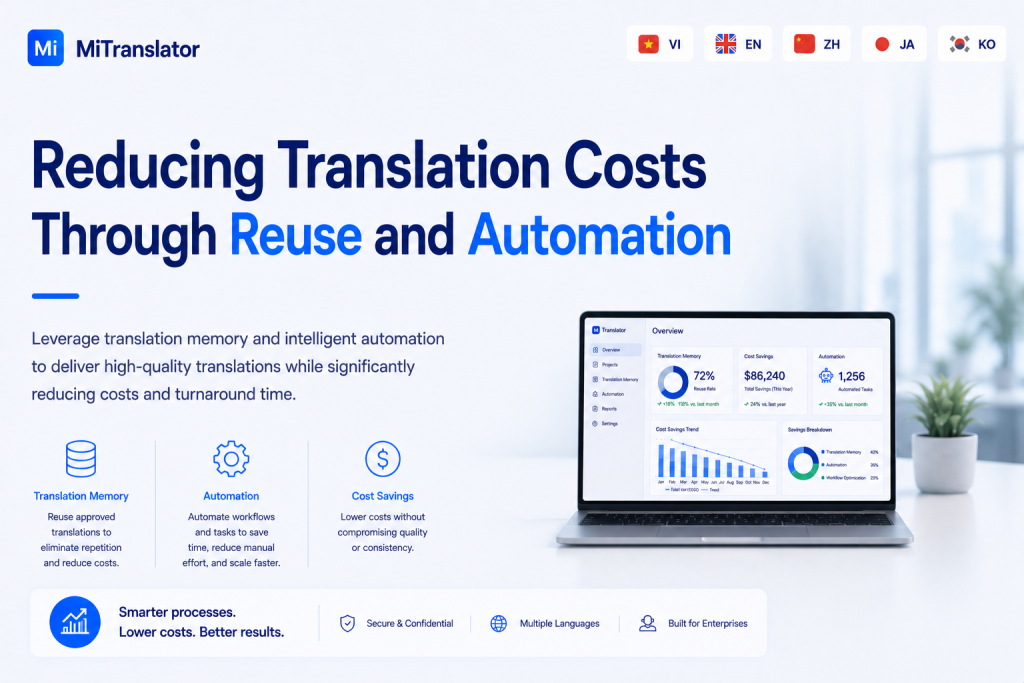
One of the most effective approaches involves leveraging content reuse and automation technologies. By reusing previously translated content and automating repetitive tasks, businesses can significantly lower translation expenses, accelerate project delivery, and maintain greater consistency across multilingual assets.
Why Translation Costs Increase Over Time
Many organizations assume translation costs are directly tied to the number of words being translated. While volume certainly plays a role, several other factors can contribute to rising translation expenses.
Common cost drivers include:
- Repeated translation of similar content
- Frequent document updates
- Large-scale product documentation
- Website localization projects
- Multiple language versions
- Manual project management processes
- Inconsistent terminology
- Extensive review cycles
Without proper systems in place, businesses may end up paying repeatedly to translate content that has already been translated in previous projects.
What Is Translation Reuse?
Translation reuse refers to the process of leveraging previously translated content instead of translating identical or similar text from scratch each time.
Many business documents contain recurring content, including:
- Standard contract clauses
- Product descriptions
- Technical specifications
- Safety instructions
- Corporate policies
- Compliance statements
- Employee handbook content
- Marketing messaging
Rather than re-translating these sections repeatedly, organizations can reuse approved translations to improve efficiency and reduce costs.
The Business Benefits of Translation Reuse
Lower Translation Expenses
Reusing existing translations reduces the amount of new content that requires human translation.
This directly lowers project costs while preserving quality.
Faster Turnaround Times
Previously approved content can be inserted immediately, reducing the time required to complete projects.
Improved Consistency
Using approved translations helps maintain consistent terminology and messaging across all documents.
Reduced Review Effort
Because reused content has often already undergone quality review, internal stakeholders spend less time reviewing repetitive material.
Better Scalability
Organizations can manage increasing volumes of multilingual content without proportionally increasing translation budgets.
Translation Memory: The Foundation of Reuse
Translation Memory (TM) is one of the most important technologies supporting translation reuse.
A translation memory database stores previously translated text segments and automatically suggests approved translations when identical or similar content appears in future projects.
For example, if a company frequently uses a clause such as:
“Payment shall be made within thirty (30) days from the date of invoice.”
The translation memory system can automatically retrieve the approved translation whenever the same sentence appears again.
Benefits of translation memory include:
- Cost reduction
- Faster project completion
- Consistent terminology
- Improved quality
- Reduced duplication of effort
Translation memory is particularly valuable for legal, technical, manufacturing, healthcare, and regulatory documentation.
Understanding Translation Matches
Translation memory systems categorize content according to match levels.
Exact Matches
The source text is identical to content previously translated.
These segments often require little or no additional translation work.
Fuzzy Matches
The source text is similar—but not identical—to previously translated content.
Translators can modify existing translations rather than starting from scratch.
No Matches
Completely new content that requires full translation.
Organizations with mature translation memory databases often achieve substantial savings because a large percentage of their content falls into exact-match or fuzzy-match categories.
How Automation Reduces Translation Costs
Beyond content reuse, automation can significantly reduce administrative and operational costs associated with translation projects.
Automated Project Creation
Modern translation management systems can automatically:
- Create projects
- Assign translators
- Route files
- Generate notifications
- Track deadlines
This reduces manual project management effort.
Automated File Processing
Automation tools can extract content from:
- Word documents
- PDFs
- Websites
- Software applications
- Content management systems
This minimizes time spent preparing files for translation.
Automated Quality Checks
Quality assurance tools can automatically identify:
- Missing translations
- Terminology inconsistencies
- Formatting issues
- Number mismatches
- Spelling errors
Automated QA reduces review time and helps prevent costly mistakes.
Workflow Automation
Translation workflows can be configured to automatically move content through:
- Translation
- Editing
- Review
- Approval
- Delivery
This improves efficiency while reducing administrative overhead.
Common Areas Where Businesses Can Reuse Content
Legal Documentation
Legal departments frequently use standardized clauses and contractual language across multiple agreements.
Examples include:
- Non-disclosure agreements
- Employment contracts
- Service agreements
- Supplier contracts
- Licensing agreements
Technical Documentation
Technical manuals often contain recurring instructions and specifications.
Examples include:
- Safety warnings
- Installation instructions
- Maintenance procedures
- Product specifications
Corporate Policies
Many organizations regularly update internal policies while retaining substantial portions of existing content.
Marketing Content
Brand messaging, product descriptions, and campaign materials often contain reusable language across markets.
Regulatory Documentation
Compliance-related documents frequently include recurring legal and regulatory language that benefits from translation memory reuse.
Challenges to Effective Translation Reuse
Inconsistent Source Content
When source documents vary significantly in wording, opportunities for reuse decrease.
Standardized content creation practices help improve translation memory effectiveness.
Poor Terminology Management
Without approved glossaries and terminology standards, translation consistency may suffer.
Fragmented Translation Processes
Using multiple providers without centralized language resources can reduce reuse opportunities.
Lack of Technology Integration
Organizations that rely solely on manual workflows often struggle to maximize reuse and automation benefits.
Best Practices for Reducing Translation Costs
Build and Maintain Translation Memories
Translation memory databases become more valuable over time as additional content is translated and stored.
Standardize Source Content
Consistent writing styles and terminology improve reuse rates and reduce translation complexity.
Develop Corporate Glossaries
Approved terminology helps maintain consistency and supports efficient translation workflows.
Implement Translation Management Systems
Translation Management Systems (TMS) provide centralized control over projects, language assets, and automation workflows.
Plan for Long-Term Language Management
Organizations that view translation as an ongoing business process rather than a series of isolated projects often achieve greater cost savings.
Work with a Consistent Translation Partner
Maintaining a long-term relationship with a professional translation provider helps preserve language assets and maximize reuse opportunities.
Industries That Benefit Most from Reuse and Automation
Many sectors achieve significant savings through translation reuse and automation.
Manufacturing
Large volumes of technical documentation create substantial opportunities for content reuse.
Technology
Software localization and product documentation frequently contain recurring terminology and interface content.
Healthcare
Medical device documentation and regulatory submissions often include standardized language.
Financial Services
Financial reporting and compliance documentation frequently use repetitive terminology and disclosures.
Legal Services
Contractual language and governance documents often contain reusable clauses.
E-Commerce
Product catalogs and website content can benefit significantly from automation and translation memory technology.
How MITRANS Helps Businesses Optimize Translation Costs
MITRANS supports organizations seeking to reduce translation expenses while maintaining high quality standards.
Our approach includes:
- Translation memory management
- Terminology database development
- Quality assurance processes
- Workflow optimization
- Technical document translation
- Legal translation
- Financial translation
- Website localization
- Corporate content management
By combining experienced linguists with modern translation technologies, MITRANS helps businesses improve efficiency, maintain consistency, and maximize the value of their multilingual content investments.
We support major language pairs including:
- English ↔ Vietnamese
- Chinese ↔ Vietnamese
- Japanese ↔ Vietnamese
- Korean ↔ Vietnamese
- English ↔ Chinese
- English ↔ Japanese
- English ↔ Korean
Frequently Asked Questions
What is translation reuse?
Translation reuse refers to using previously translated content instead of translating identical or similar text from scratch.
How does translation memory reduce costs?
Translation memory stores approved translations and automatically suggests them when similar content appears in future projects, reducing translation effort and expenses.
Can automation replace human translators?
No. Automation improves efficiency and handles repetitive tasks, but human translators remain essential for accuracy, context, quality, and compliance.
Which industries benefit most from translation reuse?
Manufacturing, technology, healthcare, legal, financial, and e-commerce sectors often achieve significant savings due to high volumes of recurring content.
Is translation memory useful for small businesses?
Yes. Even smaller organizations can benefit from improved consistency, faster turnaround times, and reduced translation costs over time.
Contact MITRANS for Professional Translation Services
Professional translation plays a critical role in ensuring accuracy, compliance, and effective communication across international business activities. Whether you require translation for legal, financial, technical, corporate, immigration, or regulatory documents, MITRANS is ready to help.
Contact MITRANS today for fast, accurate, and professional translation services tailored to your business and documentation requirements.