As organizations expand globally, managing multilingual communication becomes increasingly complex. Large enterprises often need to translate thousands of documents, websites, marketing materials, legal contracts, technical manuals, compliance records, and customer communications across multiple languages and regions.
Traditional translation workflows that rely on email exchanges, spreadsheets, and manual project coordination can become inefficient, especially when multiple departments, stakeholders, and translation providers are involved. To address these challenges, many organizations are adopting enterprise translation portals to centralize and streamline their multilingual content management processes.
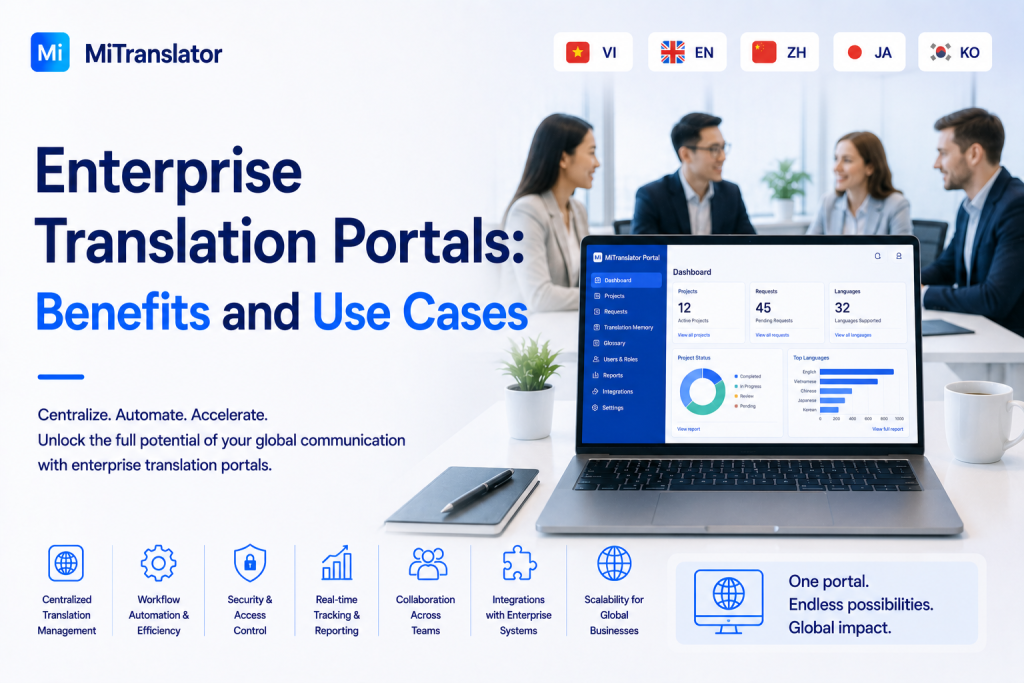
Enterprise translation portals provide businesses with a secure, scalable, and efficient environment for managing translation requests, tracking projects, maintaining consistency, and improving collaboration across global teams.
What Is an Enterprise Translation Portal?
An enterprise translation portal is a centralized digital platform that allows organizations to manage translation and localization projects through a single online system.
The portal serves as a hub where employees, project managers, translators, reviewers, and stakeholders can collaborate throughout the translation lifecycle.
Depending on the organization and provider, an enterprise translation portal may support:
- Translation request submission
- Project tracking
- File management
- Workflow automation
- Terminology management
- Translation memory integration
- Quality assurance processes
- Reporting and analytics
- Secure document sharing
The primary objective is to improve efficiency while maintaining translation quality and consistency.
Why Enterprise Translation Portals Are Becoming More Important
Growing Volumes of Multilingual Content
Modern organizations generate vast amounts of content that often require translation.
Examples include:
- Corporate policies
- Legal agreements
- Financial reports
- Product documentation
- Marketing campaigns
- Websites
- Training materials
- Customer support content
Managing these materials manually becomes increasingly difficult as content volumes grow.
Global Workforce Collaboration
Multinational organizations often operate across multiple countries and time zones.
Enterprise translation portals provide a centralized environment that enables collaboration among global teams regardless of location.
Need for Faster Turnaround Times
Businesses increasingly require rapid translation services to support international operations, product launches, compliance requirements, and customer communications.
Centralized platforms help accelerate project workflows.
Demand for Consistency
Organizations need consistent terminology, branding, and messaging across all languages.
Translation portals help maintain these standards through integrated language resources and approval workflows.
Key Features of Enterprise Translation Portals
Centralized Project Management
Users can submit, monitor, and manage translation requests from a single location.
This reduces administrative complexity and improves project visibility.
Secure Document Storage
Enterprise portals often include secure repositories for storing source files, translated content, and historical project records.
This helps protect confidential business information.
Workflow Automation
Automation capabilities may include:
- Project assignment
- Approval routing
- Status notifications
- Deadline tracking
- File delivery
These features reduce manual coordination efforts.
Translation Memory Integration
Translation memory technology stores previously translated content and suggests approved translations for future projects.
Benefits include:
- Faster translation
- Lower costs
- Greater consistency
- Improved efficiency
Terminology Management
Portals often include centralized glossaries and terminology databases to ensure consistent language usage across projects and departments.
User Access Controls
Role-based permissions allow organizations to control access to sensitive information and workflows.
Major Benefits of Enterprise Translation Portals
Improved Operational Efficiency
A centralized platform reduces administrative overhead and streamlines project coordination.
Employees spend less time managing translation requests and more time focusing on core business activities.
Enhanced Translation Consistency
Shared terminology databases, translation memories, and standardized workflows help ensure consistency across all multilingual content.
Better Visibility and Reporting
Project managers can monitor:
- Project status
- Delivery timelines
- Translation volumes
- Language usage
- Performance metrics
This visibility supports better decision-making and resource planning.
Stronger Data Security
Many enterprise translation portals include:
- Encrypted file transfers
- Secure user authentication
- Access controls
- Audit trails
- Compliance monitoring
These features help protect sensitive corporate information.
Scalability
Enterprise portals can support growing translation demands without significantly increasing administrative complexity.
This is particularly valuable for organizations operating in multiple countries.
Faster Time-to-Market
Streamlined translation workflows help businesses launch products, services, websites, and marketing campaigns more quickly across global markets.
Common Use Cases for Enterprise Translation Portals
Legal Document Translation
Corporate legal departments frequently manage:
- Contracts
- Compliance documentation
- Corporate governance records
- Regulatory submissions
- Intellectual property filings
A centralized portal helps organize and track these projects efficiently.
Financial Reporting
Global organizations often translate:
- Annual reports
- Financial statements
- Investor communications
- Audit documentation
- Regulatory disclosures
Translation portals help maintain consistency and compliance throughout the reporting process.
Technical Documentation
Manufacturers and technology companies commonly translate:
- User manuals
- Product specifications
- Safety documentation
- Engineering records
- Maintenance procedures
Enterprise platforms support large-scale technical content management.
Human Resources Communications
HR departments frequently require multilingual support for:
- Employment contracts
- Employee handbooks
- Training materials
- Internal policies
- Benefits documentation
Centralized workflows help ensure consistency across global workforces.
Website and Marketing Localization
Marketing teams often manage large volumes of multilingual content, including:
- Websites
- Product descriptions
- Advertising campaigns
- Social media content
- Promotional materials
Translation portals support ongoing localization efforts while maintaining brand consistency.
Customer Support Content
Global businesses frequently translate:
- Knowledge base articles
- FAQs
- Service documentation
- Customer communications
Enterprise portals help manage continuous updates efficiently.
Industries That Benefit from Enterprise Translation Portals
Enterprise translation portals are widely used across industries such as:
Manufacturing
Manufacturers often manage large volumes of technical and regulatory documentation.
Technology
Technology companies require multilingual support for software, applications, documentation, and customer communications.
Financial Services
Banks, insurers, and investment firms rely on secure multilingual communication and compliance documentation.
Healthcare
Healthcare organizations frequently manage regulatory submissions, patient information, and medical documentation.
Legal Services
Law firms and legal departments benefit from centralized management of multilingual legal content.
Retail and E-Commerce
Retail businesses use translation portals to support global product catalogs, marketing campaigns, and customer support operations.
Challenges Organizations Face Without a Translation Portal
Companies that rely on decentralized translation processes often encounter:
- Email overload
- Lost files
- Version control problems
- Inconsistent terminology
- Limited project visibility
- Delayed approvals
- Security risks
- Increased administrative costs
As organizations grow, these challenges can significantly impact efficiency and quality.
How to Choose the Right Enterprise Translation Portal
When evaluating translation portal solutions, organizations should consider:
Security Features
The platform should provide strong data protection measures and support confidentiality requirements.
Workflow Flexibility
The system should accommodate the organization’s existing business processes and approval structures.
Integration Capabilities
Compatibility with content management systems, document repositories, and business applications can improve efficiency.
Scalability
The platform should support future growth and increasing translation volumes.
Reporting Functions
Detailed reporting helps organizations monitor translation performance and optimize workflows.
Language Resource Management
Translation memory and terminology management capabilities are essential for maintaining consistency.
How MITRANS Supports Enterprise Translation Management
MITRANS provides professional translation solutions that help organizations manage multilingual content efficiently and consistently.
Our services support:
- Corporate document translation
- Legal translation
- Financial translation
- Technical translation
- Website localization
- Regulatory documentation
- Human resources documentation
- Global communication initiatives
By combining professional linguists, structured workflows, terminology management, and quality assurance processes, MITRANS helps businesses improve multilingual communication while maintaining accuracy, consistency, and confidentiality.
We support major language pairs including:
- English ↔ Vietnamese
- Chinese ↔ Vietnamese
- Japanese ↔ Vietnamese
- Korean ↔ Vietnamese
- English ↔ Chinese
- English ↔ Japanese
- English ↔ Korean
Frequently Asked Questions
What is an enterprise translation portal?
An enterprise translation portal is a centralized platform used to manage translation requests, workflows, terminology, files, and multilingual content across an organization.
Why do large organizations use translation portals?
They help improve efficiency, maintain consistency, enhance security, and provide better visibility into translation activities.
How do translation portals improve consistency?
Many portals integrate translation memory systems and terminology databases that help standardize language usage across projects.
Are enterprise translation portals secure?
Most enterprise-grade platforms include encryption, access controls, authentication systems, and audit trails to protect sensitive information.
Which industries benefit most from translation portals?
Manufacturing, technology, healthcare, finance, legal services, retail, and multinational corporations commonly use enterprise translation portals to support global operations.
Contact MITRANS for Professional Translation Services
Professional translation plays a critical role in ensuring accuracy, compliance, and effective communication across international business activities. Whether you require translation for legal, financial, technical, corporate, immigration, or regulatory documents, MITRANS is ready to help.
Contact MITRANS today for fast, accurate, and professional translation services tailored to your business and documentation requirements.