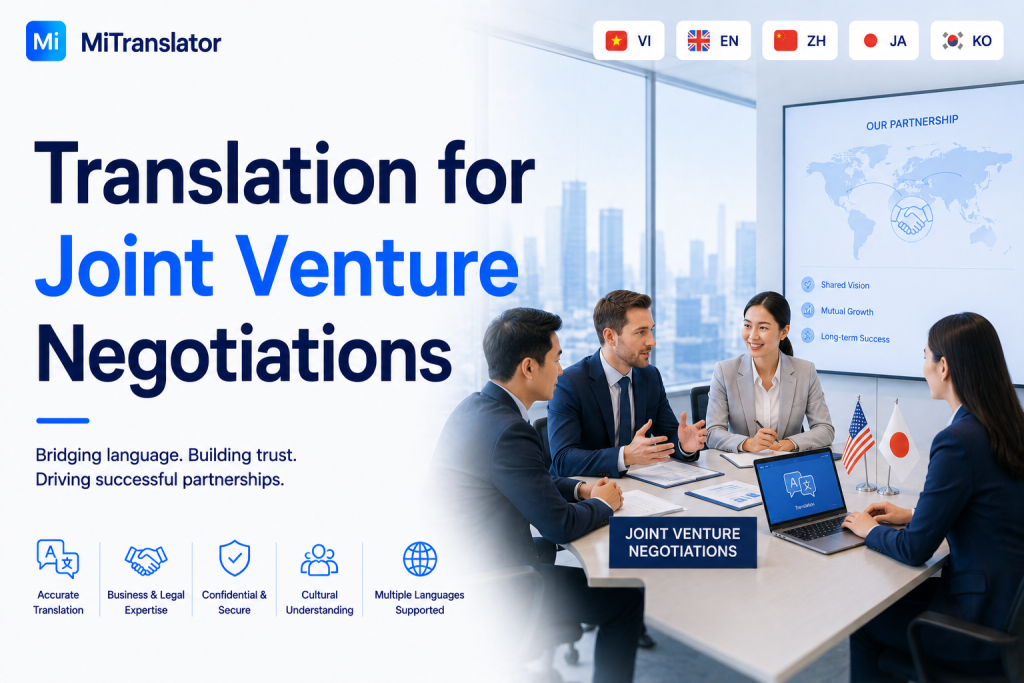
Joint ventures have become a popular strategy for companies seeking to expand into new markets, access local expertise, share investment risks, and accelerate business growth. Whether involving multinational corporations, foreign investors, manufacturers, technology companies, or infrastructure developers, joint venture negotiations often bring together partners from different countries, cultures, and legal systems.
Effective communication is critical during these negotiations. Business objectives, investment commitments, governance structures, intellectual property rights, profit-sharing arrangements, and dispute resolution mechanisms must be clearly understood by all parties. When negotiations involve participants who speak different languages, professional translation becomes an essential component of the negotiation process.
Translation for joint venture negotiations helps businesses overcome language barriers, reduce misunderstandings, support informed decision-making, and establish a solid foundation for long-term partnership success.
What Is Translation for Joint Venture Negotiations?
Translation for joint venture negotiations refers to the translation of documents, proposals, agreements, presentations, and communications exchanged between prospective joint venture partners during the negotiation and establishment process.
The purpose is to ensure that all parties can accurately understand the legal, financial, operational, and strategic aspects of the proposed collaboration.
Translation support may be required before, during, and after negotiations, covering both formal documentation and ongoing business communications.
Why Translation Matters in Joint Venture Negotiations
Supporting Clear Communication
Joint venture negotiations often involve complex discussions regarding ownership, management authority, capital contributions, operational responsibilities, and business objectives.
Accurate translation helps ensure that all parties understand the proposed terms and expectations.
Reducing Commercial Risks
Misunderstandings caused by language differences can lead to disputes, delays, and failed negotiations.
Professional translation minimizes the risk of incorrect interpretations.
Facilitating Cross-Border Investments
Foreign investors frequently rely on translated documents to evaluate opportunities and assess potential risks before entering into joint venture arrangements.
Supporting Legal Compliance
Joint venture transactions often involve multiple regulatory authorities, licensing requirements, and corporate registration procedures.
Accurate translation helps support compliance throughout the process.
Building Trust Between Partners
Clear communication helps strengthen confidence among negotiating parties and contributes to productive business relationships.
Common Documents Requiring Translation During Joint Venture Negotiations
Non-Disclosure Agreements (NDAs)
Negotiations often begin with confidentiality agreements that protect sensitive business information shared during discussions.
Letters of Intent (LOIs)
Letters of intent outline preliminary understandings and negotiation frameworks before formal agreements are finalized.
Memoranda of Understanding (MOUs)
MOUs commonly describe the intended scope of cooperation between prospective partners.
Business Proposals
Companies frequently exchange business plans, strategic proposals, and investment presentations during negotiations.
Due Diligence Documents
Joint venture partners often review:
- Corporate records
- Financial statements
- Tax documents
- Regulatory filings
- Operational reports
- Intellectual property documentation
These materials often require translation for effective review.
Feasibility Studies
Large projects may involve technical, financial, and market feasibility studies that require multilingual evaluation.
Corporate Governance Documents
Governance-related records such as company charters, shareholder agreements, and board resolutions may be translated during negotiations.
Draft Joint Venture Agreements
The proposed joint venture agreement itself is often translated multiple times as negotiations evolve.
Key Issues Commonly Negotiated in Joint Ventures
Ownership Structure
Partners typically negotiate:
- Equity ownership percentages
- Voting rights
- Capital contributions
- Profit-sharing arrangements
Accurate translation is critical because these provisions directly affect the economic interests of each party.
Management and Control
Joint venture partners often establish governance structures covering:
- Board composition
- Executive appointments
- Decision-making authority
- Reserved matters
- Reporting obligations
Capital Contributions
Negotiations may address:
- Initial funding requirements
- Additional capital commitments
- Contribution schedules
- Asset transfers
Intellectual Property Rights
Technology transfers, trademarks, patents, proprietary systems, and trade secrets often play a major role in joint venture discussions.
Operational Responsibilities
The parties must clearly define each partner’s role in managing and operating the joint venture.
Exit Mechanisms
Many joint venture agreements include provisions addressing:
- Share transfers
- Buyout rights
- Dissolution procedures
- Termination rights
These provisions require precise translation to avoid future disputes.
Common Challenges in Translating Joint Venture Negotiations
Complex Legal Terminology
Joint venture negotiations frequently involve legal concepts relating to corporate law, investment law, competition law, and contract law.
Translators must understand both legal terminology and commercial context.
Financial and Investment Language
Discussions often include terminology relating to:
- Valuation
- Capital structure
- Profit allocation
- Financing arrangements
- Return on investment
Financial accuracy is essential.
Industry-Specific Content
Joint ventures are common in industries such as:
- Manufacturing
- Technology
- Energy
- Healthcare
- Real estate
- Infrastructure
Each sector uses specialized terminology that requires subject-matter expertise.
Cultural Differences
Negotiation styles and business communication practices vary significantly between countries.
Translation professionals must be sensitive to cultural nuances that may affect communication.
Confidentiality Requirements
Joint venture discussions often involve highly sensitive business information, making confidentiality a critical consideration.
Risks of Poor Translation
Inaccurate translation during negotiations can create serious business risks.
Potential consequences include:
- Misunderstood commercial terms
- Delayed negotiations
- Regulatory compliance issues
- Contract disputes
- Investment losses
- Failed transactions
- Damaged business relationships
- Increased legal expenses
Because negotiations often shape long-term business partnerships, translation quality can directly affect transaction success.
Best Practices for Joint Venture Negotiation Translation
Use Experienced Legal and Business Translators
Joint venture documents require expertise in corporate law, finance, investment transactions, and business terminology.
Establish Terminology Consistency
Consistent translation of key terms helps avoid confusion throughout the negotiation process.
Examples include:
- Equity ownership
- Voting rights
- Capital contributions
- Board authority
- Profit distribution
- Intellectual property
Understand the Transaction Structure
Translators should understand the nature of the proposed joint venture and the commercial objectives of the parties involved.
Implement Multi-Level Quality Control
A robust quality assurance process should include:
- Translation
- Editing
- Proofreading
- Terminology verification
- Legal review where necessary
Maintain Strict Confidentiality
Secure document handling procedures are essential for protecting sensitive commercial information.
Industries That Frequently Use Joint Venture Translation Services
Translation for joint venture negotiations is commonly required in:
- Manufacturing
- Technology
- Renewable energy
- Oil and gas
- Construction
- Real estate
- Healthcare
- Telecommunications
- Logistics
- Financial services
Organizations operating internationally often rely on multilingual documentation throughout the negotiation process.
How MITRANS Supports Joint Venture Negotiations
MITRANS provides professional translation services for joint venture negotiations and cross-border business transactions.
Our services include translation of:
- Non-disclosure agreements
- Letters of intent
- Memoranda of understanding
- Business proposals
- Due diligence documents
- Financial reports
- Corporate governance records
- Joint venture agreements
- Regulatory filings
- Investment documentation
MITRANS combines experienced legal and financial translators with rigorous quality assurance procedures to deliver accurate, confidential, and business-focused translations.
We support major language pairs including:
- English ↔ Vietnamese
- Chinese ↔ Vietnamese
- Japanese ↔ Vietnamese
- Korean ↔ Vietnamese
- English ↔ Chinese
- English ↔ Japanese
- English ↔ Korean
Our team helps businesses communicate effectively during complex international negotiations while supporting compliance and transaction success.
Frequently Asked Questions
Why is translation important during joint venture negotiations?
Translation helps ensure that all parties fully understand legal, financial, operational, and strategic aspects of the proposed partnership.
What documents are most commonly translated?
Commonly translated documents include NDAs, MOUs, letters of intent, due diligence records, financial reports, business proposals, and draft joint venture agreements.
Can translation errors affect joint venture success?
Yes. Misunderstandings regarding ownership rights, governance structures, investment obligations, or contractual provisions can lead to disputes and transaction failures.
Should translators have legal and financial expertise?
Absolutely. Joint venture negotiations involve specialized terminology that requires subject-matter knowledge beyond general language skills.
How can companies ensure translation quality?
Working with experienced professional translators and implementing comprehensive quality assurance procedures helps ensure accuracy and consistency.
Contact MITRANS for Professional Translation Services
Professional translation plays a critical role in ensuring accuracy, compliance, and effective communication across international business activities. Whether you require translation for legal, financial, technical, corporate, immigration, or regulatory documents, MITRANS is ready to help.
Contact MITRANS today for fast, accurate, and professional translation services tailored to your business and documentation requirements.