As businesses expand internationally, employee mobility has become a key component of global workforce management. Companies frequently relocate employees across borders to support business growth, establish new operations, transfer expertise, manage international projects, or fill specialized positions in foreign markets.
A successful relocation involves far more than arranging travel and housing. Employees and their families often need to prepare extensive documentation for immigration, employment, taxation, healthcare, education, banking, and residency purposes. Many of these documents must be translated into the official language of the destination country.
Professional translation for foreign employee relocation packages helps organizations streamline international assignments, reduce administrative delays, and ensure compliance with local regulations. Accurate translation also helps relocating employees transition more smoothly into their new environment.
What Is a Foreign Employee Relocation Package?
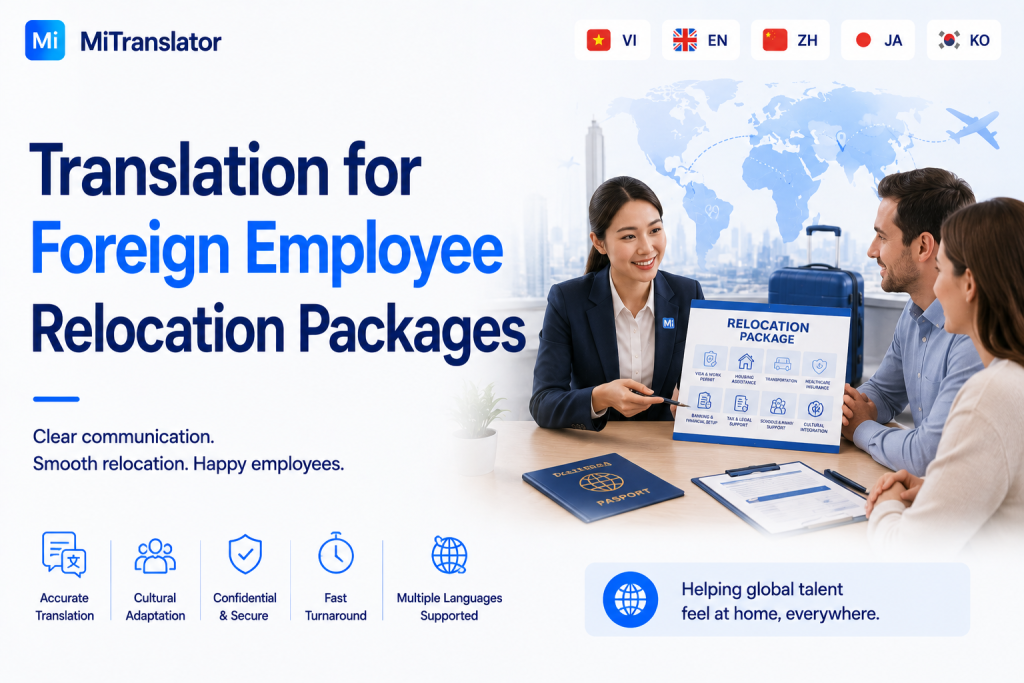
A foreign employee relocation package is a collection of services, benefits, and administrative support provided by an employer to assist employees moving to another country for work.
Relocation packages often include:
- Visa and immigration support
- Work permit assistance
- Housing support
- Family relocation assistance
- Education support for children
- Healthcare enrollment
- Banking and financial setup
- Tax compliance support
- Cultural integration services
Because these activities require extensive documentation, translation services are often an essential component of the relocation process.
Why Translation Matters in Employee Relocation
Supporting Immigration Procedures
Employees relocating internationally must typically submit documentation to immigration authorities.
Accurate translation helps ensure that applications are processed efficiently and comply with local requirements.
Facilitating Work Permit Applications
Work permits often require supporting documentation related to education, employment history, qualifications, and identity verification.
Professional translation helps authorities review these records accurately.
Assisting Family Relocation
When spouses and children accompany the employee, additional documentation may be required for:
- Dependent visas
- School enrollment
- Healthcare registration
- Residency applications
Translation helps simplify these administrative procedures.
Supporting Regulatory Compliance
Employers must often provide translated records to satisfy labor, immigration, and tax regulations in the destination country.
Improving Employee Experience
A smooth relocation process helps employees adapt more quickly to their new environment, reducing stress and improving assignment success rates.
Common Documents Included in Relocation Packages
Passports and Identification Documents
Identity verification is required throughout the relocation process.
Commonly translated documents include:
- Passports
- National identity cards
- Residence cards
- Family registration records
Employment Documents
Employment-related records frequently require translation.
Examples include:
- Employment contracts
- Offer letters
- Assignment letters
- Employment verification letters
- Salary confirmation letters
- Reference letters
Educational Credentials
Many countries require translated educational records to verify qualifications.
These may include:
- Diplomas
- Degrees
- Academic transcripts
- Professional certificates
- Training records
Birth Certificates
Birth certificates are commonly required for employees and accompanying family members.
Marriage Certificates
Marriage certificates are often necessary when applying for dependent visas or family relocation programs.
Criminal Record Certificates
Immigration authorities frequently request police clearance certificates or criminal background checks.
Medical Records
Healthcare registration and visa procedures may require translation of:
- Medical reports
- Vaccination records
- Health certificates
- Insurance documentation
Financial Documents
Relocating employees may need translated:
- Bank statements
- Tax records
- Income verification letters
- Financial sponsorship documents
Common Challenges in Relocation Document Translation
Tight Relocation Timelines
International assignments are often time-sensitive.
Employees may need translated documents quickly to meet visa, work permit, and travel deadlines.
Multiple Jurisdictions
Different countries have unique documentation and translation requirements.
Organizations must ensure compliance with destination-specific regulations.
Family Documentation Requirements
Relocation often involves spouses and children, increasing the volume and complexity of documentation.
Certification and Notarization Requirements
Many authorities require:
- Certified translations
- Notarized translations
- Sworn translations
- Official translator declarations
Failure to meet these requirements can delay relocation processes.
Consistency Across Documents
Names, dates, addresses, and identification numbers must remain consistent across all translated records.
Even minor inconsistencies can create administrative complications.
Risks of Poor Translation
Translation errors can significantly disrupt relocation programs.
Potential consequences include:
- Visa delays
- Work permit rejections
- Immigration complications
- Delayed employee onboarding
- Family relocation issues
- School enrollment delays
- Increased relocation costs
- Regulatory compliance concerns
Because many relocation processes depend on official documentation, accuracy is essential.
Best Practices for Translating Relocation Documents
Start Documentation Early
Employees should begin preparing required documents as early as possible to avoid last-minute delays.
Verify Destination Requirements
Translation and certification requirements vary between countries.
Organizations should confirm requirements before initiating translation projects.
Use Professional Translators
Immigration, employment, and legal documents require translators familiar with official terminology and administrative procedures.
Maintain Consistent Personal Information
Names, dates of birth, passport numbers, and addresses should remain identical across all translated records.
Implement Quality Assurance Reviews
A structured review process helps ensure accuracy, completeness, and consistency throughout the relocation package.
Relocation Scenarios That Commonly Require Translation
Corporate Transfers
Multinational corporations frequently relocate managers, executives, and specialists to overseas offices.
Foreign Direct Investment Projects
Companies establishing operations abroad often relocate key personnel during the setup phase.
Global Talent Recruitment
Organizations hiring international professionals may require translation support during onboarding and immigration procedures.
Long-Term International Assignments
Employees assigned to foreign markets for extended periods often need extensive document preparation.
Family Relocation Programs
Many expatriate assignments involve accompanying spouses and children who require additional immigration and administrative support.
How Translation Supports Global Mobility Programs
Effective translation services contribute directly to successful employee mobility programs by helping organizations:
- Accelerate immigration processing
- Improve compliance
- Reduce administrative errors
- Support employee satisfaction
- Minimize assignment delays
- Facilitate international workforce deployment
For multinational employers, translation is often a critical component of relocation planning and workforce management.
How MITRANS Supports Employee Relocation Projects
MITRANS provides professional translation services for employee relocation, immigration, and international mobility programs.
Our services include translation of:
- Passports
- Birth certificates
- Marriage certificates
- Educational credentials
- Employment contracts
- Assignment letters
- Criminal record certificates
- Medical records
- Financial documents
- Immigration application materials
MITRANS follows rigorous quality assurance procedures to ensure accuracy, consistency, and compliance with official documentation requirements.
We support major language pairs including:
- English ↔ Vietnamese
- Chinese ↔ Vietnamese
- Japanese ↔ Vietnamese
- Korean ↔ Vietnamese
- English ↔ Chinese
- English ↔ Japanese
- English ↔ Korean
Our experienced team understands the documentation challenges associated with international relocation and global workforce mobility.
Frequently Asked Questions
Why do relocation packages require document translation?
Many immigration authorities, employers, schools, healthcare providers, and government agencies require documentation in the official language of the destination country.
Which documents are most commonly translated for relocation?
Passports, birth certificates, marriage certificates, educational records, employment documents, criminal record certificates, and financial records are among the most frequently translated documents.
Do relocation documents require certified translations?
Many jurisdictions require certified, notarized, or sworn translations depending on the type of document and intended use.
Can translation delays affect relocation timelines?
Yes. Delays in document preparation can affect visa processing, work permit approvals, school enrollment, and employee onboarding schedules.
How can companies reduce relocation-related translation risks?
Working with experienced professional translators and preparing documentation early helps minimize errors and delays.
Contact MITRANS for Professional Translation Services
Professional translation plays a critical role in ensuring accuracy, compliance, and effective communication across international business activities. Whether you require translation for legal, financial, technical, corporate, immigration, or regulatory documents, MITRANS is ready to help.
Contact MITRANS today for fast, accurate, and professional translation services tailored to your business and documentation requirements.