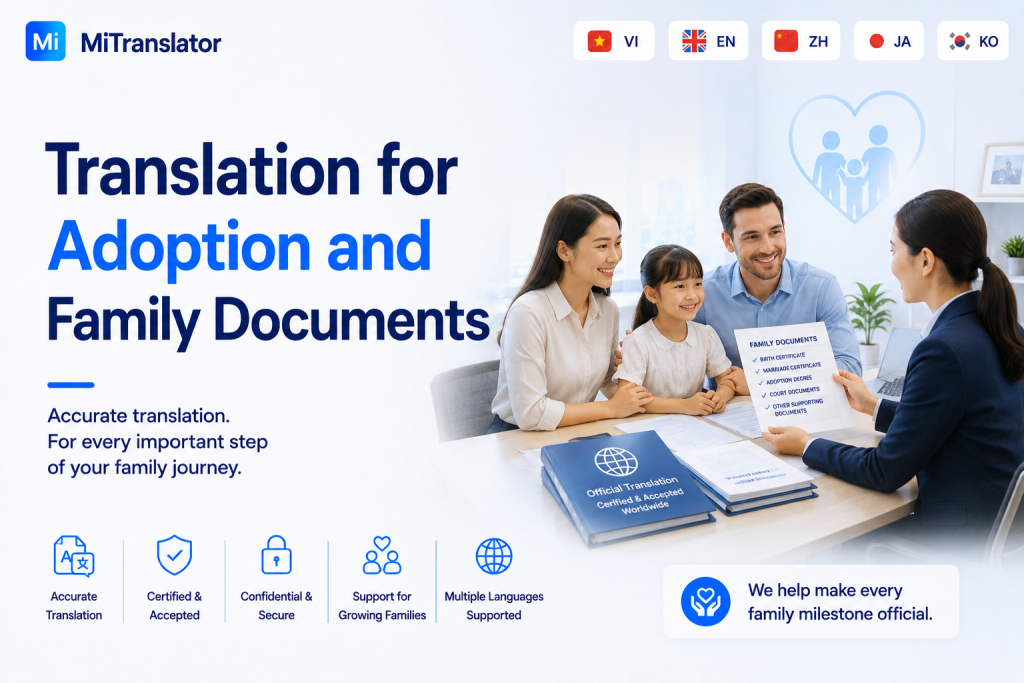
Adoption and family-related legal procedures often involve extensive documentation that must be submitted to government agencies, courts, immigration authorities, social service organizations, and international adoption agencies. Whether the process involves domestic adoption, intercountry adoption, guardianship arrangements, family reunification, or immigration sponsorship, accurate document translation is essential to ensure compliance and avoid delays.
Family documents contain highly sensitive personal information and often carry significant legal implications. Errors in translation can create inconsistencies in identity records, family relationships, legal status, or eligibility assessments. For this reason, professional translation plays a critical role in supporting successful adoption and family-related applications.
As international mobility and cross-border family arrangements continue to increase, the demand for accurate translation of adoption and family documents has become more important than ever.
What Is Adoption and Family Document Translation?
Adoption and family document translation refers to the professional translation of personal, legal, civil, and supporting documents required for family-related legal procedures.
These translations are commonly needed for:
- International adoption applications
- Family reunification programs
- Immigration sponsorship
- Guardianship proceedings
- Child custody matters
- Marriage registration
- Birth registration
- Court proceedings involving family law
The purpose is to ensure that authorities can accurately review and verify family relationships, legal rights, and supporting evidence.
Why Accurate Translation Matters
Supporting Legal Recognition of Family Relationships
Government agencies and courts rely on translated documents to verify relationships between parents, children, spouses, guardians, and other family members.
Accurate translation helps prevent misunderstandings and administrative complications.
Facilitating International Adoption
International adoption often involves documentation issued in multiple countries and languages.
Professional translation ensures that adoption authorities, courts, and immigration agencies can evaluate records correctly.
Supporting Immigration and Family Reunification
Many immigration programs require applicants to provide evidence of family relationships.
Translation allows immigration officers to review these documents efficiently and consistently.
Ensuring Compliance with Regulatory Requirements
Family law procedures frequently involve strict documentation standards.
Accurate translations help applicants comply with legal and administrative requirements.
Reducing Processing Delays
Incomplete or inaccurate translations can lead to requests for clarification, additional documentation, or application resubmission.
Common Adoption Documents Requiring Translation
Adoption Decrees
Adoption decrees formally establish the legal relationship between adoptive parents and a child.
These documents are often required for immigration, citizenship, and legal recognition purposes.
Adoption Agency Reports
International adoption procedures frequently require reports prepared by adoption agencies and social service organizations.
Home Study Reports
Home studies evaluate the suitability of prospective adoptive parents and are commonly required in international adoption cases.
Consent Documents
Parents, guardians, or legal representatives may be required to provide written consent as part of the adoption process.
Court Orders
Family courts often issue orders relating to adoption approval, guardianship arrangements, or parental rights.
Child Welfare Documentation
Social service records may be required to support adoption applications and child placement decisions.
Common Family Documents Requiring Translation
Birth Certificates
Birth certificates are among the most frequently translated family documents.
They are commonly used to establish identity, parentage, and family relationships.
Marriage Certificates
Marriage certificates are often required for immigration sponsorship, family reunification, and legal recognition purposes.
Divorce Certificates
Family law proceedings and immigration applications may require proof of divorce or marital status changes.
Household Registration Documents
Some jurisdictions maintain household registration systems that record family relationships and residency information.
Death Certificates
Death certificates may be required in inheritance matters, guardianship proceedings, and adoption cases.
Guardianship Documents
Guardianship records establish legal authority over minors or dependent individuals.
Family Relationship Certificates
Many countries issue certificates confirming family relationships for administrative and immigration purposes.
Common Situations Requiring Family Document Translation
International Adoption
Families adopting children from another country frequently need extensive document translation support.
Family-Based Immigration
Immigration authorities often require translated family records when reviewing sponsorship applications.
Citizenship Applications
Applicants may need translated documents to establish family lineage or eligibility for citizenship programs.
Child Custody Proceedings
Cross-border custody matters often involve documents issued in multiple jurisdictions.
Marriage Registration Abroad
Individuals marrying in another country may need translated civil status documents.
Inheritance and Estate Matters
Family documents are frequently required to establish legal heirs and family relationships.
Common Challenges in Translating Adoption and Family Documents
Sensitive Personal Information
Family documents contain personal details that must be handled carefully and confidentially.
Legal Terminology
Family law terminology varies between countries and legal systems.
Translators must understand the legal significance of family-related terms and concepts.
Different Documentation Standards
Countries often use different document formats, naming conventions, and administrative procedures.
Consistency Across Multiple Documents
Names, dates, places of birth, and family relationships must remain consistent throughout the document package.
Certification Requirements
Many authorities require:
- Certified translations
- Notarized translations
- Sworn translations
- Official translator declarations
Failure to meet these requirements can delay processing.
Risks of Poor Translation
Errors in adoption and family document translations can create significant complications.
Potential consequences include:
- Delayed adoption approvals
- Immigration processing delays
- Requests for additional documentation
- Legal disputes
- Rejected applications
- Inconsistent family records
- Increased administrative costs
Because family documents often serve as legal evidence, accuracy is essential.
Best Practices for Adoption and Family Document Translation
Work with Professional Translators
Family-related legal documents require translators who understand official documentation standards and legal terminology.
Ensure Consistency of Personal Information
Names, dates of birth, addresses, and family relationships should remain consistent across all documents.
Verify Certification Requirements
Applicants should confirm whether the receiving authority requires certified, notarized, or sworn translations.
Submit Clear Document Copies
High-quality scans help improve translation accuracy and reduce transcription errors.
Allow Time for Quality Assurance
Editing, proofreading, and final quality review help ensure accuracy and completeness.
Who Commonly Requires Adoption and Family Document Translation?
Translation services for family-related documents are frequently used by:
- Adoptive parents
- Immigration applicants
- Family sponsors
- Legal guardians
- Family law attorneys
- Adoption agencies
- Social service organizations
- Government authorities
- International students with dependents
- Multinational families
These individuals and organizations often require professionally translated documents to support legal and administrative procedures.
How MITRANS Supports Adoption and Family Document Translation
MITRANS provides professional translation services for adoption, immigration, family law, and civil status documentation.
Our services include translation of:
- Birth certificates
- Marriage certificates
- Divorce certificates
- Adoption decrees
- Home study reports
- Guardianship documents
- Family relationship certificates
- Household registration records
- Court orders
- Immigration supporting documents
MITRANS follows strict quality assurance procedures to ensure that translations are accurate, complete, and suitable for official submission.
We support major language pairs including:
- English ↔ Vietnamese
- Chinese ↔ Vietnamese
- Japanese ↔ Vietnamese
- Korean ↔ Vietnamese
- English ↔ Chinese
- English ↔ Japanese
- English ↔ Korean
Our experienced translation team understands the importance of precision, confidentiality, and compliance when handling sensitive family-related documentation.
Frequently Asked Questions
Why are translations required for adoption documents?
Authorities must be able to review and verify legal, personal, and family information contained in documents issued in another language.
What family documents are most commonly translated?
Birth certificates, marriage certificates, divorce certificates, adoption decrees, guardianship records, and family relationship certificates are among the most frequently translated documents.
Do adoption documents require certified translations?
Many adoption agencies, courts, immigration authorities, and government agencies require certified translations. Requirements vary by jurisdiction.
Can translation errors delay adoption or immigration applications?
Yes. Errors involving names, dates, legal status, or family relationships can lead to processing delays or requests for additional documentation.
How can applicants ensure translation accuracy?
Using professional translators, providing clear document copies, and allowing time for quality review can significantly reduce translation-related risks.
Contact MITRANS for Professional Translation Services
Professional translation plays a critical role in ensuring accuracy, compliance, and effective communication across international business activities. Whether you require translation for legal, financial, technical, corporate, immigration, or regulatory documents, MITRANS is ready to help.
Contact MITRANS today for fast, accurate, and professional translation services tailored to your business and documentation requirements.