As businesses expand into international markets and manage multilingual operations across multiple regions, maintaining consistent communication becomes increasingly difficult. Different teams, translators, departments, and platforms may use inconsistent wording for the same products, features, technical concepts, or business processes.
Without structured terminology management, organizations may face:
- Inconsistent brand communication
- Customer confusion
- Translation quality issues
- Operational inefficiencies
- Compliance risks
- Poor user experience
For multilingual companies operating in Vietnam and global markets, terminology management has become a critical part of enterprise localization strategy.
In this article, we explain what terminology management is, why it matters for multilingual businesses, and how organizations can build more consistent and scalable localization workflows.
What Is Terminology Management?
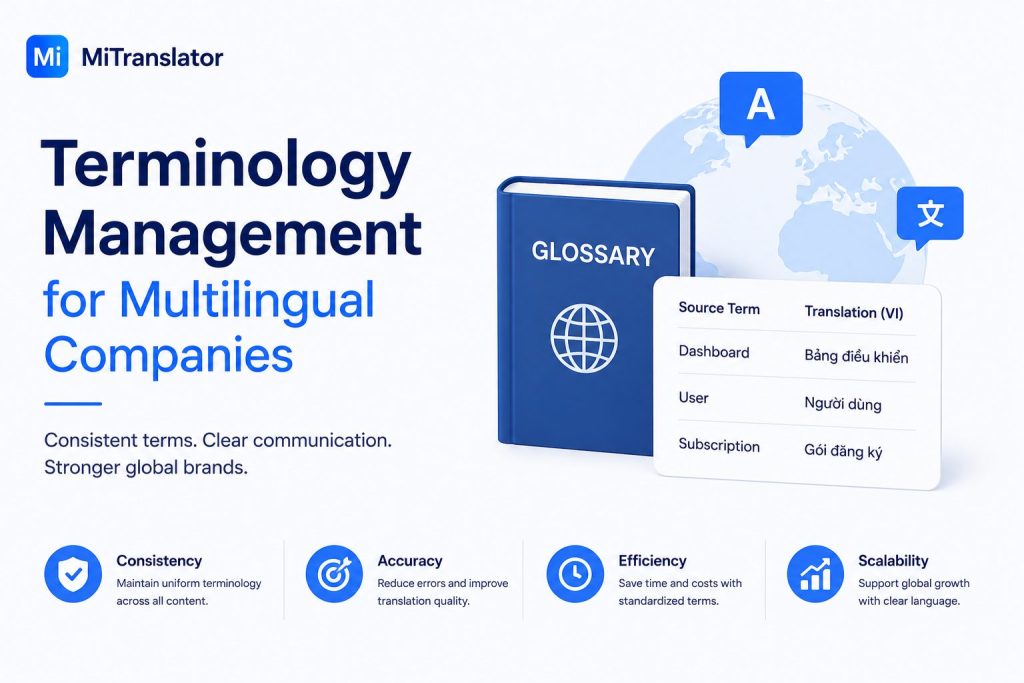
Terminology management is the process of creating, organizing, standardizing, and maintaining approved business terminology across multilingual communication.
This includes managing:
- Product names
- Technical terms
- UI labels
- Industry terminology
- Legal wording
- Brand language
- Operational vocabulary
The goal is to ensure that the same terms are translated and used consistently across all platforms, departments, and languages.
Why Terminology Management Matters
Improves Translation Consistency
Consistent terminology helps businesses maintain:
- Professional communication
- Brand identity
- Product clarity
- Customer trust
For example, if a SaaS company translates the same feature differently across:
- Mobile apps
- Websites
- Help centers
- Customer support documentation
users may become confused.
Terminology management ensures multilingual consistency across all touchpoints.
Strengthens Brand Communication
Global businesses rely on consistent messaging across international markets.
Standardized terminology helps maintain:
- Brand voice
- Product identity
- Marketing consistency
- Customer experience
This is especially important for:
- SaaS companies
- E-commerce brands
- Enterprise software
- Technology platforms
Reduces Translation Errors
Without approved terminology databases, translators may:
- Use inconsistent wording
- Misinterpret technical concepts
- Create localization conflicts
Terminology management reduces ambiguity and improves translation accuracy.
Improves Localization Scalability
As companies grow, multilingual content volumes increase rapidly.
Terminology systems help organizations:
- Accelerate localization workflows
- Reduce repetitive corrections
- Improve collaboration
- Scale global operations more efficiently
Common Problems Without Terminology Management
Inconsistent Product Naming
Different teams may translate the same product feature in different ways.
For example:
- “Dashboard”
- “Control Panel”
- “Management Screen”
may all appear within the same product ecosystem.
This creates poor user experience and weakens brand consistency.
Department-Level Language Conflicts
Marketing, product, legal, and customer support teams may each use different terminology for the same concept.
Without centralized terminology governance, multilingual communication becomes fragmented.
Difficulties With Technical Translation
Industries such as:
- Manufacturing
- Finance
- Healthcare
- SaaS
- Logistics
often require highly specialized terminology.
Incorrect technical wording may create:
- Operational misunderstandings
- Compliance issues
- Customer confusion
Localization Delays
Without approved terminology systems, localization teams spend more time:
- Reviewing wording
- Correcting inconsistencies
- Rechecking translations
- Aligning departments
Terminology management improves workflow efficiency.
What a Terminology Management System Includes
Professional terminology management often includes:
- Approved glossaries
- Translation memory systems
- Style guides
- Brand terminology databases
- Multilingual terminology rules
- QA review processes
These systems help maintain consistent communication across multilingual environments.
Best Practices for Terminology Management
Create Centralized Glossaries
Businesses should maintain centralized terminology databases that include:
- Approved source terms
- Preferred translations
- Usage notes
- Context explanations
- Brand guidelines
This improves alignment across teams and vendors.
Combine Human Expertise With Technology
Modern localization workflows often combine:
- Translation memory
- AI-assisted translation
- Human QA review
- Terminology management systems
Technology improves efficiency, while human review ensures contextual accuracy.
Maintain Cross-Department Alignment
Terminology should remain consistent across:
- Marketing
- Product teams
- Legal departments
- Customer support
- Technical documentation
Centralized governance improves multilingual consistency.
Regularly Update Terminology Databases
Business language evolves over time.
Organizations should regularly review:
- Product updates
- Brand terminology
- Industry language
- Customer-facing communication
Outdated terminology systems can reduce localization quality.
Industries That Depend on Terminology Consistency
Terminology management is especially important for:
- SaaS and technology companies
- Manufacturing businesses
- Financial institutions
- Healthcare organizations
- Legal services
- E-commerce platforms
- Logistics companies
- Enterprise operations
These industries often manage complex multilingual communication across multiple systems and regions.
How MITRANS Supports Terminology Management
MITRANS Translator provides terminology management and multilingual localization solutions for global businesses operating in Vietnam and Southeast Asia.
Our services include:
- Terminology database management
- Translation memory workflows
- AI-assisted translation
- Human QA review
- Enterprise localization support
- SaaS and technical localization
- Multilingual workflow management
MITRANS supports multiple language pairs, including:
- English ↔ Vietnamese
- Chinese ↔ Vietnamese
- Japanese ↔ Vietnamese
- Korean ↔ Vietnamese
- French ↔ Vietnamese
By combining professional linguists, scalable localization systems, and structured terminology management, MITRANS helps businesses maintain accurate and consistent multilingual communication.
Frequently Asked Questions
What is terminology management?
Terminology management is the process of organizing and standardizing approved business terminology across multilingual communication and localization workflows.
Why is terminology consistency important?
Consistent terminology improves customer experience, translation quality, brand communication, and operational clarity.
What industries benefit from terminology management?
Industries such as SaaS, manufacturing, finance, healthcare, logistics, and enterprise technology rely heavily on terminology consistency.
Does MITRANS provide terminology management services?
Yes. MITRANS supports terminology management, translation memory systems, AI-assisted workflows, and enterprise localization solutions.
Conclusion
As businesses continue scaling multilingual operations, terminology management has become essential for maintaining consistency, improving localization quality, and supporting efficient enterprise communication.
From SaaS platforms and technical documentation to global marketing and customer support, structured terminology systems help organizations build stronger multilingual operations across international markets.
Need Vietnamese Translation or Localization Support?
MITRANS helps global businesses manage multilingual communication, localization, and Vietnamese market operations with quality-controlled translation workflows.
Contact MITRANS Translator today for fast, accurate, and professional language solutions tailored to your business.