As businesses expand across global markets, multilingual communication has become a core part of daily operations. International teams now manage large volumes of content across multiple languages, platforms, and departments — from product updates and technical documentation to customer support and marketing communication.
However, manual translation processes often create:
- Workflow bottlenecks
- Delayed communication
- Inconsistent terminology
- Operational inefficiencies
- Higher localization costs
To solve these challenges, many organizations are adopting translation workflow automation to streamline multilingual operations and improve collaboration across international teams.
In this article, we explain what translation workflow automation is, why it matters for global businesses, and how enterprises can build scalable multilingual workflows more efficiently.
What Is Translation Workflow Automation?
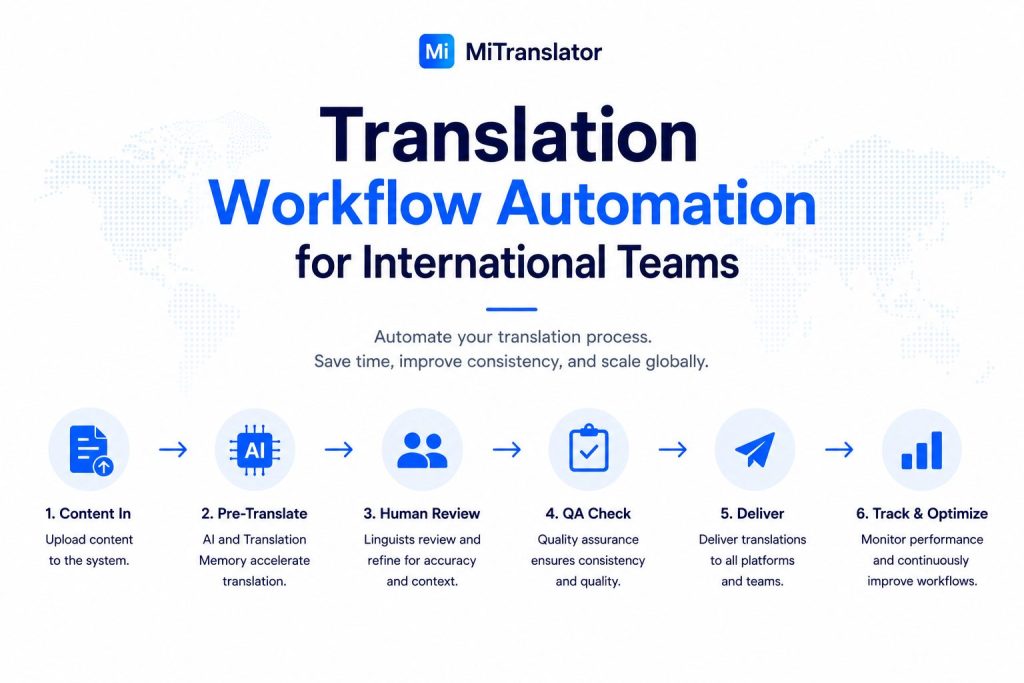
Translation workflow automation refers to using technology to streamline and manage multilingual translation processes across teams, systems, and content pipelines.
Instead of handling localization manually through email chains and disconnected files, automated workflows help businesses:
- Route content automatically
- Manage approvals
- Reuse translations
- Maintain terminology consistency
- Reduce repetitive tasks
- Accelerate localization delivery
Modern translation workflows often combine:
- AI-assisted translation
- Translation memory systems
- Terminology management
- Human QA review
- API integrations
- Centralized localization platforms
Why International Teams Need Workflow Automation
Global Content Volumes Are Increasing
International businesses continuously update:
- Websites
- Mobile apps
- Product documentation
- Internal systems
- Marketing campaigns
- Customer support materials
Managing multilingual updates manually becomes difficult as content volume grows.
Automation helps organizations scale localization operations more efficiently.
Teams Work Across Multiple Time Zones
Global organizations often coordinate between:
- Headquarters
- Regional offices
- Localization vendors
- Product teams
- Marketing departments
- Customer support teams
Manual workflows slow communication and reduce operational efficiency.
Automated systems improve collaboration across distributed international teams.
Faster Product Releases Require Faster Localization
Modern businesses release updates rapidly, especially in:
- SaaS platforms
- E-commerce systems
- Mobile apps
- Enterprise software
Translation workflows must support continuous localization without delaying product delivery.
Consistency Matters Across Markets
International brands must maintain consistent terminology and communication across:
- Languages
- Departments
- Platforms
- Customer touchpoints
Workflow automation helps standardize multilingual operations.
Key Components of Translation Workflow Automation
Translation Memory Systems
Translation memory helps businesses:
- Reuse approved translations
- Reduce repetitive work
- Improve terminology consistency
- Accelerate localization workflows
This is especially useful for recurring business content.
AI-Assisted Translation
AI translation systems improve:
- Speed
- Scalability
- Workflow efficiency
However, human review remains essential for:
- Context
- Tone
- Cultural adaptation
- UX quality
- Industry terminology
The best workflows combine AI efficiency with human expertise.
Centralized Localization Platforms
Centralized systems help teams:
- Track projects
- Manage multilingual assets
- Control permissions
- Improve collaboration
- Standardize workflows
This improves operational visibility and scalability.
Automated Content Routing
Workflow automation can automatically:
- Assign translation tasks
- Trigger review processes
- Send notifications
- Sync updated content
- Deliver finalized translations
This reduces manual coordination work.
Terminology Management
Automated localization systems often include:
- Approved glossaries
- Brand terminology databases
- Style guides
- Consistency checks
Terminology management improves multilingual communication quality.
Benefits of Translation Workflow Automation
Faster Localization Speed
Automation reduces manual delays and accelerates:
- Translation delivery
- Review cycles
- Product launches
- Global communication
Improved Operational Efficiency
International teams spend less time managing:
- File exchanges
- Status tracking
- Manual approvals
- Repetitive translation tasks
This improves productivity across departments.
Better Translation Consistency
Automated systems support:
- Terminology alignment
- Translation memory reuse
- Centralized QA workflows
Consistency improves customer experience and brand communication.
Scalable Multilingual Operations
Automation helps enterprises manage:
- Larger content volumes
- More languages
- Continuous localization updates
- International growth
This supports long-term global scalability.
Common Challenges Without Workflow Automation
Businesses relying on manual localization processes often face:
- Slow translation turnaround
- Inconsistent terminology
- Duplicate work
- Version control problems
- Communication delays
- Limited scalability
As organizations grow internationally, these problems become increasingly difficult to manage.
Industries That Benefit From Translation Workflow Automation
Workflow automation is especially valuable for:
- SaaS companies
- E-commerce platforms
- Manufacturing businesses
- Technology companies
- Financial institutions
- Healthcare organizations
- Logistics companies
- Enterprise operations teams
These industries frequently manage high-volume multilingual communication across global markets.
Best Practices for Translation Workflow Automation
Combine Automation With Human QA
AI and automation improve efficiency, but professional human review remains critical for:
- Localization quality
- Cultural relevance
- Brand consistency
- Contextual accuracy
Centralize Localization Management
Centralized systems improve:
- Workflow visibility
- Team collaboration
- Operational consistency
- Scalability
Maintain Translation Memory and Terminology Databases
Approved multilingual resources help businesses:
- Reduce errors
- Improve consistency
- Accelerate future localization
Standardize Global Localization Processes
Clear workflows help international teams:
- Reduce confusion
- Improve coordination
- Maintain quality standards
- Scale operations more effectively
How MITRANS Supports Translation Workflow Automation
MITRANS Translator provides AI-assisted translation workflow solutions for international businesses operating across Vietnam and global markets.
Our services include:
- Translation workflow automation
- AI-assisted localization
- Translation memory management
- Human QA review
- Terminology management
- Enterprise multilingual operations
- SaaS and technical localization
MITRANS supports multiple language pairs, including:
- English ↔ Vietnamese
- Chinese ↔ Vietnamese
- Japanese ↔ Vietnamese
- Korean ↔ Vietnamese
- French ↔ Vietnamese
By combining automation technology with professional linguistic review and scalable localization systems, MITRANS helps businesses streamline multilingual communication and support international operations more efficiently.
Frequently Asked Questions
What is translation workflow automation?
Translation workflow automation uses technology to streamline multilingual localization processes, reduce manual tasks, and improve operational efficiency.
Why do international teams need localization automation?
Automation helps global teams manage multilingual communication faster, maintain consistency, and support scalable international operations.
Can AI translation fully automate localization?
AI translation improves speed and scalability, but human review is still important for quality, tone, and contextual accuracy.
Does MITRANS support automated localization workflows?
Yes. MITRANS provides AI-assisted translation workflow solutions combined with human QA review and enterprise localization support.
Conclusion
As businesses continue expanding internationally, translation workflow automation has become essential for managing multilingual communication efficiently and at scale.
From SaaS platforms and technical documentation to customer support and global marketing operations, automated localization systems help international teams improve speed, consistency, and operational scalability.
Need Vietnamese Translation or Localization Support?
MITRANS helps global businesses manage multilingual communication, localization, and Vietnamese market operations with quality-controlled translation workflows.
Contact MITRANS Translator today for fast, accurate, and professional language solutions tailored to your business.