As businesses manage increasing volumes of multilingual content across websites, mobile apps, customer communication, legal documents, and operational systems, maintaining consistency and efficiency in translation workflows becomes a major challenge.
One of the most important technologies used in professional localization today is Translation Memory (TM). Translation memory helps businesses improve translation consistency, reduce costs, accelerate multilingual workflows, and scale localization operations more effectively.
For companies operating in Vietnam and global markets, understanding how translation memory works can significantly improve enterprise translation management.
In this article, we explain what translation memory is, how it works, and why businesses use it in modern localization workflows.
What Is Translation Memory?
Translation Memory (TM) is a language database that stores previously translated content for reuse in future translation projects.
When a sentence or segment has already been translated, the system can automatically suggest the existing translation whenever similar content appears again.
Translation memory systems typically store:
- Sentences
- Phrases
- UI strings
- Product descriptions
- Technical instructions
- Repetitive business content
This allows translators and localization teams to work faster and maintain consistency across multilingual content.
How Translation Memory Works
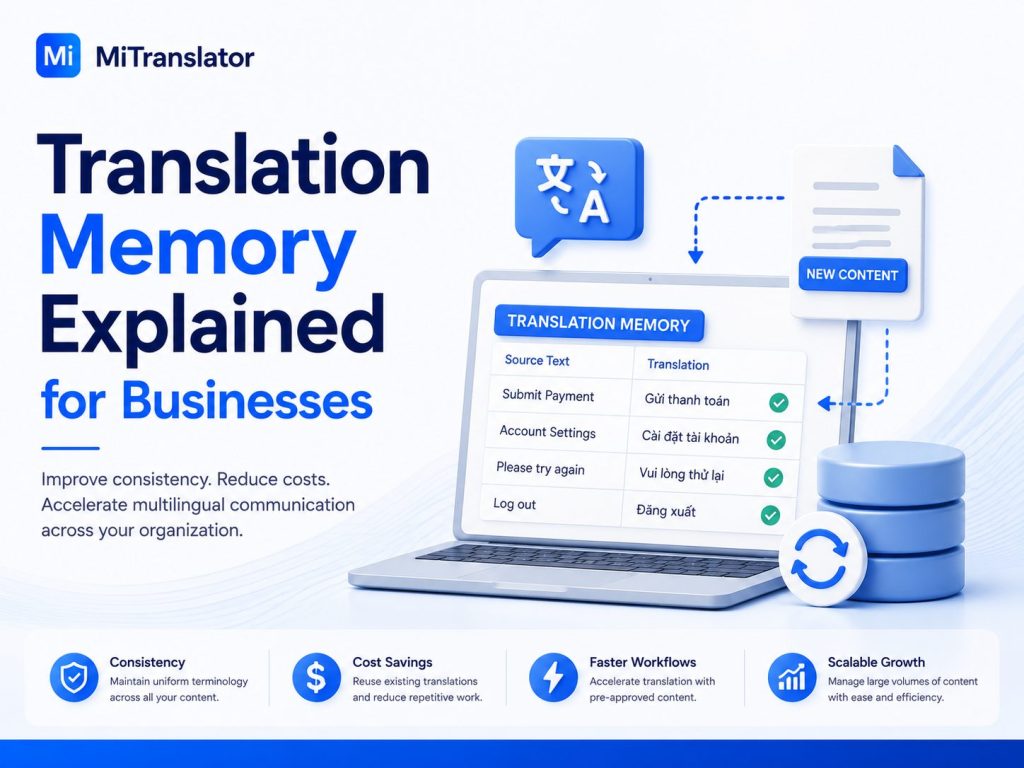
Translation memory systems divide content into smaller segments, usually sentence-by-sentence.
For example:
| Source Text | Stored Translation |
|---|---|
| Submit Payment | Gửi thanh toán |
| Account Settings | Cài đặt tài khoản |
| Please try again | Vui lòng thử lại |
When the same or similar content appears later, the system automatically suggests the previous translation instead of translating from scratch.
This improves:
- Workflow speed
- Terminology consistency
- Translation quality
- Operational efficiency
Why Businesses Use Translation Memory
Improves Translation Consistency
Consistency is critical for:
- Brand communication
- Customer experience
- Technical documentation
- SaaS platforms
- Enterprise operations
Translation memory helps businesses standardize terminology across:
- Teams
- Departments
- Products
- Markets
- Communication channels
This is especially important for large organizations managing multilingual content at scale.
Reduces Translation Costs
Reusing existing translations reduces repetitive work.
Businesses can lower localization costs for:
- Repeated documentation
- Product updates
- Website revisions
- Ongoing multilingual workflows
Translation memory becomes more valuable over time as the database grows.
Speeds Up Localization Workflows
Translation memory improves workflow efficiency by:
- Reducing manual translation effort
- Accelerating project turnaround
- Supporting continuous localization
- Improving enterprise scalability
This is especially useful for:
- SaaS platforms
- E-commerce businesses
- Global websites
- Mobile apps
- Enterprise systems
Supports Large-Scale Content Management
Enterprise organizations often manage:
- Thousands of documents
- Frequent content updates
- Cross-platform localization
- Global communication workflows
Translation memory helps businesses maintain operational control across multilingual environments.
Difference Between Translation Memory and Machine Translation
Many businesses confuse translation memory with AI translation, but they are different technologies.
Translation Memory
Translation memory:
- Reuses human-approved translations
- Focuses on consistency
- Stores approved terminology
- Supports structured workflows
Machine Translation (AI Translation)
Machine translation:
- Generates new translations automatically
- Focuses on speed and automation
- Uses AI language models
- May require human review
Modern enterprise workflows often combine:
- Translation memory
- AI-assisted translation
- Human QA review
- Terminology management
This hybrid approach improves both efficiency and quality.
Industries That Benefit From Translation Memory
Translation memory is widely used by:
- SaaS companies
- Manufacturing businesses
- E-commerce platforms
- Legal firms
- Financial institutions
- Healthcare organizations
- Technology companies
- Enterprise operations teams
Industries with repetitive multilingual content benefit the most from TM systems.
Common Content Types Managed With Translation Memory
Businesses commonly use translation memory for:
- Website localization
- Product descriptions
- Technical documentation
- UI and UX content
- Customer support materials
- Legal templates
- Internal communication
- Training materials
- Compliance documentation
- Marketing assets
The more reusable the content, the greater the efficiency gains.
Best Practices for Translation Memory Management
Maintain Approved Terminology
Businesses should create:
- Glossaries
- Style guides
- Brand terminology rules
This improves consistency across all multilingual communication.
Combine TM With Human QA Review
Human review remains essential for:
- Tone adaptation
- Contextual accuracy
- UX quality
- Cultural localization
Translation memory improves efficiency, but professional oversight still matters.
Centralize Localization Workflows
Centralized translation management helps enterprises:
- Maintain consistency
- Reduce duplication
- Improve collaboration
- Scale multilingual operations
Regularly Update Translation Databases
Translation memory systems should be maintained and updated to ensure:
- Terminology relevance
- Brand consistency
- Workflow accuracy
Outdated translation databases can reduce localization quality.
How MITRANS Uses Translation Memory
MITRANS Translator uses translation memory systems to help businesses improve multilingual consistency, localization speed, and enterprise workflow efficiency.
Our services include:
- Translation memory management
- AI-assisted translation
- Human QA review
- Enterprise localization workflows
- Technical translation
- SaaS localization
- Multilingual terminology management
MITRANS supports multiple language pairs, including:
- English ↔ Vietnamese
- Chinese ↔ Vietnamese
- Japanese ↔ Vietnamese
- Korean ↔ Vietnamese
- French ↔ Vietnamese
By combining translation memory technology with professional human review and scalable localization systems, MITRANS helps businesses streamline multilingual communication and improve operational efficiency.
Frequently Asked Questions
What is translation memory?
Translation memory is a database that stores previously translated content so it can be reused in future translation projects.
How does translation memory help businesses?
Translation memory improves consistency, reduces translation costs, accelerates workflows, and supports scalable multilingual operations.
Is translation memory the same as AI translation?
No. Translation memory reuses existing approved translations, while AI translation automatically generates new translations.
Does MITRANS use translation memory systems?
Yes. MITRANS uses translation memory technology alongside AI-assisted workflows and professional human review to improve localization quality and operational efficiency.
Conclusion
As businesses continue expanding multilingual operations, translation memory has become an essential tool for improving consistency, reducing localization costs, and scaling enterprise communication more efficiently.
From SaaS platforms and technical documentation to customer support and global websites, translation memory helps organizations maintain high-quality multilingual communication across international markets.
Need Vietnamese Translation or Localization Support?
MITRANS helps global businesses manage multilingual communication, localization, and Vietnamese market operations with quality-controlled translation workflows.
Contact MITRANS Translator today for fast, accurate, and professional language solutions tailored to your business.