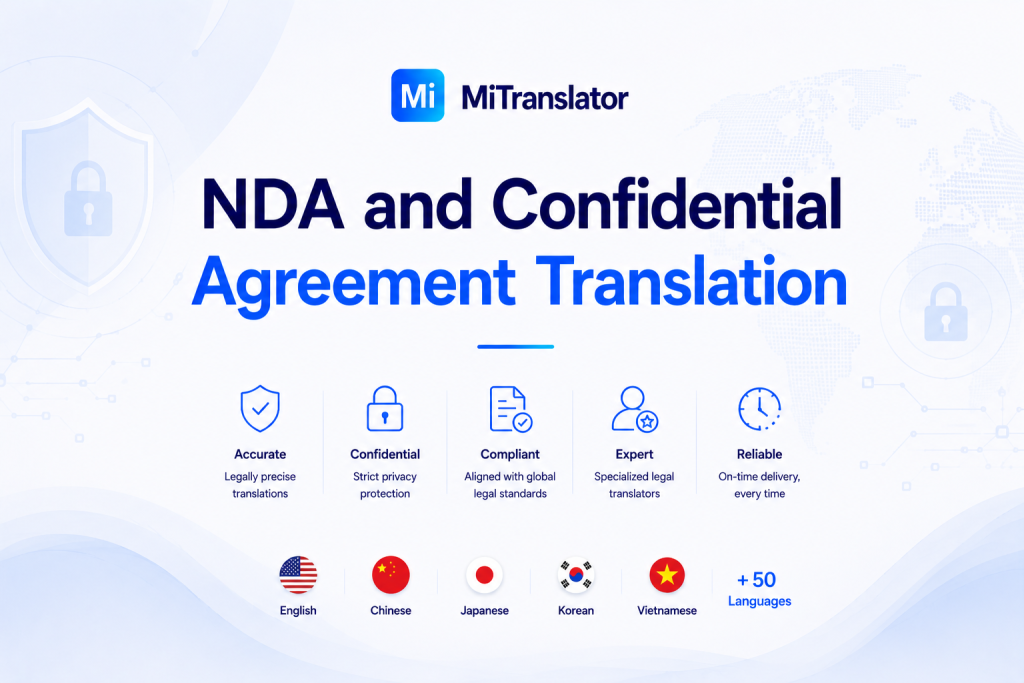
In today’s global business environment, companies frequently share sensitive information with partners, suppliers, investors, employees, consultants, and potential clients. Before confidential information is exchanged, businesses often require the signing of a Non-Disclosure Agreement (NDA) or Confidentiality Agreement to protect proprietary data and reduce legal risks.
When parties operate in different countries and languages, accurate NDA and confidential agreement translation becomes essential. A poorly translated confidentiality agreement can create ambiguity, weaken legal protections, and expose businesses to significant financial and reputational risks. Professional legal translation ensures that all parties clearly understand their obligations while preserving the legal intent of the original document.
What Is an NDA?
An NDA, or Non-Disclosure Agreement, is a legally binding contract that restricts the disclosure of confidential information shared between two or more parties.
NDAs are commonly used when businesses need to discuss sensitive matters such as:
- Business partnerships
- Product development
- Manufacturing projects
- Investment opportunities
- Mergers and acquisitions
- Technology transfers
- Research and development activities
- Client relationships
The purpose of an NDA is to prevent unauthorized disclosure or misuse of confidential information.
What Is a Confidentiality Agreement?
A confidentiality agreement is similar to an NDA and is often used interchangeably in business and legal contexts.
These agreements establish rules regarding:
- Information sharing
- Data protection
- Confidentiality obligations
- Permitted use of information
- Disclosure restrictions
- Legal remedies for breaches
Depending on the situation, confidentiality agreements may be unilateral, bilateral, or multilateral.
Why Accurate NDA Translation Matters
Protecting Legal Rights
The primary purpose of an NDA is to provide legal protection. Translation errors can weaken contractual protections and create uncertainty regarding each party’s obligations.
Accurate translation helps preserve the enforceability of confidentiality provisions.
Supporting International Business Relationships
Cross-border transactions often involve parties who speak different languages.
Professional translation ensures that all parties fully understand:
- Confidentiality obligations
- Information ownership
- Disclosure restrictions
- Contract duration
- Legal consequences
Reducing Legal Risks
Ambiguous contract language can increase the likelihood of disputes and misunderstandings.
Accurate translation minimizes legal exposure and helps maintain clear contractual expectations.
Facilitating International Collaboration
Companies often require NDAs before sharing:
- Technical documentation
- Manufacturing processes
- Product designs
- Financial information
- Customer data
- Business strategies
Clear translations help facilitate collaboration while protecting sensitive information.
Common Types of NDAs Requiring Translation
Business Partnership NDAs
Organizations exploring strategic partnerships frequently require confidentiality agreements before discussions begin.
Manufacturing and Supplier NDAs
Manufacturers often share proprietary production methods, technical specifications, and product information with suppliers and contractors.
Technology and Software NDAs
Technology companies rely on NDAs to protect:
- Source code
- Product roadmaps
- Technical specifications
- Intellectual property
- Research findings
Employment Confidentiality Agreements
Employers may require employees to sign confidentiality agreements regarding sensitive company information.
Investment and Due Diligence NDAs
Investors often review confidential financial and operational information before making investment decisions.
Key Clauses in NDAs and Confidentiality Agreements
Definition of Confidential Information
This section identifies the types of information protected by the agreement.
Examples may include:
- Trade secrets
- Technical data
- Financial information
- Business plans
- Customer information
- Product specifications
Translation accuracy is essential because the scope of protection depends on these definitions.
Non-Disclosure Obligations
This clause explains how confidential information must be handled and protected.
Permitted Use of Information
Many agreements specify that confidential information may only be used for particular business purposes.
Exclusions from Confidentiality
Certain information may be excluded from protection, such as information that:
- Is publicly available
- Was previously known
- Is independently developed
- Is legally required to be disclosed
Duration of Confidentiality
The agreement often specifies how long confidentiality obligations remain in effect.
Remedies and Legal Consequences
These clauses explain the legal actions available if confidentiality obligations are breached.
Challenges in NDA Translation
Legal Terminology
Confidentiality agreements contain specialized legal language that may not have direct equivalents across different legal systems.
Professional translators must understand legal terminology and contractual concepts.
Jurisdictional Differences
Contract law varies significantly between countries.
A clause drafted under one legal system may require careful translation to preserve its intended meaning.
Maintaining Legal Intent
The goal of legal translation is not simply linguistic accuracy but preservation of legal effect and contractual intent.
Consistency Across Documents
Businesses often maintain multiple agreements involving the same parties or projects.
Consistent terminology helps reduce confusion and legal risks.
Common NDA Translation Mistakes to Avoid
Literal Translation of Legal Terms
Word-for-word translation may fail to capture the intended legal meaning.
Ambiguous Language
Unclear wording can weaken confidentiality protections and create interpretation disputes.
Inconsistent Terminology
Different translations of the same legal term may affect contract clarity and enforceability.
Omitting Key Information
Even minor omissions can significantly alter legal obligations.
Using General Translators for Legal Documents
Legal agreements should be translated by professionals familiar with contract law and legal terminology.
Best Practices for NDA and Confidential Agreement Translation
Work with Legal Translation Specialists
Professional legal translators understand contractual language, legal concepts, and confidentiality requirements.
Maintain Terminology Consistency
Legal glossaries and translation memories help ensure consistent use of terminology throughout the agreement.
Implement Multi-Level Review
A professional legal translation workflow should include:
- Translation
- Legal terminology review
- Editing and proofreading
- Quality assurance review
- Final verification
Preserve Document Structure
Contract numbering, definitions, references, and clause formatting should remain consistent with the original document.
Protect Confidential Information
Because NDAs themselves often contain sensitive information, translation providers should follow strict confidentiality and data security procedures.
How MITRANS Supports NDA and Confidential Agreement Translation
MITRANS provides professional legal translation services for businesses, law firms, investors, manufacturers, and multinational organizations requiring accurate NDA and confidentiality agreement translations.
Our services include translation of:
- Non-Disclosure Agreements (NDAs)
- Confidentiality agreements
- Manufacturing agreements
- Supplier contracts
- Employment agreements
- Technology licensing agreements
- Investment agreements
- Corporate legal documents
- Partnership contracts
- Intellectual property agreements
MITRANS supports major language pairs commonly used in international business, including:
- English ↔ Vietnamese
- Chinese ↔ Vietnamese
- Korean ↔ Vietnamese
- Japanese ↔ Vietnamese
Our experienced legal translators help ensure that confidentiality obligations, legal protections, and contractual intent are accurately preserved.
Frequently Asked Questions
What is the difference between an NDA and a confidentiality agreement?
In most business contexts, the terms are used interchangeably. Both are designed to protect confidential information and define disclosure obligations.
Why is professional NDA translation important?
Accurate translation helps preserve legal protections, reduce risks, and ensure that all parties clearly understand their contractual obligations.
Can MITRANS translate bilingual NDAs?
Yes. MITRANS supports bilingual and multilingual NDA translation projects for businesses operating internationally.
How does MITRANS ensure legal accuracy?
We use legal translation specialists, terminology management systems, and multi-level quality assurance processes to maintain accuracy and consistency.
Is confidential information protected during translation?
Absolutely. MITRANS follows strict confidentiality procedures and secure document management practices to safeguard client information.
Contact MITRANS for NDA and Confidential Agreement Translation
Accurate NDA and confidentiality agreement translation is essential for protecting sensitive business information, reducing legal risks, and supporting successful international partnerships. If your organization requires professional translation of NDAs, confidentiality agreements, licensing contracts, investment agreements, or other legal documents, MITRANS is ready to support you.
Contact MITRANS today for fast, accurate, and professional legal translation services tailored to your business and confidentiality requirements.