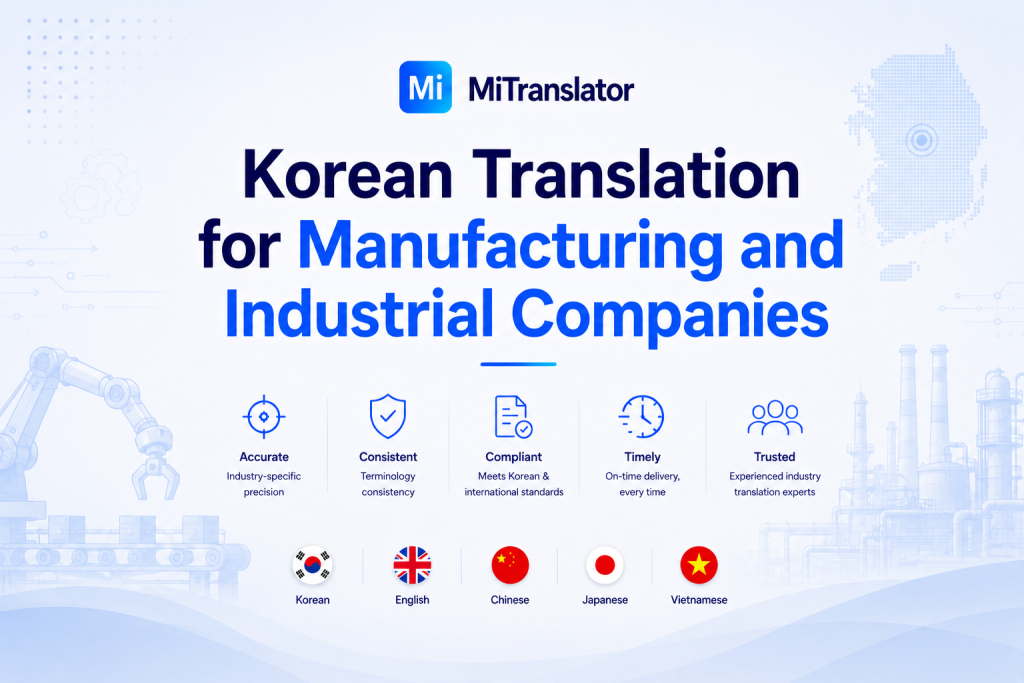
South Korea is one of Vietnam’s largest foreign investors, with thousands of Korean companies operating across manufacturing, electronics, automotive, textiles, industrial equipment, logistics, and supporting industries. As Korean businesses continue to expand their operations in Vietnam, the demand for accurate Korean translation services has grown significantly.
Manufacturing and industrial companies rely on technical documentation, operational procedures, quality standards, and compliance materials to maintain efficiency and consistency. Professional Korean translation services help bridge language gaps between Korean management teams and Vietnamese employees, ensuring smooth communication across all levels of an organization.
Why Korean Translation Is Important for Manufacturing Companies
Manufacturing operations depend on clear communication. From production procedures and quality standards to safety instructions and technical specifications, every document plays a role in maintaining operational performance.
Accurate Korean translation helps companies:
- Improve communication between Korean and Vietnamese teams
- Maintain production consistency
- Support quality management systems
- Enhance workplace safety
- Facilitate technology transfer
- Reduce operational errors
- Improve employee training
- Support compliance and audit readiness
For Korean-invested enterprises, professional translation is often a key factor in achieving efficient and scalable operations.
Types of Manufacturing Documents That Commonly Require Korean Translation
Standard Operating Procedures (SOPs)
SOPs provide step-by-step instructions that help employees perform tasks consistently and correctly.
Common examples include:
- Production procedures
- Machine operating instructions
- Quality control processes
- Maintenance procedures
- Safety protocols
Accurate translation ensures employees understand exactly how each task should be performed.
Work Instructions
Work instructions provide detailed guidance for specific manufacturing activities.
Examples include:
- Assembly instructions
- Packaging procedures
- Equipment setup guidelines
- Inspection procedures
- Process control instructions
Technical Manuals
Manufacturing facilities often use equipment imported from South Korea.
Technical manuals may include:
- User manuals
- Installation guides
- Maintenance manuals
- Troubleshooting documentation
- Equipment specifications
Professional translation helps operators and technicians use machinery safely and efficiently.
Quality Management Documentation
Quality-related documents often include:
- Quality manuals
- Audit reports
- Inspection standards
- Control plans
- Corrective action reports
- ISO documentation
Accurate translation helps organizations maintain compliance and product quality.
Manufacturing Specifications
Technical specifications define production requirements related to:
- Materials
- Tolerances
- Equipment settings
- Product standards
- Testing methods
Translation accuracy is essential to prevent quality issues and production errors.
Industries That Frequently Require Korean Translation
Electronics Manufacturing
Many Korean electronics manufacturers operate large production facilities in Vietnam.
These companies frequently require translation of:
- Technical documentation
- Production procedures
- Quality standards
- Training materials
- Equipment manuals
Automotive and Auto Parts Manufacturing
Automotive suppliers rely on highly standardized documentation to maintain quality and compliance requirements.
Industrial Equipment Manufacturing
Industrial equipment companies often require multilingual documentation for production, maintenance, and service operations.
Textile and Garment Manufacturing
Korean garment and textile manufacturers frequently translate production guidelines, quality standards, and operational procedures.
Consumer Goods Manufacturing
Consumer product manufacturers use translated documentation to support production consistency and workforce training.
Common Challenges in Korean Manufacturing Translation
Specialized Technical Terminology
Manufacturing documentation often contains industry-specific terminology related to:
- Engineering
- Automation
- Electronics
- Machinery
- Quality management
- Industrial production
Translators must understand both the language and technical context.
Korean Manufacturing Concepts
Many Korean companies use internal terminology, production methodologies, and operational systems that require specialized knowledge to translate accurately.
Consistency Across Large Documentation Sets
Manufacturing companies may maintain hundreds of interconnected documents.
Terminology must remain consistent across:
- SOPs
- Work instructions
- Technical manuals
- Quality documents
- Training materials
Complex Formatting
Manufacturing documentation frequently includes:
- Process flowcharts
- Tables
- Technical drawings
- Inspection checklists
- Production diagrams
Translations should preserve both accuracy and usability.
Risks of Poor Translation in Manufacturing Environments
Production Errors
Misunderstood procedures can result in defects, rework, and production delays.
Quality Problems
Inaccurate translation of specifications and quality standards can affect product consistency and customer satisfaction.
Workplace Safety Incidents
Poorly translated safety procedures may increase the risk of accidents and compliance violations.
Communication Barriers
Language misunderstandings can reduce collaboration between Korean management teams and Vietnamese employees.
Increased Operational Costs
Translation errors often lead to additional training, corrective actions, equipment downtime, and production inefficiencies.
Best Practices for Korean Manufacturing Translation
Use Industry-Specialized Translators
Manufacturing documentation should be translated by professionals with technical and industrial expertise.
Develop Terminology Glossaries
Approved terminology helps maintain consistency across all operational documents.
Implement Quality Assurance Procedures
A professional manufacturing translation workflow should include:
- Translation
- Technical terminology review
- Editing and proofreading
- Formatting verification
- Final quality control review
Preserve Original Structure
Document numbering, diagrams, flowcharts, and visual instructions should remain clear and consistent after translation.
Protect Confidential Information
Manufacturing documents often contain proprietary processes, technical specifications, and intellectual property that require secure handling.
How Korean Translation Supports Manufacturing Operations in Vietnam
Professional Korean translation helps manufacturing companies:
- Improve workforce communication
- Reduce training time
- Increase operational efficiency
- Support quality control programs
- Improve safety performance
- Facilitate technology transfer
- Strengthen compliance management
- Support business expansion
These benefits contribute directly to improved productivity and long-term operational success.
How MITRANS Supports Korean Manufacturing and Industrial Companies
MITRANS provides professional Korean translation services for manufacturers, industrial companies, engineering firms, and multinational organizations operating in Vietnam.
Our services include translation of:
- SOPs
- Work instructions
- Technical manuals
- Manufacturing specifications
- Quality manuals
- ISO documentation
- Audit reports
- Equipment documentation
- Safety procedures
- Training materials
MITRANS supports Korean-Vietnamese and Vietnamese-Korean translation projects across a wide range of industrial sectors.
Our experienced translators combine language expertise with technical knowledge to deliver accurate, reliable, and industry-specific translations.
Frequently Asked Questions
Why is professional Korean translation important for manufacturing companies?
Accurate translation helps ensure operational consistency, quality control, employee safety, and effective communication across multilingual teams.
Can MITRANS translate technical manuals and SOPs?
Yes. MITRANS regularly translates technical manuals, work instructions, SOPs, quality documentation, and manufacturing procedures.
How does MITRANS ensure terminology consistency?
We use terminology databases, translation memories, and multi-level review processes to maintain consistency across all documents.
What industries does MITRANS support?
MITRANS supports electronics, automotive, industrial equipment, textiles, consumer goods, logistics, and many other manufacturing sectors.
Is confidential manufacturing information protected?
Absolutely. MITRANS follows strict confidentiality procedures and secure document management practices to safeguard client information.
Contact MITRANS for Korean Translation Services
Accurate Korean translation is essential for maintaining operational efficiency, product quality, workplace safety, and effective communication within manufacturing and industrial environments. If your organization requires professional translation of technical manuals, SOPs, manufacturing specifications, quality documentation, or other industrial materials, MITRANS is ready to support you.
Contact MITRANS today for fast, accurate, and professional Korean translation services tailored to the needs of manufacturing and industrial companies in Vietnam.