As businesses expand globally, managing multilingual content manually becomes increasingly difficult. Websites, apps, product catalogs, support systems, and marketing campaigns often require continuous updates across multiple languages and markets.
A multilingual content pipeline helps businesses automate localization workflows using translation APIs, AI-assisted translation systems, terminology management, and human review processes.
For companies targeting Vietnamese and international audiences, building a scalable multilingual pipeline improves operational efficiency, accelerates localization, and supports consistent global communication.
What Is a Multilingual Content Pipeline?
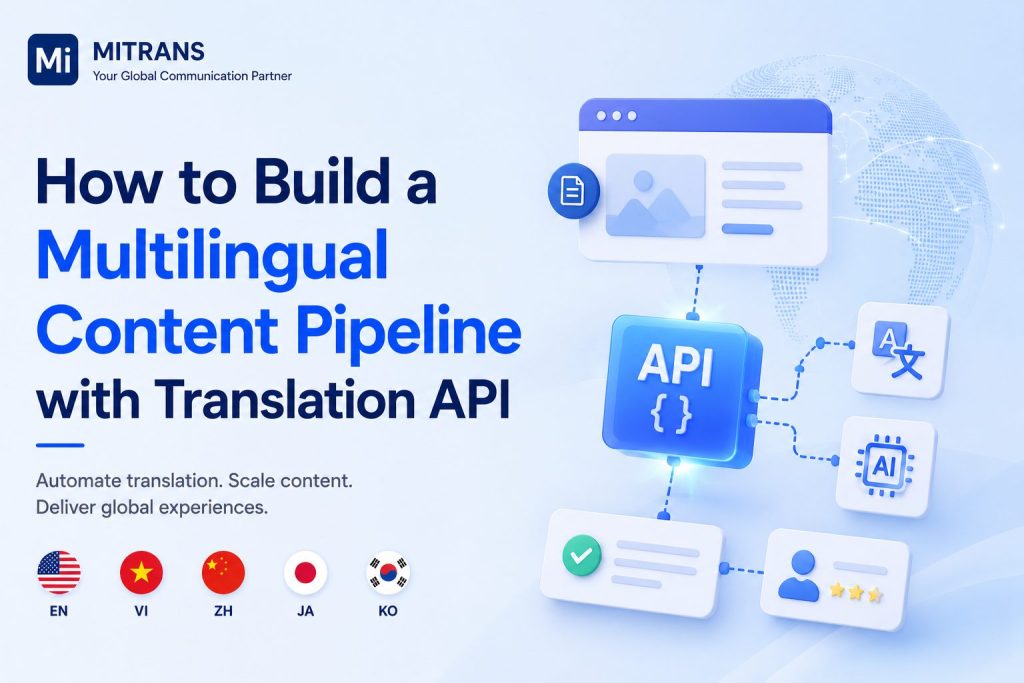
A multilingual content pipeline is a structured workflow that automates how content is translated, reviewed, localized, and delivered across multiple languages.
These pipelines typically connect:
- Content management systems (CMS)
- Translation APIs
- AI translation engines
- Translation memory systems
- Human review workflows
- Localization management platforms
The goal is to streamline multilingual publishing and reduce manual localization work.
Why Businesses Need Multilingual Content Pipelines
Modern businesses constantly update:
- Websites
- Mobile apps
- SaaS platforms
- Product descriptions
- Customer support content
- Marketing campaigns
- Enterprise documentation
Manual translation workflows can slow down publishing and create operational bottlenecks.
Automated pipelines help businesses scale multilingual content more efficiently.
What Is a Translation API?
A translation API allows applications and systems to automatically translate content between languages using AI-powered translation technologies.
Translation APIs can process:
- Text
- Documents
- Website content
- JSON files
- Software strings
- Dynamic content
- Product data
Businesses integrate APIs directly into digital systems to automate localization workflows.
Key Components of a Multilingual Content Pipeline
Content Source Systems
The pipeline usually begins with content from:
- CMS platforms
- E-commerce systems
- Product databases
- SaaS dashboards
- Knowledge bases
- Enterprise systems
Translation API Integration
Translation APIs automatically process multilingual content and generate translated output.
Translation Memory Systems
Translation memory stores previously translated segments to:
- Improve consistency
- Reduce duplication
- Accelerate future translation
Terminology Management
Glossaries ensure consistent usage of:
- Brand terminology
- Product names
- Technical language
- Industry-specific wording
Human Review and QA
Professional linguists review AI-generated content for:
- Accuracy
- Tone
- Context
- Localization quality
- Cultural adaptation
Publishing and Delivery
Final localized content is pushed back into:
- Websites
- Apps
- CMS platforms
- Customer support systems
- Enterprise workflows
Benefits of Translation API Pipelines
Faster Localization
Automated systems reduce delays and accelerate multilingual publishing.
Better Scalability
Businesses can manage growing content volumes more efficiently.
Reduced Manual Workflows
Automation minimizes repetitive:
- Copy-pasting
- File handling
- Content routing
- Translation coordination
More Consistent Localization
Centralized terminology and translation memory improve consistency across teams and markets.
Continuous Localization Support
Pipelines support ongoing updates for rapidly changing digital content.
Common Challenges When Building Multilingual Pipelines
Translation Quality
AI-generated translation may still require human review for:
- Context
- Tone
- Cultural adaptation
- Industry terminology
System Integration Complexity
Enterprises may need to connect:
- CMS platforms
- CRM systems
- Product databases
- Support tools
- SaaS environments
Data Security
Businesses handling confidential information require secure localization infrastructure and controlled content access.
Workflow Customization
Different industries require different review levels, approval structures, and localization processes.
Best Practices for Building a Translation Pipeline
Combine AI With Human Review
Hybrid workflows balance automation speed with professional localization quality.
Centralize Terminology Management
Glossaries improve consistency across:
- Departments
- Products
- Campaigns
- Languages
Prioritize Customer-Facing QA
Public-facing content should undergo human review before publishing.
Automate Repetitive Processes
Automation works best for:
- High-volume content
- Frequent updates
- Dynamic systems
- Repetitive localization workflows
Build Scalable Infrastructure
Pipelines should support:
- Global growth
- Multi-language expansion
- Continuous localization
- Enterprise collaboration
Industries Using Translation API Pipelines
Multilingual pipelines are widely used in:
- SaaS and software
- E-commerce
- Healthcare
- Finance
- Marketing agencies
- Manufacturing
- Customer support platforms
- Enterprise communication systems
- Education technology
- International media platforms
Each industry requires different levels of automation, compliance review, and localization expertise.
Why Vietnamese Localization Still Needs Human Review
Vietnamese translation often requires deeper contextual understanding for:
- Tone
- Pronoun usage
- Formality levels
- Cultural communication style
- Brand adaptation
Human review helps ensure Vietnamese content feels natural, professional, and audience-appropriate.
Why Businesses Choose MITRANS
MITRANS Translation Services helps businesses build scalable multilingual localization workflows using AI-assisted translation and professional Vietnamese review processes.
MITRANS supports organizations with:
- Translation API workflows
- Vietnamese localization
- Human QA review
- Terminology management
- Enterprise content scaling
- Software localization
- Secure document handling
From enterprise platforms to multilingual marketing operations, MITRANS helps businesses streamline localization for Vietnamese and international markets.
Frequently Asked Questions
What is a multilingual content pipeline?
It is an automated workflow that manages translation, localization, review, and multilingual content delivery across systems and platforms.
Why use translation APIs in localization workflows?
Translation APIs automate multilingual processing and improve scalability for global content operations.
Can AI translation fully automate localization?
AI improves speed and efficiency, but human review remains important for quality, tone, and cultural adaptation.
Which businesses benefit most from multilingual pipelines?
SaaS companies, e-commerce platforms, enterprises, agencies, and businesses managing large multilingual content volumes benefit most.
Request a Localization Workflow Consultation
Need professional business document translation? Request a quote from MITRANS.
Contact MITRANS for a Translation Quote
MITRANS helps businesses build scalable multilingual workflows with professional Vietnamese localization and AI-assisted translation solutions.