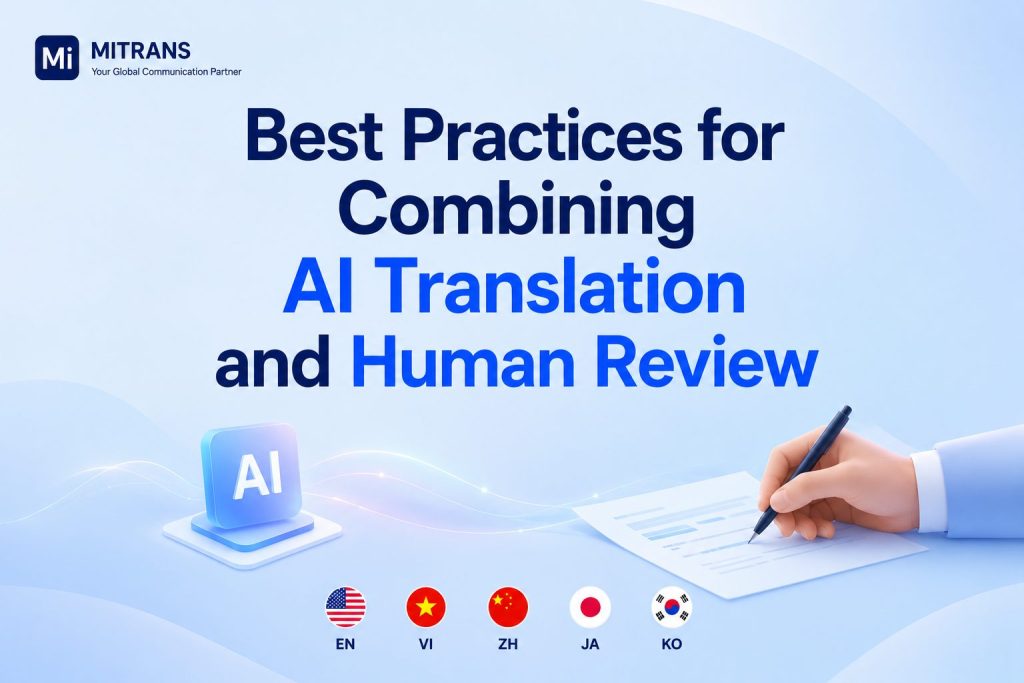
As businesses scale multilingual operations, many organizations are adopting hybrid translation workflows that combine AI-powered translation with professional human review. This approach helps companies balance speed, scalability, and translation quality across large content volumes and multiple languages.
While AI translation technologies can significantly improve efficiency, human expertise remains essential for contextual accuracy, cultural adaptation, terminology consistency, and brand communication quality.
For Vietnamese localization in particular, combining AI translation with human review often delivers the best results for enterprise content and customer-facing communication.
Why Businesses Combine AI Translation With Human Review
AI translation is highly effective for:
- Processing large content volumes
- Automating repetitive workflows
- Accelerating multilingual updates
- Supporting scalable localization systems
However, AI still struggles with:
- Tone and nuance
- Context interpretation
- Industry terminology
- Cultural localization
- Brand voice consistency
Human review helps improve final translation quality while maintaining the speed advantages of AI-assisted workflows.
What Is a Hybrid Translation Workflow?
A hybrid translation workflow typically includes:
- AI-generated draft translation
- Human editing and localization
- Terminology review
- Quality assurance checks
- Final approval and delivery
This process combines automation efficiency with professional linguistic expertise.
Benefits of Combining AI and Human Review
Faster Turnaround Times
AI speeds up initial translation processing, allowing teams to handle large projects more efficiently.
Better Scalability
Businesses can manage multilingual content growth more effectively without relying entirely on manual translation workflows.
Improved Translation Quality
Human reviewers help correct:
- Context errors
- Tone inconsistencies
- Awkward phrasing
- Technical inaccuracies
- Cultural adaptation issues
More Consistent Terminology
Professional reviewers ensure terminology consistency across:
- Departments
- Platforms
- Products
- Marketing campaigns
- Enterprise systems
Better Customer Experience
Natural localization improves communication quality and user trust for Vietnamese audiences.
Common Challenges in AI-Only Translation
Literal Translation Problems
AI systems may translate word-for-word without adapting content naturally for Vietnamese readers.
Inconsistent Tone
Customer-facing content may sound:
- Too robotic
- Overly formal
- Unnaturally casual
- Culturally inappropriate
Technical Terminology Issues
Industries such as:
- Healthcare
- Finance
- Legal
- Manufacturing
- SaaS
often require specialized terminology expertise that AI systems alone may not handle accurately.
Brand Voice Risks
Marketing and branded communication require emotional nuance and audience adaptation beyond direct translation.
Best Practices for Hybrid Translation Workflows
Use AI for High-Volume Content
AI works especially well for:
- Repetitive documents
- Internal communication
- Product catalogs
- Knowledge bases
- Frequently updated content
Prioritize Human Review for Critical Content
Professional review is especially important for:
- Legal documents
- Financial reports
- Medical content
- Marketing campaigns
- Customer-facing communication
Build Translation Glossaries
Terminology databases improve consistency across multilingual systems and workflows.
Maintain Style Guides
Style guides help reviewers preserve:
- Brand tone
- Communication style
- Localization preferences
- Industry terminology standards
Implement Quality Assurance Processes
QA review helps ensure:
- Linguistic accuracy
- Consistency
- Formatting quality
- Localization correctness
Why Vietnamese Localization Needs Human Review
Vietnamese is highly context-sensitive and requires careful adaptation for:
- Formality levels
- Pronoun usage
- Cultural communication style
- Tone variation
- Audience expectations
Human reviewers help ensure Vietnamese content feels natural and professional rather than machine-generated.
Industries Using Hybrid Translation Workflows
Hybrid AI + human translation workflows are widely used in:
- SaaS and software
- E-commerce
- Healthcare
- Finance
- Legal services
- Manufacturing
- Marketing agencies
- Customer support platforms
- Enterprise communication systems
These industries require scalable localization while maintaining high communication quality.
How Enterprises Build Effective AI + Human Systems
Successful enterprises often combine:
- Translation APIs
- AI translation engines
- Translation memory systems
- Terminology management
- Human QA review
- Centralized localization workflows
This creates scalable multilingual infrastructure for global growth.
Why Businesses Choose MITRANS
MITRANS Translation Services helps businesses combine AI-assisted translation workflows with professional Vietnamese localization and human QA expertise.
MITRANS supports organizations with:
- Enterprise localization workflows
- AI-assisted translation systems
- Human editing and review
- Terminology management
- Software localization
- Marketing localization
- Secure document handling
From large document projects to multilingual digital platforms, MITRANS helps businesses scale localization while maintaining professional translation quality.
Frequently Asked Questions
Why combine AI translation with human review?
AI improves speed and scalability, while human review improves accuracy, tone, and localization quality.
Is AI translation accurate enough on its own?
AI translation can support automation, but professional review is still important for customer-facing and high-value content.
Which content types need human review most?
Legal, medical, financial, technical, and marketing content often require deeper contextual and linguistic review.
Why is Vietnamese localization difficult for AI systems?
Vietnamese depends heavily on tone, context, and cultural communication style, which AI systems may interpret incorrectly.
Request a Translation Workflow Consultation
Need professional business document translation? Request a quote from MITRANS.
Contact MITRANS for a Translation Quote
MITRANS helps businesses combine AI translation efficiency with professional Vietnamese localization and human quality assurance for scalable multilingual communication.