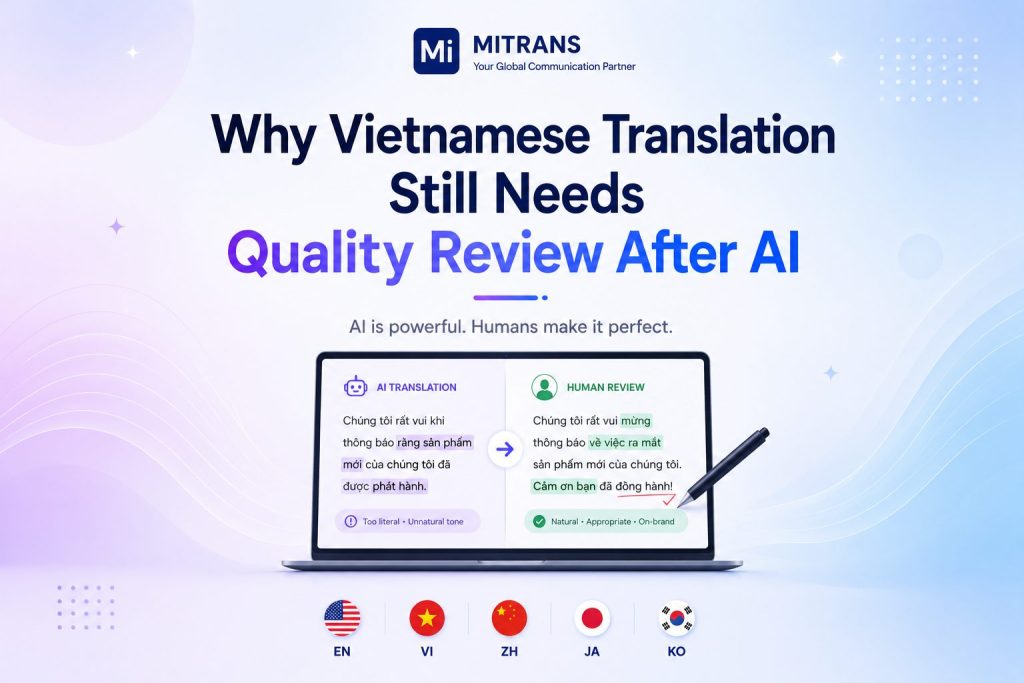
AI translation technology has improved rapidly in recent years, helping businesses automate multilingual workflows and process large amounts of content more efficiently. However, despite these advances, Vietnamese translation still requires professional quality review to ensure accuracy, natural communication, and localization quality.
For businesses targeting Vietnamese audiences, relying entirely on AI-generated translation can create risks related to tone, context, terminology, cultural adaptation, and customer experience.
This is why many companies continue to combine AI translation with professional human review in their localization workflows.
Why AI Translation Is Growing
Businesses increasingly use AI translation because it helps:
- Reduce manual workload
- Accelerate translation speed
- Support scalable localization
- Process large content volumes
- Automate multilingual workflows
AI-powered translation tools are commonly integrated into:
- Websites
- SaaS platforms
- Customer support systems
- E-commerce platforms
- Enterprise workflows
- Translation APIs
While AI improves efficiency, translation quality still varies depending on content complexity and language requirements.
Why Vietnamese Is Difficult for AI Translation
Vietnamese is highly context-sensitive and relies heavily on:
- Tone
- Communication style
- Audience relationship
- Formality level
- Cultural nuance
Literal translation often sounds unnatural in Vietnamese without localization review.
AI systems may struggle to correctly interpret communication intent, especially in customer-facing business content.
Common Problems in AI-Generated Vietnamese Translation
Unnatural Wording
AI-generated Vietnamese may sound:
- Too literal
- Robotic
- Grammatically awkward
- Culturally unnatural
This can reduce communication quality and customer trust.
Incorrect Tone and Formality
Vietnamese communication changes significantly depending on:
- Business setting
- Industry
- Customer relationship
- Audience expectations
AI systems may select inappropriate wording or pronouns for the situation.
Context Interpretation Errors
Without sufficient context, AI may:
- Misinterpret meaning
- Translate phrases incorrectly
- Create ambiguous communication
This is especially risky for business, legal, and technical content.
Terminology Inconsistency
Large-scale translation projects often require consistent terminology across:
- Products
- Departments
- Marketing campaigns
- Enterprise systems
AI alone may generate inconsistent wording without glossary management and human oversight.
Why Human Quality Review Is Still Important
Professional review improves:
- Accuracy
- Natural readability
- Cultural adaptation
- Brand voice consistency
- Terminology control
- Localization quality
Human reviewers understand communication intent beyond literal translation.
Content Types That Require Human Review
Marketing Content
Marketing localization requires:
- Emotional tone
- Audience engagement
- Persuasive communication
- Brand personality adaptation
AI-generated marketing content may feel unnatural or ineffective without human editing.
Legal and Financial Documents
Contracts, compliance documents, and financial reports require high accuracy and terminology precision.
Healthcare and Medical Content
Medical translation errors can create serious communication risks and compliance concerns.
Customer-Facing Communication
Businesses must ensure customer communication feels professional, natural, and culturally appropriate.
Why Hybrid AI + Human Workflows Work Best
Many businesses now use hybrid workflows that combine:
- AI-generated draft translation
- Human editing and review
- Terminology checks
- QA validation
- Final localization approval
This approach balances:
- Speed
- Scalability
- Cost efficiency
- Translation quality
Hybrid workflows are becoming standard in enterprise localization operations.
Best Practices for Vietnamese AI Translation Review
Use Translation Glossaries
Terminology databases improve consistency across multilingual projects.
Prioritize Customer-Facing QA
Public-facing content should always undergo professional review before publishing.
Maintain Brand Voice Guidelines
Style guides help reviewers preserve:
- Brand tone
- Communication style
- Localization preferences
Review High-Risk Content Carefully
Legal, medical, financial, and technical documents require deeper review and validation.
Industries That Need Vietnamese Localization Review
Human review is especially important in:
- SaaS and software
- E-commerce
- Healthcare
- Finance
- Legal services
- Customer support
- Marketing agencies
- Enterprise communication
These industries rely heavily on accurate and natural communication.
Why Businesses Choose MITRANS
MITRANS Translation Services helps businesses combine AI-assisted translation with professional Vietnamese localization and human quality assurance.
MITRANS supports organizations with:
- Vietnamese localization review
- AI-assisted workflows
- Human editing and QA
- Terminology management
- Software localization
- Enterprise translation systems
- Secure document handling
From customer-facing communication to enterprise localization projects, MITRANS helps businesses maintain professional multilingual quality for Vietnamese audiences.
Frequently Asked Questions
Why does Vietnamese translation still need human review after AI?
Vietnamese depends heavily on tone, context, and cultural nuance, which AI systems may interpret incorrectly.
Is AI translation accurate enough for business communication?
AI translation can improve efficiency, but professional review is still important for quality, natural readability, and localization accuracy.
Which content types require deeper review?
Marketing, legal, financial, healthcare, and customer-facing content typically require stronger human QA review.
Why are hybrid workflows becoming more common?
Hybrid workflows combine AI scalability with human expertise for better translation quality and operational efficiency.
Request a Vietnamese Localization Consultation
Need professional business document translation? Request a quote from MITRANS.
Contact MITRANS for a Translation Quote
MITRANS helps businesses combine AI translation efficiency with professional Vietnamese localization and human quality assurance for scalable multilingual communication.