
Introduction
Many global businesses entering Vietnam assume that translation and localization are the same thing. In reality, they serve very different purposes.
A direct translation may accurately convert words from one language to another, but it does not always create the right experience for Vietnamese customers. That is where localization becomes essential.
Understanding the difference between Vietnamese translation and localization helps businesses communicate more effectively, improve customer trust, and succeed in the Vietnamese market.
![Vietnamese Translation vs Localization Header — minimalist corporate style with blue typography and modern Vietnam/global theme]
What Is Vietnamese Translation?
Vietnamese translation is the process of converting text from one language into Vietnamese while preserving the original meaning.
The primary focus of translation is linguistic accuracy.
Common translation projects include:
- Contracts and legal documents
- Certificates and official paperwork
- Technical manuals
- Business reports
- Academic documents
- Product specifications
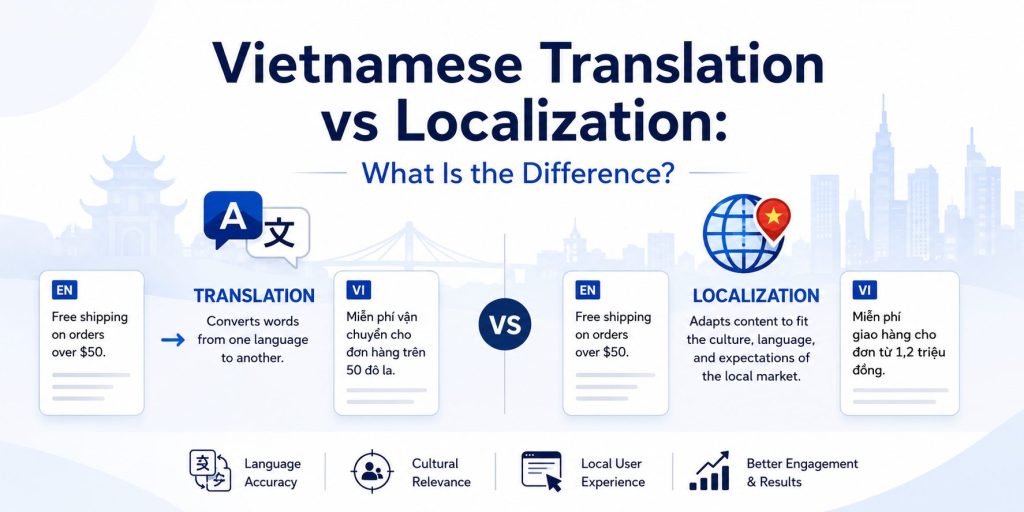
For example:
English:
“Free shipping on orders over $50.”
Vietnamese translation:
“Miễn phí vận chuyển cho đơn hàng trên 50 đô la.”
The sentence is accurate, but it may not feel fully natural or optimized for Vietnamese consumers.
Translation works best when businesses need:
- Accurate information transfer
- Legal precision
- Technical clarity
- Certified documents
What Is Vietnamese Localization?
Localization goes beyond translation.
Vietnamese localization adapts content to match Vietnamese language preferences, culture, customer behavior, and market expectations.
Instead of translating word-for-word, localization focuses on creating a natural experience for Vietnamese audiences.
Using the same example:
Localized Vietnamese version:
“Miễn phí giao hàng cho đơn từ 1,2 triệu đồng.”
This version:
- Uses Vietnamese currency instead of USD
- Sounds more natural for local shoppers
- Feels tailored to the Vietnamese market
Localization may involve adapting:
- Tone of voice
- Currency
- Date and time formats
- Cultural references
- Images and visuals
- Website UX/UI
- Marketing messages
- SEO keywords
Key Differences Between Translation and Localization
| Translation | Localization |
|---|---|
| Focuses on language accuracy | Focuses on user experience |
| Converts text directly | Adapts content culturally |
| Keeps original structure | Modifies content for local markets |
| Suitable for legal/technical content | Suitable for marketing, apps, websites |
| Mainly linguistic | Linguistic + cultural + strategic |
In simple terms:
- Translation asks: “What does this text mean?”
- Localization asks: “How should this feel to Vietnamese users?”
Why Localization Matters for Businesses Expanding into Vietnam
Better Customer Engagement
Vietnamese consumers respond better to content that feels local and natural.
Localized messaging improves:
- Brand trust
- Customer connection
- Conversion rates
- User experience
Improved Marketing Performance
Localized campaigns often outperform direct translations because they reflect local behavior and preferences.
This is especially important for:
- eCommerce
- Mobile apps
- SaaS platforms
- Digital marketing campaigns
Stronger SEO Results
Vietnamese localization also improves SEO performance.
Local keyword optimization helps businesses rank better on Vietnamese search engines and attract more organic traffic.
For example:
- A translated keyword may be technically correct
- A localized keyword matches actual Vietnamese search behavior
Reduced Communication Errors
Poorly translated content can confuse customers or damage brand credibility.
Localization helps businesses avoid:
- Cultural misunderstandings
- Unnatural phrasing
- Incorrect messaging
- UX issues
Common Mistakes Businesses Make
Using Machine Translation Only
Machine translation may help with speed, but without human review, content often sounds unnatural or inaccurate.
Translating Without Cultural Adaptation
Many businesses translate marketing campaigns directly without adjusting:
- Humor
- Tone
- Cultural context
- Customer expectations
This reduces effectiveness significantly.
Ignoring Vietnamese SEO
Literal keyword translation does not always match what Vietnamese users actually search for online.
Localization should include keyword research tailored to Vietnam.
Inconsistent Terminology
Without a terminology glossary, businesses often use inconsistent product names and messaging across platforms.
When Should You Use Translation vs Localization?
Use Translation When You Need:
- Legal document translation
- Certified translation
- Technical manuals
- Internal reports
- Academic content
- Compliance documentation
Use Localization When You Need:
- Website localization
- Marketing campaigns
- App localization
- eCommerce content
- Product launches
- Customer-facing communication
In many cases, businesses need both translation and localization together.
How MITRANS Can Help
MITRANS Translation Services provides professional Vietnamese translation and localization services for global businesses.
MITRANS supports:
- English ↔ Vietnamese translation
- Chinese, Japanese, and Korean translation
- Website localization
- Software and app localization
- Marketing localization
- Legal and technical translation
- Multilingual SEO content
Why businesses choose MITRANS:
- Native professional translators
- Localization expertise
- Fast turnaround times
- Consistent terminology management
- Quality assurance processes
- Nationwide support across Vietnam
Whether you need accurate translation or full Vietnamese localization, MITRANS helps your business communicate naturally and professionally in the Vietnamese market.
FAQ
Is translation the same as localization?
No. Translation focuses on converting language accurately, while localization adapts content culturally and strategically for local audiences.
Does every business need localization?
Businesses targeting Vietnamese customers directly usually benefit greatly from localization, especially in marketing and digital products.
Can machine translation handle localization?
No. Machine translation cannot fully understand cultural nuance, customer behavior, or brand tone.
What industries benefit most from localization?
Industries such as eCommerce, SaaS, gaming, technology, tourism, and digital marketing benefit heavily from localization.
Does MITRANS provide both translation and localization services?
Yes. MITRANS provides both professional translation and full localization solutions tailored for businesses operating in Vietnam.
Need Vietnamese Translation or Localization Support?
Looking to expand into Vietnam with clear, professional, and culturally accurate communication?
Contact MITRANS today for fast and reliable Vietnamese translation and localization services for global businesses.