

Introduction
Vietnam is one of Southeast Asia’s fastest-growing digital markets, with millions of consumers shopping, searching, and engaging online every day. For international businesses, simply translating a website into Vietnamese is no longer enough.
To truly connect with Vietnamese users, businesses need proper website localization.
Website localization helps global brands create a more natural, trustworthy, and user-friendly experience for Vietnamese audiences. From language and design to SEO and cultural adaptation, localization can significantly improve engagement and conversion rates.
This guide explains how businesses can successfully localize their websites for the Vietnamese market.
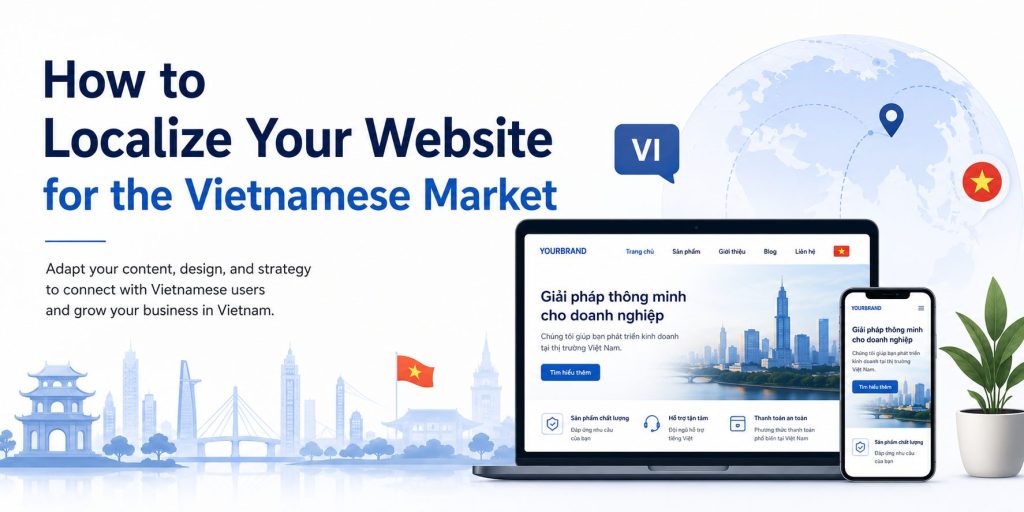
![How to Localize Your Website for the Vietnamese Market — clean corporate banner with Vietnamese and global digital theme]
What Website Localization Means
Website localization is the process of adapting a website for a specific local market — not just translating text.
For the Vietnamese market, localization may include:
- Vietnamese language adaptation
- Local currency conversion
- Vietnamese SEO optimization
- Cultural messaging adjustments
- UX/UI adaptation
- Local contact information
- Mobile-friendly optimization
- Local payment preferences
The goal is to make Vietnamese users feel that the website was designed specifically for them.
Why Vietnamese Website Localization Matters
Builds Customer Trust
Vietnamese customers are more likely to trust and purchase from businesses that communicate naturally in Vietnamese.
A poorly translated website can appear unprofessional and reduce credibility.
Improves Conversion Rates
Localized websites help users:
- Understand products more clearly
- Navigate more easily
- Feel more confident purchasing
This often leads to higher:
- Conversion rates
- Engagement
- Customer retention
Supports Vietnamese SEO
Vietnamese localization improves search engine visibility.
Localized keywords help businesses rank better for Vietnamese search queries and attract more local traffic organically.
Creates a Better Mobile Experience
Vietnam has a highly mobile-first internet audience. Localized websites optimized for mobile users perform significantly better in the market.
Step 1: Translate Content Professionally
The first step is accurate Vietnamese translation.
Businesses should professionally translate:
- Homepage content
- Product pages
- Service pages
- Menus and navigation
- Blog content
- FAQs
- Contact pages
- Checkout pages
Avoid relying solely on machine translation.
Direct translations often sound unnatural and may confuse Vietnamese users.
Professional translators help ensure:
- Accuracy
- Natural phrasing
- Industry terminology consistency
- Brand voice preservation
Step 2: Adapt Content for Vietnamese Culture
Localization goes beyond language.
Businesses should adapt:
- Tone of voice
- Marketing messages
- Visual elements
- Customer communication style
Vietnamese customers generally prefer communication that feels:
- Friendly
- Clear
- Trustworthy
- Respectful
Some cultural references or humor used in Western markets may not work effectively in Vietnam.
Step 3: Optimize for Vietnamese SEO
Vietnamese SEO requires more than direct keyword translation.
Businesses should localize:
- Keywords
- Meta titles
- Meta descriptions
- URLs
- Blog topics
- Product descriptions
For example:
- A literal keyword translation may have low search volume
- Vietnamese users may search using completely different phrasing
Proper keyword research is essential for visibility in Vietnam.
Step 4: Use Vietnamese Currency & Local Formats
Vietnamese users expect localized formatting.
Websites should adapt:
- Currency → VND
- Date format → DD/MM/YYYY
- Phone number formatting
- Address formatting
- Units of measurement
For example:
- “$50” should often become “1,2 triệu VNĐ”
- International phone formats may need local presentation
These details improve trust and usability.
Step 5: Localize UX & Website Design
Website design preferences may differ between markets.
Businesses should ensure:
- Vietnamese fonts display correctly
- Mobile responsiveness is optimized
- Vietnamese text spacing looks natural
- Navigation remains simple and clear
Localization testing is important because Vietnamese text can change page layouts and spacing.
Step 6: Add Local Trust Signals
Vietnamese consumers value trust and credibility.
Localized trust signals may include:
- Vietnamese customer support
- Local phone numbers
- Vietnamese testimonials
- Local business addresses
- Fast response channels like Zalo
- Vietnamese-language FAQs
These elements help international brands feel more accessible and reliable.
Step 7: Localize Checkout & Customer Support
For eCommerce websites, localization should also include:
- Vietnamese payment methods
- Shipping information
- Return policies
- Customer support communication
Clear Vietnamese support improves customer confidence significantly.
Common Website Localization Mistakes
Using Automatic Translation Only
Machine translation may create:
- Grammar mistakes
- Awkward phrasing
- Incorrect terminology
This can damage brand image.
Ignoring Mobile Users
Most Vietnamese users browse websites on smartphones. Poor mobile optimization can hurt conversions badly.
Translating Without SEO Research
Directly translated keywords often fail to rank on Vietnamese search engines.
Forgetting Cultural Context
Some visuals, slogans, or campaigns may not resonate with Vietnamese audiences.
Localization should always consider local user expectations.
How MITRANS Can Help
MITRANS Translation Services helps global businesses localize websites professionally for the Vietnamese market.
MITRANS services include:
- Vietnamese website translation
- Website localization
- Multilingual SEO content
- UI/UX localization
- Product page translation
- Blog localization
- English, Chinese, Japanese, and Korean translation
Why businesses choose MITRANS:
- Native Vietnamese linguists
- SEO-focused localization
- Industry-specific expertise
- Fast turnaround times
- Consistent terminology management
- Quality assurance processes
Whether you are launching an eCommerce store, SaaS platform, or corporate website, MITRANS helps ensure your website feels natural and professional for Vietnamese users.
FAQ
What is the difference between website translation and localization?
Translation converts text into another language, while localization adapts the entire website experience for local users, including culture, SEO, formatting, and UX.
Why is Vietnamese website localization important?
It improves trust, SEO visibility, user experience, and conversion rates for Vietnamese audiences.
Can Google Translate localize my website?
No. Machine translation cannot fully adapt cultural context, SEO strategy, or natural Vietnamese communication.
Is Vietnamese SEO different from English SEO?
Yes. Vietnamese search behavior and keyword usage differ significantly from English-speaking markets.
Does MITRANS provide website localization services?
Yes. MITRANS provides professional Vietnamese website localization and multilingual translation services for global businesses.
Need Vietnamese Website Localization Support?
Looking to expand your business into Vietnam with a fully localized website experience?
Contact MITRANS today for fast, accurate, and professional Vietnamese website localization services tailored to your business goals.