
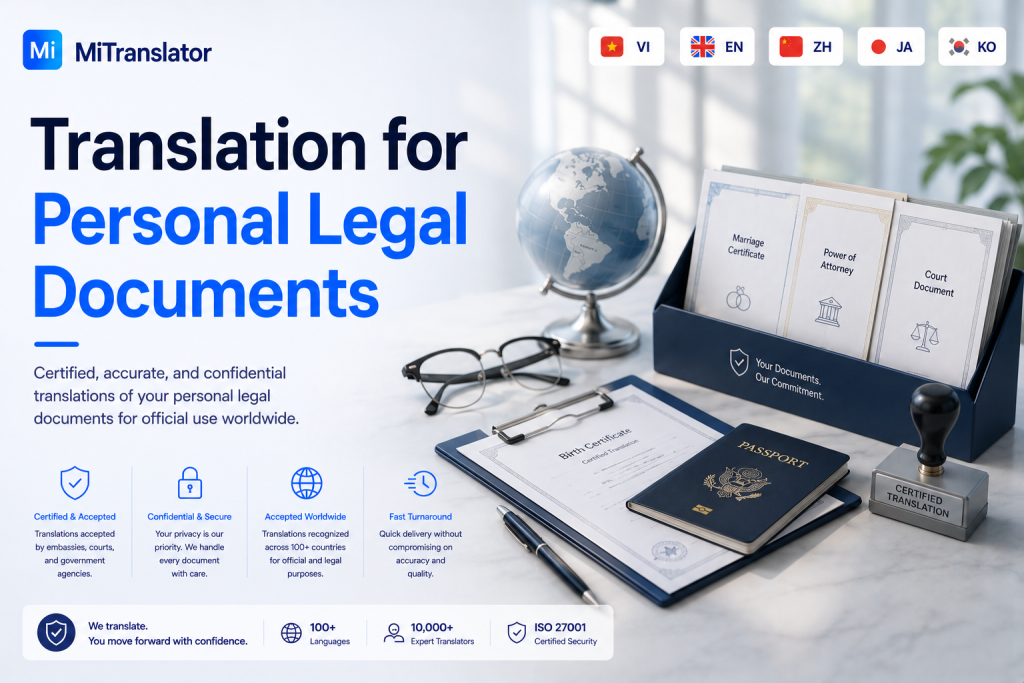
Personal legal documents play a crucial role in many important life events, including immigration, international marriage, overseas employment, education abroad, property transactions, inheritance matters, family sponsorship, and legal proceedings. When these documents need to be submitted to foreign authorities, courts, embassies, educational institutions, or employers, they often must be translated into the required language.
Because personal legal documents contain legally significant information regarding identity, civil status, family relationships, ownership rights, and legal obligations, translation accuracy is essential. Even minor errors involving names, dates, or legal terminology can lead to delays, rejected applications, or legal complications.
Professional translation services help individuals ensure that their personal legal documents are accurately translated, properly formatted, and suitable for official use both domestically and internationally.
What Are Personal Legal Documents?
Personal legal documents are official records that establish an individual’s identity, civil status, legal rights, family relationships, ownership interests, or personal legal history.
These documents are often issued by:
- Government agencies
- Civil registries
- Courts
- Educational institutions
- Law enforcement authorities
- Notary offices
- Healthcare organizations
They frequently serve as evidence in legal, administrative, immigration, and regulatory processes.
Why Personal Legal Document Translation Matters
Supporting Immigration Applications
Immigration authorities often require translated legal documents to verify an applicant’s identity, family relationships, education, employment history, and legal background.
Facilitating International Marriage and Family Sponsorship
Marriage registration, spouse visas, and family reunification applications commonly require translated personal legal records.
Meeting Embassy and Consular Requirements
Embassies frequently require certified translations of official documents during visa and citizenship applications.
Supporting Overseas Employment
Employers may request translated personal legal documents when hiring foreign nationals.
Assisting International Education
Universities often require translated civil and academic records during admissions and enrollment processes.
Enabling Legal Recognition Abroad
Accurate translation helps foreign authorities recognize and evaluate documents issued in another country.
Common Personal Legal Documents Requiring Translation
Birth Certificates
Birth certificates are among the most commonly translated legal documents.
They are frequently used for:
- Visa applications
- Citizenship procedures
- School enrollment
- Immigration sponsorship
- Family reunification
Marriage Certificates
Marriage certificates are often required for:
- Spouse visas
- Family immigration
- International marriage registration
- Insurance claims
- Property transactions
Divorce Certificates
Proof of divorce may be necessary for remarriage, immigration applications, or legal proceedings.
Death Certificates
Death certificates are commonly translated for:
- Estate administration
- Inheritance matters
- Insurance claims
- Family legal proceedings
Household Registration Documents
Many countries maintain household registration systems that record family relationships and residency information.
National Identity Cards
Identity cards often require translation for immigration, banking, employment, and legal purposes.
Passports
Passports may be translated when required by government agencies, educational institutions, or employers.
Criminal Record Certificates
Police clearance certificates are frequently required for:
- Immigration applications
- Work permits
- Professional licensing
- Overseas employment
Court Documents
Personal legal matters may involve:
- Court judgments
- Custody orders
- Guardianship orders
- Name change certificates
- Legal declarations
Notarial Documents
Notarized affidavits, declarations, and legal statements may require translation for international use.
Common Situations Requiring Personal Legal Document Translation
Immigration and Visa Applications
Applicants often need translated documentation to support visa, residency, and citizenship procedures.
Family Sponsorship Programs
Governments frequently require evidence of family relationships through translated legal documents.
Overseas Employment
Foreign employers may request translated records to verify identity, qualifications, and legal status.
International Education
Students often submit translated civil documents alongside academic records.
Property Transactions Abroad
Real estate purchases, inheritances, and ownership transfers may require translated legal documentation.
International Legal Proceedings
Cross-border legal matters often involve multilingual documentation reviewed by courts and legal professionals.
Common Challenges in Translating Personal Legal Documents
Maintaining Accuracy of Personal Information
Names, dates, addresses, identification numbers, and family relationships must be translated consistently and accurately.
Legal Terminology Differences
Legal systems vary significantly between countries.
Certain legal concepts may not have direct equivalents in another language.
Certification Requirements
Many authorities require:
- Certified translations
- Notarized translations
- Sworn translations
- Translator declarations
Failure to meet these requirements may result in document rejection.
Official Formatting Expectations
Authorities often expect translated documents to closely reflect the structure and content of the original document.
Confidentiality Concerns
Personal legal records contain sensitive information that must be handled securely.
Risks of Poor Translation
Translation errors can create significant administrative and legal complications.
Potential consequences include:
- Delayed visa approvals
- Rejected immigration applications
- Legal disputes
- Requests for document resubmission
- Embassy processing delays
- Inconsistent identity records
- Increased legal expenses
Because personal legal documents often serve as official evidence, accuracy is essential.
Best Practices for Personal Legal Document Translation
Use Professional Translators
Legal and official documents should be translated by professionals familiar with legal terminology and official documentation standards.
Verify Certification Requirements
Before translation begins, applicants should confirm whether the receiving authority requires certification, notarization, or sworn translation.
Submit Clear Copies
High-quality scans improve translation accuracy and reduce the risk of transcription errors.
Maintain Consistency Across Documents
Personal information should remain identical across all translated records and supporting documents.
Allow Time for Quality Review
A comprehensive review process helps identify and correct potential errors before submission.
Industries and Organizations That Frequently Request Personal Legal Document Translations
Personal legal document translations are commonly required by:
- Embassies and consulates
- Immigration authorities
- Universities and colleges
- International employers
- Government agencies
- Courts
- Law firms
- Financial institutions
- Insurance companies
- Adoption agencies
These organizations often rely on translated records when evaluating applications and legal matters.
How MITRANS Supports Personal Legal Document Translation
MITRANS provides professional translation services for personal legal documents intended for official domestic and international use.
Our services include translation of:
- Birth certificates
- Marriage certificates
- Divorce certificates
- Death certificates
- Passports
- Identity cards
- Household registration records
- Criminal record certificates
- Court documents
- Guardianship records
- Notarial documents
MITRANS follows rigorous quality assurance procedures to ensure that translations are accurate, complete, and suitable for official submission.
We support major language pairs including:
- English ↔ Vietnamese
- Chinese ↔ Vietnamese
- Japanese ↔ Vietnamese
- Korean ↔ Vietnamese
- English ↔ Chinese
- English ↔ Japanese
- English ↔ Korean
Our experienced translation team understands the importance of precision, confidentiality, and compliance when handling personal legal documentation.
Frequently Asked Questions
What are personal legal documents?
Personal legal documents are official records relating to identity, family relationships, civil status, legal rights, and personal legal matters.
Why do personal legal documents require translation?
Translation allows foreign authorities, employers, universities, courts, and government agencies to review documents issued in another language.
Do personal legal documents require certified translation?
Many official procedures require certified translations, although requirements vary depending on the destination country and authority.
Can translation errors affect immigration applications?
Yes. Mistakes involving names, dates, legal status, or family relationships can delay processing or result in requests for additional documentation.
How can applicants ensure translation accuracy?
Working with experienced professional translators and conducting thorough quality reviews helps minimize translation-related risks.
Contact MITRANS for Professional Translation Services
Professional translation plays a critical role in ensuring accuracy, compliance, and effective communication across international business activities. Whether you require translation for legal, financial, technical, corporate, immigration, or regulatory documents, MITRANS is ready to help.
Contact MITRANS today for fast, accurate, and professional translation services tailored to your business and documentation requirements.