In today’s global business environment, speed is often just as important as accuracy. Companies launching products in multiple markets, managing international operations, or responding to regulatory requirements frequently need translated content delivered within tight deadlines. Whether translating legal contracts, technical manuals, financial reports, websites, marketing materials, or compliance documentation, organizations increasingly expect faster turnaround times without sacrificing quality.
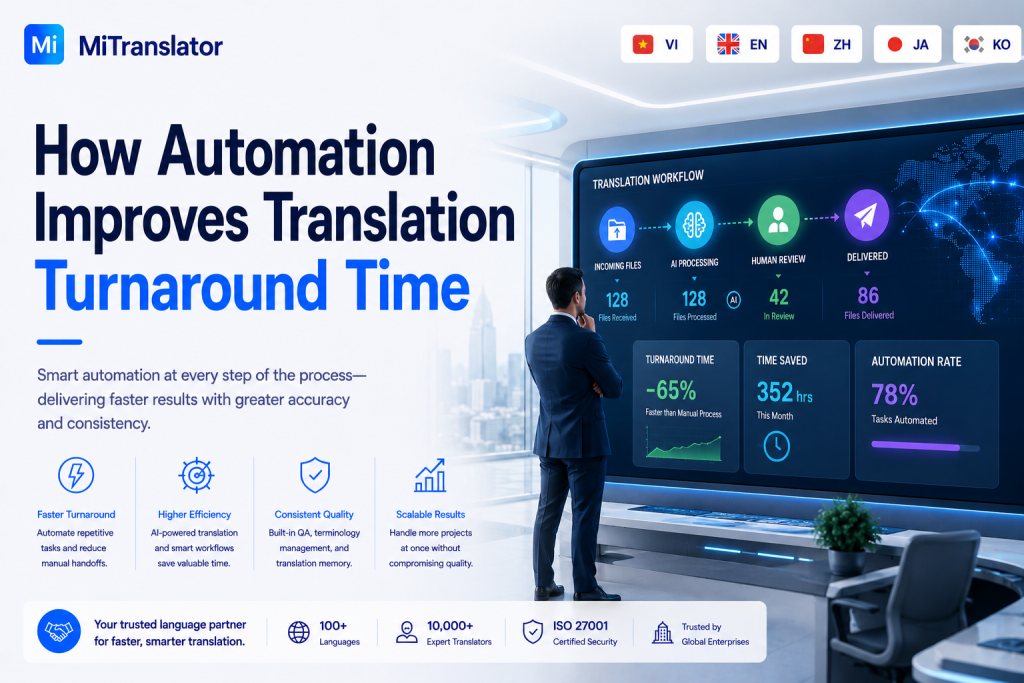
To meet these demands, translation providers and enterprises are turning to automation technologies. Automation has transformed many aspects of the translation process, helping streamline workflows, reduce manual tasks, improve project visibility, and accelerate delivery schedules.
While professional human translators remain essential for ensuring linguistic accuracy and cultural appropriateness, automation plays a critical role in improving efficiency and reducing turnaround times throughout the translation lifecycle.
What Is Translation Automation?
Translation automation refers to the use of technology to streamline and automate repetitive tasks associated with translation projects.
Rather than replacing human translators, automation supports them by handling administrative, technical, and workflow-related processes more efficiently.
Examples of translation automation include:
- Automated project creation
- File processing automation
- Translation memory utilization
- Workflow routing
- Automated notifications
- Quality assurance checks
- Content synchronization
- Project tracking and reporting
By reducing manual intervention, automation allows translation teams to focus more on linguistic quality and less on operational tasks.
Why Turnaround Time Matters
Businesses often require rapid translation services for a variety of reasons.
Global Product Launches
Companies launching products internationally must prepare multilingual documentation simultaneously across multiple markets.
Regulatory Deadlines
Organizations frequently face strict submission deadlines for compliance reports, licensing applications, and regulatory filings.
International Business Transactions
Mergers, acquisitions, investments, and legal proceedings often require urgent document translation.
Customer Support
Global businesses need timely translation of support content, FAQs, and service documentation to maintain customer satisfaction.
Competitive Advantage
Faster multilingual communication enables organizations to respond more quickly to market opportunities and customer demands.
Reducing translation turnaround time can directly impact business performance and operational efficiency.
Traditional Translation Workflows
Before the widespread adoption of automation, many translation projects relied heavily on manual processes.
Typical steps included:
- Receiving files by email
- Manually creating projects
- Assigning translators
- Tracking progress through spreadsheets
- Sending files between stakeholders
- Performing manual quality checks
- Delivering completed translations
These workflows often introduced delays, especially when managing multiple projects or large document volumes.
How Automation Accelerates Translation Projects
Automated Project Creation
Translation management systems can automatically generate projects as soon as files are received.
Automation can:
- Create project records
- Assign workflows
- Generate deadlines
- Allocate resources
- Notify team members
This eliminates time-consuming administrative tasks and allows projects to begin immediately.
Faster File Processing
Many documents require preparation before translation begins.
Automation tools can quickly process:
- Microsoft Office files
- PDFs
- XML files
- HTML content
- Software resource files
- Content management system exports
Automated file handling reduces preparation time and minimizes human error.
Translation Memory Technology
Translation memory is one of the most effective tools for reducing turnaround times.
The system stores previously translated content and automatically suggests approved translations when similar text appears in future projects.
Benefits include:
- Less repetitive translation work
- Faster completion of recurring content
- Greater consistency
- Reduced review requirements
Organizations with extensive translation memory databases often experience substantial productivity gains.
Automated Workflow Routing
Translation projects frequently involve multiple participants, including:
- Translators
- Editors
- Reviewers
- Subject-matter experts
- Project managers
Automation can automatically move content through each stage of the workflow without requiring manual coordination.
This reduces bottlenecks and keeps projects moving efficiently.
Real-Time Project Tracking
Automated project management systems provide visibility into project status and progress.
Project managers can monitor:
- Completed tasks
- Pending reviews
- Delivery schedules
- Resource allocation
This visibility helps identify and address potential delays before they affect delivery deadlines.
Automation and Quality Assurance
Faster delivery should never come at the expense of quality.
Fortunately, automation can also improve quality control processes.
Automated Quality Checks
Quality assurance tools can automatically identify:
- Missing translations
- Inconsistent terminology
- Number mismatches
- Formatting issues
- Spelling errors
- Punctuation inconsistencies
These checks help detect potential problems earlier in the process.
Terminology Verification
Automation tools can compare translations against approved terminology databases.
This helps maintain consistency across documents and reduces the need for extensive manual review.
Version Control
Automated systems help manage document versions and reduce confusion caused by multiple file revisions.
This is especially valuable for large enterprise projects involving numerous stakeholders.
Automation in Website and Software Localization
Automation has become particularly important for digital content.
Website Localization
Modern localization platforms can automatically:
- Detect website updates
- Extract new content
- Route content for translation
- Reintegrate translated text
This allows businesses to maintain multilingual websites more efficiently.
Software Localization
Software development teams often use automation to streamline localization workflows.
Benefits include:
- Continuous localization
- Faster release cycles
- Reduced manual file handling
- Improved consistency
Automation supports agile development environments where content changes frequently.
Business Benefits Beyond Faster Turnaround
Improved Scalability
Automation allows organizations to manage larger translation volumes without proportionally increasing administrative resources.
Reduced Operational Costs
By eliminating repetitive manual tasks, automation improves productivity and helps reduce overall project costs.
Better Resource Allocation
Project managers can focus on strategic activities rather than routine administrative tasks.
Greater Transparency
Automated reporting provides stakeholders with clear visibility into project performance and timelines.
Consistent Processes
Standardized workflows help ensure that projects are managed consistently across departments, regions, and languages.
Common Misconceptions About Translation Automation
Automation Replaces Human Translators
This is one of the most common misconceptions.
Automation improves efficiency but does not replace the expertise required for:
- Legal translation
- Financial translation
- Technical translation
- Medical translation
- Marketing localization
- Regulatory documentation
Human translators remain essential for context, accuracy, and cultural adaptation.
Faster Means Lower Quality
When implemented properly, automation can improve both speed and quality through enhanced workflow management and automated quality checks.
Automation Only Benefits Large Enterprises
Organizations of all sizes can benefit from automation, particularly those that regularly manage multilingual content.
Industries That Benefit Most from Translation Automation
Manufacturing
Manufacturers frequently translate technical documentation, safety instructions, and product manuals.
Technology
Software companies rely heavily on automation to support continuous localization.
Financial Services
Financial institutions often manage large volumes of regulatory and reporting documentation.
Healthcare
Healthcare organizations require timely translation of regulatory submissions, patient information, and compliance materials.
Legal Services
Law firms and corporate legal departments benefit from faster processing of contracts and legal documentation.
E-Commerce
Online retailers use automation to manage multilingual product catalogs and customer-facing content.
How MITRANS Uses Automation to Improve Translation Efficiency
MITRANS combines experienced professional translators with modern translation technologies to deliver accurate and efficient language solutions.
Our workflow incorporates:
- Translation memory systems
- Terminology management tools
- Automated project tracking
- Quality assurance technology
- Secure digital document management
- Workflow automation
These technologies help us reduce turnaround times while maintaining the accuracy, consistency, and confidentiality required for professional translation projects.
MITRANS supports a wide range of content, including:
- Legal documents
- Financial reports
- Corporate records
- Technical manuals
- Immigration documents
- Academic records
- Regulatory submissions
We provide services across major language pairs, including:
- English ↔ Vietnamese
- Chinese ↔ Vietnamese
- Japanese ↔ Vietnamese
- Korean ↔ Vietnamese
- English ↔ Chinese
- English ↔ Japanese
- English ↔ Korean
Frequently Asked Questions
What is translation automation?
Translation automation involves using technology to streamline administrative tasks, workflows, file processing, quality checks, and content management throughout the translation process.
Does automation replace professional translators?
No. Automation improves efficiency, but human translators remain essential for ensuring accuracy, context, compliance, and cultural appropriateness.
How does translation memory improve turnaround time?
Translation memory stores previously translated content and automatically suggests approved translations for similar text, reducing repetitive work and accelerating project completion.
Can automation improve translation quality?
Yes. Automated quality assurance tools help identify errors, inconsistencies, and formatting issues before delivery.
Which industries benefit most from translation automation?
Manufacturing, technology, healthcare, legal services, financial services, and e-commerce organizations often achieve significant efficiency gains through translation automation.
Contact MITRANS for Professional Translation Services
Professional translation plays a critical role in ensuring accuracy, compliance, and effective communication across international business activities. Whether you require translation for legal, financial, technical, corporate, immigration, or regulatory documents, MITRANS is ready to help.
Contact MITRANS today for fast, accurate, and professional translation services tailored to your business and documentation requirements.