
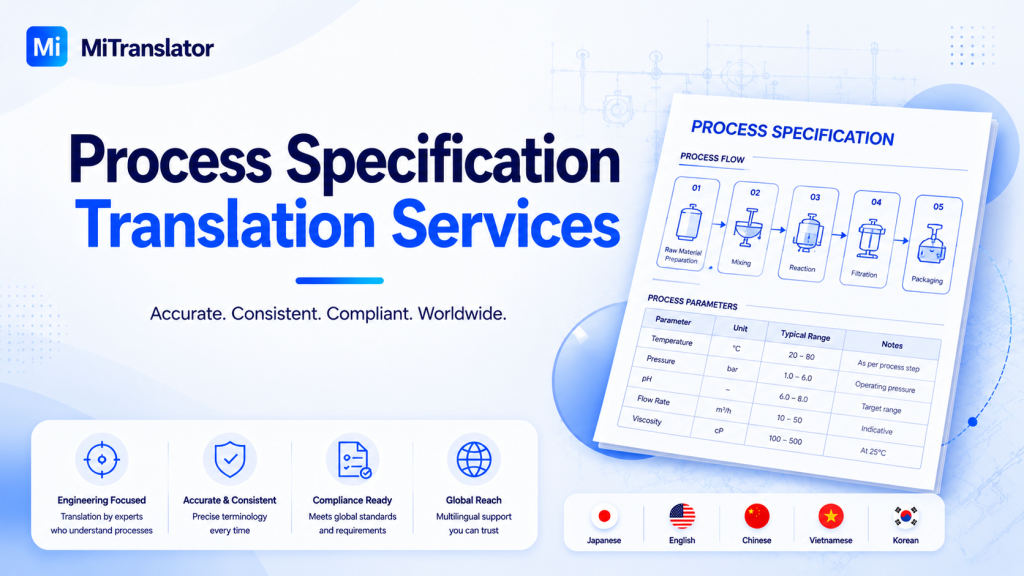
In today’s global manufacturing and engineering industries, process specifications are essential documents that ensure products are manufactured consistently, safely, and according to established quality standards. As companies expand internationally, work with overseas suppliers, or manage multilingual production facilities, accurate process specification translation becomes critical for maintaining operational efficiency and compliance.
Professional process specification translation services help manufacturers and engineering companies communicate technical requirements clearly across languages, reducing production errors, improving quality control, and supporting international collaboration.
What Are Process Specifications?
Process specifications are technical documents that define how a manufacturing process, engineering procedure, or production activity should be performed. These documents provide detailed instructions regarding materials, equipment, operating conditions, quality requirements, and process controls.
Unlike general technical documents, process specifications directly influence production outcomes and product quality.
Common process specification documents include:
- Manufacturing process specifications
- Welding procedures
- Surface treatment specifications
- Heat treatment procedures
- Coating specifications
- Assembly process instructions
- Quality control requirements
- Inspection procedures
- Testing specifications
- Production standards
- Engineering process documentation
- Validation procedures
Because these documents guide critical operations, accurate translation is essential.
Why Process Specification Translation Matters
Maintaining Product Quality
Process specifications establish standardized methods for manufacturing products. Accurate translation ensures that production teams in different locations follow the same requirements and quality standards.
Supporting Global Manufacturing Operations
Many manufacturers operate facilities in multiple countries or outsource production to international suppliers. Translated process specifications help maintain consistency across global operations.
Reducing Production Errors
Misunderstood technical requirements can lead to defects, rework, production delays, and increased operational costs.
Professional translation helps ensure that every requirement is communicated clearly.
Supporting Compliance and Audits
Many industries require documented process controls to comply with quality standards, customer requirements, and regulatory obligations.
Accurate translations support successful audits and compliance reviews.
Types of Process Specifications Commonly Requiring Translation
Manufacturing Process Specifications
These documents describe the methods, materials, equipment, and process parameters required to manufacture products consistently.
Examples include:
- Injection molding specifications
- Machining procedures
- Assembly processes
- Packaging requirements
- Production workflows
Welding Procedure Specifications (WPS)
Welding specifications define welding methods, materials, and quality requirements.
These documents are commonly used in:
- Construction
- Shipbuilding
- Energy projects
- Heavy manufacturing
- Industrial fabrication
Surface Treatment and Coating Specifications
Many products require special finishing processes such as:
- Painting
- Powder coating
- Galvanization
- Anodizing
- Surface protection treatments
Accurate translation helps ensure process compliance and product durability.
Quality Control Procedures
Quality-related specifications may include:
- Inspection criteria
- Acceptance standards
- Testing methods
- Measurement requirements
- Corrective action procedures
Engineering and Validation Documentation
Engineering companies often require translation of process validation reports, qualification procedures, and technical specifications to support project execution and compliance.
Common Challenges in Process Specification Translation
Highly Specialized Technical Terminology
Process specifications often contain industry-specific terminology related to engineering, manufacturing technologies, materials, and production equipment.
Translators must understand the technical context to ensure accuracy.
Consistency Across Large Documentation Sets
Manufacturing companies often maintain hundreds of process documents.
Consistent terminology is essential across:
- Specifications
- SOPs
- Work instructions
- Quality manuals
- Technical drawings
Industry-Specific Requirements
Different sectors use unique terminology and standards, including:
- Automotive manufacturing
- Aerospace
- Electronics
- Medical devices
- Construction
- Energy
- Oil and gas
- Industrial equipment
Complex Formatting
Process specifications frequently include:
- Flowcharts
- Process diagrams
- Tables
- Technical drawings
- Control plans
- Acceptance criteria
Translations must preserve both content and usability.
Risks of Poorly Translated Process Specifications
Product Defects
Incorrectly translated process requirements can result in inconsistent manufacturing outcomes and quality issues.
Increased Production Costs
Misunderstandings may lead to material waste, rework, equipment downtime, and delayed deliveries.
Audit Findings
Inaccurate documentation can create non-conformities during customer audits, ISO audits, and regulatory inspections.
Safety Risks
Certain process specifications include safety-critical requirements that must be understood precisely by operators and technicians.
Communication Breakdowns
Translation errors can disrupt collaboration between engineering teams, production facilities, suppliers, and customers.
Best Practices for Process Specification Translation
Work with Technical Translation Specialists
Professional translators with engineering and manufacturing expertise can accurately interpret technical terminology and process requirements.
Establish Terminology Management
Approved glossaries and translation memories help maintain consistency across all manufacturing and engineering documents.
Implement Multi-Step Quality Assurance
A professional process specification translation workflow should include:
- Translation
- Technical terminology review
- Editing and proofreading
- Formatting verification
- Final quality assurance review
Preserve Original Structure
Technical tables, process diagrams, numbering systems, and acceptance criteria should remain consistent with the source document.
Maintain Confidentiality
Process specifications often contain proprietary manufacturing methods and intellectual property that require strict confidentiality protection.
Industries That Commonly Require Process Specification Translation
Process specification translation is frequently required in:
- Manufacturing
- Automotive
- Aerospace
- Electronics
- Medical device production
- Industrial equipment manufacturing
- Construction and engineering
- Energy and utilities
- Oil and gas
- Food processing
These industries rely on precise documentation to maintain product quality, safety, and compliance.
How MITRANS Supports Manufacturing and Engineering Companies
MITRANS provides professional process specification translation services for manufacturers, engineering firms, industrial contractors, and multinational organizations operating in Vietnam and global markets.
Our services include translation of:
- Manufacturing specifications
- Engineering procedures
- Welding specifications
- Quality control documents
- Process validation reports
- Technical standards
- Production instructions
- Inspection procedures
- Testing documentation
- Industrial process manuals
MITRANS supports major language pairs commonly used in industrial environments, including:
- English ↔ Vietnamese
- Chinese ↔ Vietnamese
- Korean ↔ Vietnamese
- Japanese ↔ Vietnamese
Our experienced technical translators combine engineering knowledge with linguistic expertise to deliver accurate, reliable, and industry-specific translations.
Frequently Asked Questions
Why is process specification translation important?
Accurate translation helps ensure product quality, operational consistency, regulatory compliance, and effective communication across international manufacturing operations.
Can MITRANS translate engineering process documentation?
Yes. MITRANS supports the translation of manufacturing specifications, engineering procedures, validation reports, and technical documentation.
How does MITRANS ensure technical accuracy?
We use specialized technical translators, terminology management systems, and multi-level quality assurance procedures to maintain accuracy and consistency.
Can process specifications retain their original formatting after translation?
Yes. We preserve document structures, tables, diagrams, and process flows whenever possible.
Is confidential manufacturing information protected?
Absolutely. MITRANS follows strict confidentiality procedures and secure document handling practices to protect proprietary information.
Contact MITRANS for Process Specification Translation Services
Accurate process specification translation is essential for maintaining product quality, operational efficiency, regulatory compliance, and successful international collaboration. If your organization requires professional translation of manufacturing specifications, engineering procedures, quality control documentation, validation reports, or other technical materials, MITRANS is ready to support you.
Contact MITRANS today for fast, accurate, and professional process specification translation services tailored to the needs of manufacturing and engineering companies.
Process Specification Translation Services for Manufacturing and Engineering Companies
In today’s global manufacturing and engineering industries, process specifications are essential documents that ensure products are manufactured consistently, safely, and according to established quality standards. As companies expand internationally, work with overseas suppliers, or manage multilingual production facilities, accurate process specification translation becomes critical for maintaining operational efficiency and compliance.
Professional process specification translation services help manufacturers and engineering companies communicate technical requirements clearly across languages, reducing production errors, improving quality control, and supporting international collaboration.
What Are Process Specifications?
Process specifications are technical documents that define how a manufacturing process, engineering procedure, or production activity should be performed. These documents provide detailed instructions regarding materials, equipment, operating conditions, quality requirements, and process controls.
Unlike general technical documents, process specifications directly influence production outcomes and product quality.
Common process specification documents include:
- Manufacturing process specifications
- Welding procedures
- Surface treatment specifications
- Heat treatment procedures
- Coating specifications
- Assembly process instructions
- Quality control requirements
- Inspection procedures
- Testing specifications
- Production standards
- Engineering process documentation
- Validation procedures
Because these documents guide critical operations, accurate translation is essential.
Why Process Specification Translation Matters
Maintaining Product Quality
Process specifications establish standardized methods for manufacturing products. Accurate translation ensures that production teams in different locations follow the same requirements and quality standards.
Supporting Global Manufacturing Operations
Many manufacturers operate facilities in multiple countries or outsource production to international suppliers. Translated process specifications help maintain consistency across global operations.
Reducing Production Errors
Misunderstood technical requirements can lead to defects, rework, production delays, and increased operational costs.
Professional translation helps ensure that every requirement is communicated clearly.
Supporting Compliance and Audits
Many industries require documented process controls to comply with quality standards, customer requirements, and regulatory obligations.
Accurate translations support successful audits and compliance reviews.
Types of Process Specifications Commonly Requiring Translation
Manufacturing Process Specifications
These documents describe the methods, materials, equipment, and process parameters required to manufacture products consistently.
Examples include:
- Injection molding specifications
- Machining procedures
- Assembly processes
- Packaging requirements
- Production workflows
Welding Procedure Specifications (WPS)
Welding specifications define welding methods, materials, and quality requirements.
These documents are commonly used in:
- Construction
- Shipbuilding
- Energy projects
- Heavy manufacturing
- Industrial fabrication
Surface Treatment and Coating Specifications
Many products require special finishing processes such as:
- Painting
- Powder coating
- Galvanization
- Anodizing
- Surface protection treatments
Accurate translation helps ensure process compliance and product durability.
Quality Control Procedures
Quality-related specifications may include:
- Inspection criteria
- Acceptance standards
- Testing methods
- Measurement requirements
- Corrective action procedures
Engineering and Validation Documentation
Engineering companies often require translation of process validation reports, qualification procedures, and technical specifications to support project execution and compliance.
Common Challenges in Process Specification Translation
Highly Specialized Technical Terminology
Process specifications often contain industry-specific terminology related to engineering, manufacturing technologies, materials, and production equipment.
Translators must understand the technical context to ensure accuracy.
Consistency Across Large Documentation Sets
Manufacturing companies often maintain hundreds of process documents.
Consistent terminology is essential across:
- Specifications
- SOPs
- Work instructions
- Quality manuals
- Technical drawings
Industry-Specific Requirements
Different sectors use unique terminology and standards, including:
- Automotive manufacturing
- Aerospace
- Electronics
- Medical devices
- Construction
- Energy
- Oil and gas
- Industrial equipment
Complex Formatting
Process specifications frequently include:
- Flowcharts
- Process diagrams
- Tables
- Technical drawings
- Control plans
- Acceptance criteria
Translations must preserve both content and usability.
Risks of Poorly Translated Process Specifications
Product Defects
Incorrectly translated process requirements can result in inconsistent manufacturing outcomes and quality issues.
Increased Production Costs
Misunderstandings may lead to material waste, rework, equipment downtime, and delayed deliveries.
Audit Findings
Inaccurate documentation can create non-conformities during customer audits, ISO audits, and regulatory inspections.
Safety Risks
Certain process specifications include safety-critical requirements that must be understood precisely by operators and technicians.
Communication Breakdowns
Translation errors can disrupt collaboration between engineering teams, production facilities, suppliers, and customers.
Best Practices for Process Specification Translation
Work with Technical Translation Specialists
Professional translators with engineering and manufacturing expertise can accurately interpret technical terminology and process requirements.
Establish Terminology Management
Approved glossaries and translation memories help maintain consistency across all manufacturing and engineering documents.
Implement Multi-Step Quality Assurance
A professional process specification translation workflow should include:
- Translation
- Technical terminology review
- Editing and proofreading
- Formatting verification
- Final quality assurance review
Preserve Original Structure
Technical tables, process diagrams, numbering systems, and acceptance criteria should remain consistent with the source document.
Maintain Confidentiality
Process specifications often contain proprietary manufacturing methods and intellectual property that require strict confidentiality protection.
Industries That Commonly Require Process Specification Translation
Process specification translation is frequently required in:
- Manufacturing
- Automotive
- Aerospace
- Electronics
- Medical device production
- Industrial equipment manufacturing
- Construction and engineering
- Energy and utilities
- Oil and gas
- Food processing
These industries rely on precise documentation to maintain product quality, safety, and compliance.
How MITRANS Supports Manufacturing and Engineering Companies
MITRANS provides professional process specification translation services for manufacturers, engineering firms, industrial contractors, and multinational organizations operating in Vietnam and global markets.
Our services include translation of:
- Manufacturing specifications
- Engineering procedures
- Welding specifications
- Quality control documents
- Process validation reports
- Technical standards
- Production instructions
- Inspection procedures
- Testing documentation
- Industrial process manuals
MITRANS supports major language pairs commonly used in industrial environments, including:
- English ↔ Vietnamese
- Chinese ↔ Vietnamese
- Korean ↔ Vietnamese
- Japanese ↔ Vietnamese
Our experienced technical translators combine engineering knowledge with linguistic expertise to deliver accurate, reliable, and industry-specific translations.
Frequently Asked Questions
Why is process specification translation important?
Accurate translation helps ensure product quality, operational consistency, regulatory compliance, and effective communication across international manufacturing operations.
Can MITRANS translate engineering process documentation?
Yes. MITRANS supports the translation of manufacturing specifications, engineering procedures, validation reports, and technical documentation.
How does MITRANS ensure technical accuracy?
We use specialized technical translators, terminology management systems, and multi-level quality assurance procedures to maintain accuracy and consistency.
Can process specifications retain their original formatting after translation?
Yes. We preserve document structures, tables, diagrams, and process flows whenever possible.
Is confidential manufacturing information protected?
Absolutely. MITRANS follows strict confidentiality procedures and secure document handling practices to protect proprietary information.
Contact MITRANS for Process Specification Translation Services
Accurate process specification translation is essential for maintaining product quality, operational efficiency, regulatory compliance, and successful international collaboration. If your organization requires professional translation of manufacturing specifications, engineering procedures, quality control documentation, validation reports, or other technical materials, MITRANS is ready to support you.
Contact MITRANS today for fast, accurate, and professional process specification translation services tailored to the needs of manufacturing and engineering companies.