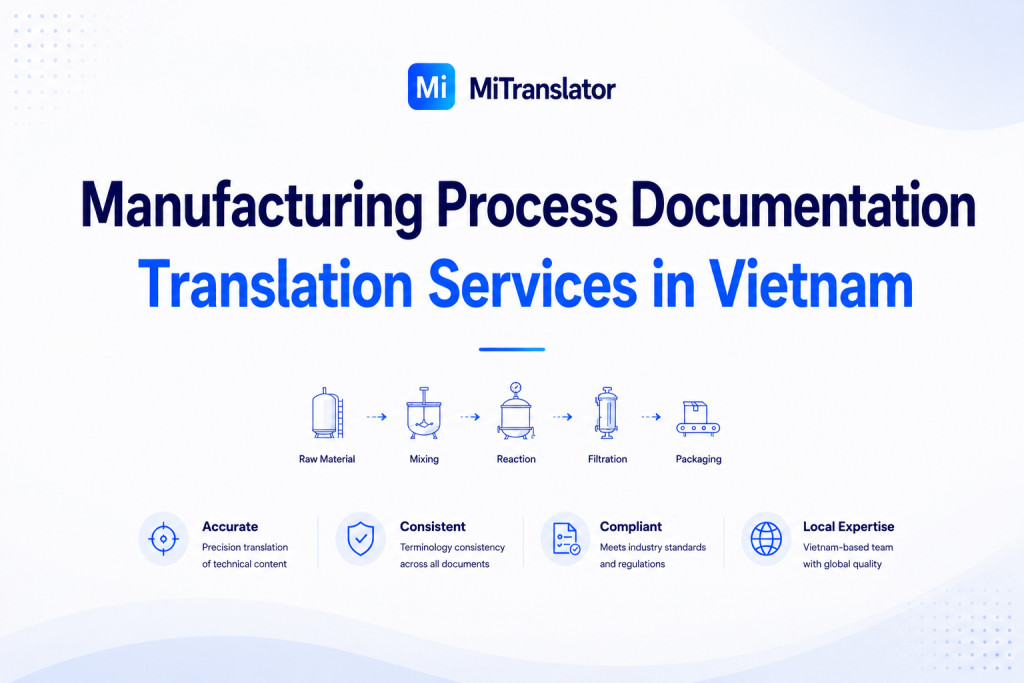
As Vietnam continues to strengthen its position as a global manufacturing hub, international companies increasingly rely on accurate technical documentation to manage production operations, maintain quality standards, and support compliance requirements. Manufacturing process documentation serves as the foundation for consistent production, employee training, quality assurance, and operational efficiency.
For multinational manufacturers, suppliers, and industrial organizations operating in Vietnam, professional manufacturing process documentation translation services are essential for ensuring that critical information is communicated clearly across languages and departments.
What Is Manufacturing Process Documentation?
Manufacturing process documentation refers to the collection of technical documents that define how products should be manufactured, inspected, tested, and controlled throughout the production lifecycle.
These documents help ensure that every employee, technician, engineer, and quality specialist follows standardized procedures and requirements.
Common manufacturing process documents include:
- Standard Operating Procedures (SOPs)
- Work instructions
- Process specifications
- Production procedures
- Quality control plans
- Inspection procedures
- Process flowcharts
- Equipment operating instructions
- Manufacturing manuals
- Validation protocols
- Process audit reports
- Training materials
Because these documents directly impact product quality and operational performance, accurate translation is critical.
Why Manufacturing Process Documentation Translation Matters
Maintaining Production Consistency
Manufacturing companies often operate across multiple locations and employ multilingual workforces. Accurate translation ensures that production procedures are implemented consistently regardless of language differences.
When operators follow the same documented procedures, organizations can achieve greater process stability and product quality.
Supporting Quality Management Systems
Manufacturing documentation plays a central role in quality management programs.
Accurate translations help organizations comply with:
- ISO 9001
- IATF 16949
- ISO 13485
- ISO 22000
- GMP requirements
- Customer-specific standards
Clear documentation helps ensure that quality requirements are understood and followed throughout the organization.
Improving Employee Training
Translated manufacturing documents help employees understand production requirements, operating procedures, and quality expectations more effectively.
This improves:
- Onboarding efficiency
- Workforce competency
- Training consistency
- Operational performance
Supporting International Manufacturing Operations
Many factories in Vietnam operate under the management of foreign-invested companies from Japan, South Korea, China, Europe, and North America.
Professional translation helps bridge communication gaps between headquarters and local production teams.
Types of Manufacturing Process Documents That Commonly Require Translation
Standard Operating Procedures (SOPs)
SOPs are among the most frequently translated manufacturing documents.
These documents define:
- Process steps
- Employee responsibilities
- Operating requirements
- Safety measures
- Quality controls
Work Instructions
Work instructions provide detailed guidance for specific tasks and production activities.
Examples include:
- Assembly instructions
- Machine operation procedures
- Packaging requirements
- Equipment setup instructions
Quality Control Documentation
Quality-related documentation often includes:
- Inspection standards
- Acceptance criteria
- Testing procedures
- Quality audit checklists
- Corrective action reports
Accurate translation helps maintain quality consistency across production facilities.
Manufacturing Specifications
Process specifications define technical requirements related to:
- Materials
- Equipment settings
- Production parameters
- Tolerances
- Product characteristics
Safety and Compliance Documentation
Manufacturing facilities rely on safety documentation to protect employees and comply with regulations.
Examples include:
- Safety procedures
- Emergency response plans
- Hazard communication documents
- Risk assessments
Common Challenges in Manufacturing Documentation Translation
Technical Terminology
Manufacturing documents contain specialized terminology related to engineering, production processes, machinery, automation, and quality management.
Translators must understand both the language and technical context.
Consistency Across Large Document Sets
A manufacturing operation may maintain hundreds of interconnected documents.
Consistent terminology is essential across:
- SOPs
- Work instructions
- Specifications
- Quality manuals
- Audit records
Industry-Specific Requirements
Different industries use specialized terminology and standards.
Common sectors requiring manufacturing documentation translation include:
- Electronics manufacturing
- Automotive production
- Medical device manufacturing
- Industrial equipment
- Food processing
- Pharmaceutical production
- Aerospace manufacturing
Complex Formatting
Manufacturing documents often include:
- Process flowcharts
- Technical diagrams
- Tables
- Checklists
- Visual work instructions
- Equipment illustrations
Translations should preserve both accuracy and usability.
Risks of Poorly Translated Manufacturing Documentation
Production Errors
Misunderstood instructions can result in process deviations, defects, and production inefficiencies.
Quality Issues
Incorrectly translated specifications may affect product quality and increase rejection rates.
Safety Incidents
Poorly translated safety instructions can increase workplace risks and compliance concerns.
Audit Findings
Translation inconsistencies can lead to non-conformities during internal, customer, or certification audits.
Increased Costs
Operational mistakes caused by unclear documentation may result in rework, downtime, material waste, and delayed deliveries.
Best Practices for Manufacturing Process Documentation Translation
Use Manufacturing Translation Specialists
Professional translators with manufacturing expertise understand production terminology and operational requirements.
Develop Approved Terminology Glossaries
Terminology management helps maintain consistency across all manufacturing documents and future revisions.
Implement Multi-Step Quality Assurance
A professional manufacturing documentation translation process should include:
- Translation
- Technical terminology review
- Editing and proofreading
- Formatting verification
- Final quality assurance review
Preserve Original Structure
Document numbering, process flows, diagrams, and revision controls should remain consistent after translation.
Protect Proprietary Information
Manufacturing documentation often contains confidential processes and intellectual property that require secure handling.
Industries That Benefit from Manufacturing Documentation Translation
Manufacturing process documentation translation is particularly valuable for:
- Electronics manufacturers
- Automotive suppliers
- Medical device companies
- Industrial equipment manufacturers
- Food and beverage producers
- Pharmaceutical companies
- Aerospace suppliers
- Contract manufacturers
- Logistics and warehouse operations
These organizations rely on clear documentation to maintain quality, efficiency, and compliance.
How MITRANS Supports Manufacturing Documentation Translation in Vietnam
MITRANS provides professional manufacturing process documentation translation services for factories, engineering companies, industrial organizations, and multinational corporations operating in Vietnam.
Our services include translation of:
- SOPs
- Work instructions
- Process specifications
- Quality manuals
- Audit reports
- Manufacturing procedures
- Technical manuals
- Safety documentation
- Validation protocols
- Training materials
MITRANS supports major language pairs commonly used in Vietnam’s manufacturing sector, including:
- English ↔ Vietnamese
- Korean ↔ Vietnamese
- Japanese ↔ Vietnamese
- Chinese ↔ Vietnamese
Our experienced technical translators combine manufacturing knowledge with linguistic expertise to deliver accurate, consistent, and professional translations.
Frequently Asked Questions
Why is manufacturing documentation translation important?
Accurate translation helps ensure production consistency, quality control, employee safety, compliance, and effective communication across multilingual operations.
Can MITRANS translate SOPs and work instructions?
Yes. MITRANS regularly translates SOPs, work instructions, process specifications, quality documents, and manufacturing manuals.
How does MITRANS ensure terminology consistency?
We use terminology databases, translation memories, and multi-level review processes to maintain consistency across all documents.
Can translated documents preserve diagrams and formatting?
Yes. We maintain document structures, flowcharts, tables, and visual elements whenever possible.
Is confidential manufacturing information protected?
Absolutely. MITRANS follows strict confidentiality procedures and secure document management practices to protect client information.
Contact MITRANS for Manufacturing Process Documentation Translation Services in Vietnam
Accurate manufacturing process documentation translation is essential for maintaining quality standards, operational efficiency, workforce training, and regulatory compliance. If your organization requires professional translation of SOPs, work instructions, process specifications, quality manuals, technical procedures, or other manufacturing documents, MITRANS is ready to support you.
Contact MITRANS today for fast, accurate, and professional manufacturing process documentation translation services tailored to your industry and operational requirements.