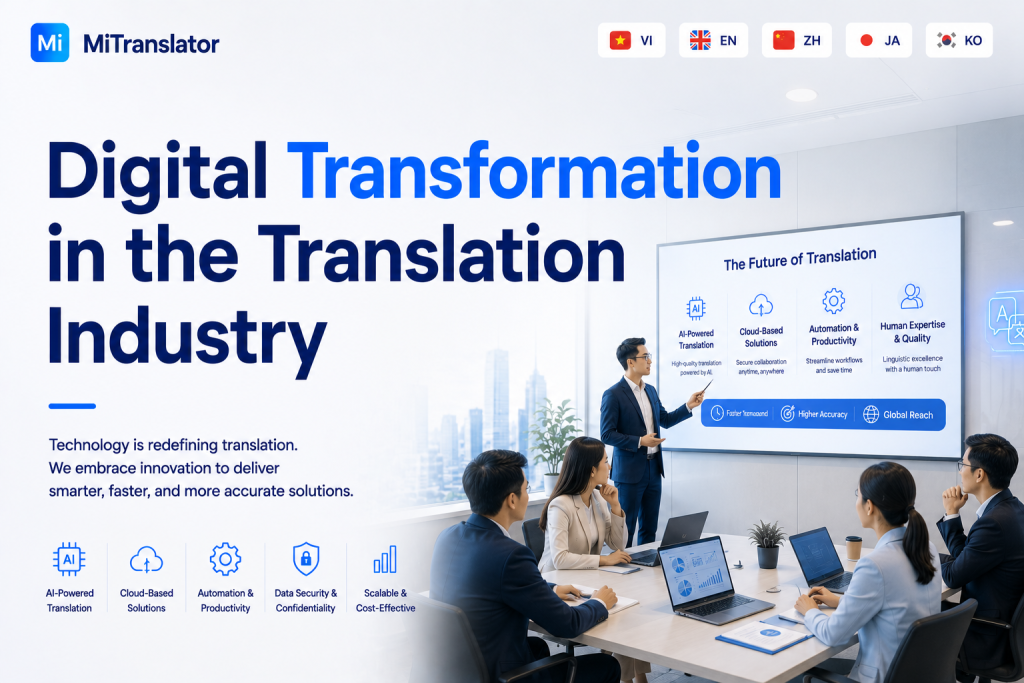
Digital transformation is reshaping industries across the global economy, and the translation industry is no exception. As businesses expand internationally and multilingual communication becomes increasingly important, translation service providers are adopting new technologies, digital workflows, and automation tools to improve efficiency, scalability, and service quality.
The translation industry has evolved significantly from traditional paper-based processes and manual project management. Today, cloud-based platforms, artificial intelligence (AI), translation management systems, automation technologies, and collaborative digital environments are transforming how translation projects are managed and delivered.
For businesses operating in global markets, understanding digital transformation in the translation industry is essential for selecting the right language service partners and developing effective multilingual communication strategies.
What Is Digital Transformation in the Translation Industry?
Digital transformation in the translation industry refers to the integration of digital technologies into translation workflows, project management processes, content localization strategies, and client service delivery.
Rather than relying solely on manual translation processes, modern translation providers use technology to streamline operations, improve consistency, enhance collaboration, and manage large volumes of multilingual content.
Digital transformation affects virtually every aspect of translation services, including:
- Project management
- Content processing
- Translation workflows
- Quality assurance
- Client communication
- Terminology management
- Content localization
- Document delivery
The goal is not to replace human expertise but to improve efficiency while maintaining translation quality.
Why Digital Transformation Matters in Translation
Growing Demand for Multilingual Content
Global businesses now publish content across multiple platforms and markets simultaneously.
Organizations routinely require translation for:
- Websites
- Mobile applications
- Legal documents
- Financial reports
- Technical manuals
- E-commerce platforms
- Marketing campaigns
- Customer support materials
Traditional workflows often struggle to keep pace with the increasing volume and speed of content creation.
Faster Turnaround Expectations
Businesses expect translation projects to be completed more quickly than ever before.
Digital workflows help reduce administrative delays and improve project efficiency.
Need for Consistency Across Markets
Global brands require consistent messaging, terminology, and customer experiences across multiple languages.
Technology helps translation teams maintain this consistency more effectively.
Increasing Regulatory Complexity
Organizations operating internationally must manage multilingual compliance documentation and regulatory filings.
Digital systems help support accuracy and document control in regulated environments.
Key Technologies Driving Digital Transformation
Translation Management Systems (TMS)
A Translation Management System is one of the most important technologies in the modern translation industry.
TMS platforms help manage:
- Translation workflows
- Project assignments
- File handling
- Progress tracking
- Quality control
- Client communication
Benefits include:
- Improved efficiency
- Better visibility
- Faster turnaround times
- Enhanced collaboration
Translation Memory Technology
Translation memory stores previously translated content and automatically suggests approved translations when similar text appears in future projects.
Advantages include:
- Greater consistency
- Reduced translation costs
- Faster delivery
- Improved quality control
Translation memory is particularly valuable for organizations that frequently translate recurring content.
Artificial Intelligence and Machine Translation
AI-powered translation tools have advanced significantly in recent years.
Machine translation can assist with:
- Large-volume content processing
- Initial translation drafts
- Internal communications
- Content categorization
- Workflow automation
However, human review remains essential for legal, financial, technical, healthcare, immigration, and compliance-sensitive content.
Optical Character Recognition (OCR)
OCR technology converts scanned documents, PDFs, and images into editable text.
This technology is widely used for:
- Certificates
- Legal documents
- Government records
- Historical archives
- Technical documentation
OCR improves efficiency by reducing manual data entry requirements.
Cloud-Based Collaboration Platforms
Cloud technology enables translators, editors, project managers, and clients to collaborate in real time regardless of location.
Benefits include:
- Remote accessibility
- Faster communication
- Secure document sharing
- Improved project coordination
How Digital Transformation Is Changing Translation Workflows
Traditional Workflow
Historically, translation projects often involved:
- Manual document submission
- Email-based communication
- Spreadsheet tracking
- Multiple file versions
- Limited project visibility
These processes were often time-consuming and difficult to scale.
Modern Digital Workflow
Today’s translation projects often include:
- Online document submission
- Automated project setup
- Centralized terminology databases
- Cloud-based collaboration
- Automated quality checks
- Digital delivery platforms
These improvements allow providers to manage larger workloads more efficiently while maintaining quality standards.
Benefits of Digital Transformation for Clients
Faster Project Delivery
Automation reduces administrative tasks and allows translation teams to focus on linguistic work.
Improved Consistency
Technology helps maintain terminology consistency across projects, languages, and business units.
Better Scalability
Organizations can manage increasing volumes of multilingual content without significantly increasing administrative complexity.
Enhanced Transparency
Digital platforms provide clients with greater visibility into project status, timelines, and deliverables.
Cost Efficiency
Technology-driven workflows help reduce repetitive work and improve resource utilization.
Improved Data Management
Centralized systems make it easier to store, retrieve, and manage multilingual content over time.
Challenges of Digital Transformation in Translation
Maintaining Human Quality Standards
While automation improves efficiency, human expertise remains critical for ensuring translation accuracy and contextual understanding.
Overreliance on technology may create quality risks for sensitive content.
Data Security and Confidentiality
Translation projects often involve confidential information such as:
- Legal contracts
- Financial statements
- Corporate records
- Medical documentation
- Personal data
Translation providers must implement strong cybersecurity and data protection measures.
Technology Integration Costs
Implementing advanced translation technologies requires investment in software, training, infrastructure, and workflow redesign.
Managing Change
Organizations may face challenges adapting to new technologies and digital working methods.
Successful digital transformation requires both technological and operational change management.
Industries Benefiting Most from Digital Translation Solutions
Digital transformation has had a significant impact across many sectors.
Legal Services
Law firms and corporate legal departments increasingly use digital translation workflows for contracts, compliance records, and litigation documentation.
Financial Services
Banks, insurers, and investment firms rely on multilingual financial reporting and regulatory compliance documentation.
Manufacturing
Manufacturers frequently translate product manuals, technical specifications, safety documentation, and supplier communications.
Healthcare
Healthcare organizations require multilingual patient information, regulatory submissions, and medical documentation.
Technology
Technology companies often localize software, websites, applications, and support documentation for global audiences.
E-Commerce
Online retailers depend heavily on multilingual product descriptions, customer support content, and marketing materials.
The Continuing Importance of Human Translators
Despite advances in AI and automation, human expertise remains essential.
Professional translators provide:
- Contextual understanding
- Cultural adaptation
- Industry-specific expertise
- Legal accuracy
- Regulatory compliance
- Brand consistency
Technology serves as a productivity tool rather than a complete replacement for professional human translation.
The most successful translation providers combine technological innovation with experienced linguistic professionals.
How MITRANS Embraces Digital Transformation
MITRANS combines professional translation expertise with modern digital workflows to deliver efficient and reliable language solutions.
Our approach incorporates:
- Digital project management
- Translation memory technology
- Terminology management systems
- OCR processing
- Secure online document handling
- Quality assurance workflows
- Cloud-based collaboration tools
These technologies help improve efficiency while maintaining the accuracy, consistency, and confidentiality required for professional translation projects.
MITRANS supports a wide range of document types, including:
- Legal documents
- Financial reports
- Corporate records
- Technical documentation
- Immigration paperwork
- Academic documents
- Regulatory submissions
We provide services across major language pairs, including:
- English ↔ Vietnamese
- Chinese ↔ Vietnamese
- Japanese ↔ Vietnamese
- Korean ↔ Vietnamese
- English ↔ Chinese
- English ↔ Japanese
- English ↔ Korean
Frequently Asked Questions
What is digital transformation in translation?
It refers to the adoption of digital technologies, automation tools, and modern workflows that improve translation efficiency, consistency, and scalability.
Does AI replace human translators?
No. AI can assist with certain tasks, but professional human translators remain essential for accuracy, context, compliance, and quality assurance.
What is a Translation Management System?
A Translation Management System (TMS) is a platform used to manage translation projects, workflows, terminology, and collaboration.
How does translation memory improve efficiency?
Translation memory stores previously translated content and suggests approved translations for future projects, helping improve consistency and reduce costs.
Why is digital transformation important for global businesses?
Digital translation solutions help organizations manage increasing volumes of multilingual content more efficiently while supporting international growth and compliance requirements.
Contact MITRANS for Professional Translation Services
Professional translation plays a critical role in ensuring accuracy, compliance, and effective communication across international business activities. Whether you require translation for legal, financial, technical, corporate, immigration, or regulatory documents, MITRANS is ready to help.
Contact MITRANS today for fast, accurate, and professional translation services tailored to your business and documentation requirements.