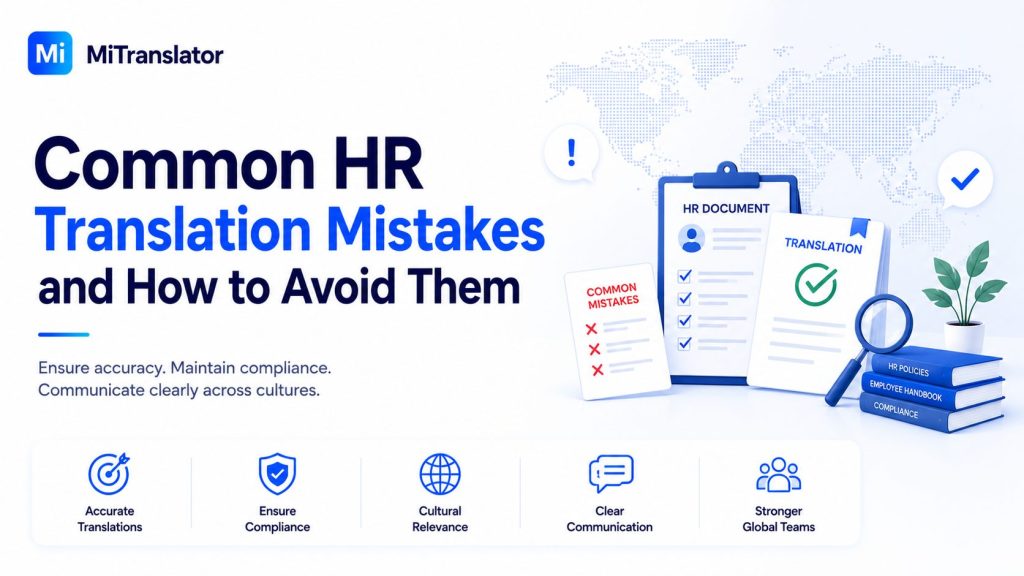
As businesses expand internationally and manage increasingly diverse workforces, HR translation has become a critical part of effective employee communication. From employment contracts and employee handbooks to workplace policies and training materials, HR documents help organizations establish expectations, maintain compliance, and support employee engagement.
However, HR translation is far more complex than simply converting words from one language to another. Even minor translation mistakes can create confusion, damage employee trust, lead to compliance issues, or expose companies to legal risks. For multinational organizations, ensuring the accuracy and cultural appropriateness of HR content is essential for successful workforce management.
This article explores some of the most common HR translation mistakes businesses make, their potential consequences, and practical strategies to avoid them.
What Are HR Translation Mistakes?
HR translation mistakes occur when employee-related documents, policies, or communications are translated inaccurately, inconsistently, or without considering legal and cultural contexts.
HR content often contains specialized terminology, sensitive employee information, and legally significant language. Errors can occur during the translation process when organizations rely on unqualified translators, machine translation, inconsistent terminology, or inadequate quality control procedures.
Common HR documents that require professional translation include:
- Employment contracts
- Employee handbooks
- Workplace policies
- Recruitment materials
- Benefits documentation
- Performance review forms
- Training materials
- Health and safety instructions
- Internal communications
- Compliance documentation
Because these documents directly affect employees and organizational operations, translation quality plays a significant role in ensuring clarity, fairness, and compliance.
Why HR Translation Accuracy Matters for Businesses
Protects Legal Compliance
Many HR documents contain legally binding language. Translation errors can result in misunderstandings regarding employee rights, obligations, compensation, or workplace policies.
Supports Employee Understanding
Employees need clear and accurate information to perform their jobs effectively. Poor translations can create confusion and reduce confidence in company communications.
Enhances Employee Experience
Providing high-quality multilingual HR materials demonstrates professionalism and respect for employees from different linguistic backgrounds.
Reduces Operational Risks
Misinterpreted policies or procedures can lead to workplace disputes, productivity issues, and administrative complications.
Strengthens Global Workforce Management
Accurate HR translation helps multinational organizations maintain consistency across locations while ensuring local relevance.
Common Challenges in HR Translation
Using Machine Translation for Sensitive Documents
One of the most common mistakes is relying entirely on machine translation tools for HR content.
While automated tools can provide quick translations, they often struggle with:
- Legal terminology
- Employment-specific language
- Cultural nuances
- Context-sensitive phrases
- Performance evaluation language
An incorrectly translated employment contract or workplace policy can create serious misunderstandings.
Inconsistent HR Terminology
Organizations often use multiple translators, departments, or vendors. Without a standardized terminology system, key HR terms may be translated differently across documents.
For example:
- Performance review
- Probation period
- Annual leave
- Overtime policy
- Performance improvement plan
Inconsistent terminology can confuse employees and weaken communication effectiveness.
Ignoring Local Labor Regulations
Many HR documents are created at corporate headquarters and translated for international offices. However, direct translation alone may not account for local labor laws and employment requirements.
A policy that complies with regulations in one country may require significant adaptation before being used elsewhere.
Failing to Localize Cultural References
Workplace communication styles vary across cultures. Language that sounds professional and constructive in one region may appear overly direct or unclear in another.
Without localization, translated HR content may not resonate with local employees.
Poor Translation of Performance Reviews
Performance evaluations often contain nuanced feedback that must be communicated carefully.
Translation mistakes may:
- Make feedback appear harsher than intended
- Dilute important development recommendations
- Change the tone of manager comments
- Create employee dissatisfaction
Neglecting Quality Assurance
Some organizations distribute translated HR documents without proper review procedures.
Without quality assurance checks, errors may remain undetected and become embedded in official company communications.
Best Practices to Avoid HR Translation Mistakes
Work With Professional HR Translators
HR documents require specialized knowledge of employment terminology, workplace communication, and legal language.
Choose translators with experience in:
- Human resources
- Employment law
- Corporate communications
- Employee relations
Create Standardized Terminology Resources
Develop multilingual glossaries and terminology databases that include:
- HR terminology
- Legal terms
- Company-specific language
- Performance management terminology
This helps ensure consistency across all HR materials.
Implement Localization Strategies
Adapt content to reflect:
- Local labor regulations
- Cultural expectations
- Workplace communication norms
- Regional terminology preferences
Localization helps improve employee understanding and engagement.
Establish Quality Review Processes
Every translated document should undergo:
- Linguistic review
- Terminology verification
- Compliance review
- Formatting checks
Quality assurance significantly reduces the likelihood of errors.
Use Translation Memory Technology
Translation memory tools help organizations:
- Maintain consistency
- Improve efficiency
- Reduce costs
- Reuse approved translations
This is particularly valuable for recurring HR documents and policy updates.
Protect Confidential Information
HR documents often contain sensitive employee data.
Organizations should:
- Use secure translation workflows
- Sign confidentiality agreements
- Limit document access
- Work with trusted language service providers
Train Internal HR Teams
HR professionals should understand the importance of localization and translation quality.
Providing basic training helps teams identify potential issues before documents are distributed.
HR Translation Checklist
Before publishing translated HR content, confirm that:
- Terminology is consistent across documents.
- Local labor requirements have been reviewed.
- Cultural adaptation has been completed.
- Confidential information is protected.
- Quality assurance reviews have been performed.
- Formatting matches the original document.
- Employee-facing language is clear and understandable.
How MITRANS Can Help
HR documents influence every stage of the employee lifecycle, from recruitment and onboarding to performance management and compliance. Ensuring that these materials are translated accurately and professionally is essential for effective workforce management.
MITRANS provides specialized HR translation and localization services designed to help businesses communicate clearly with multilingual workforces.
Our services include:
- Employment contract translation
- Employee handbook translation
- Workplace policy translation
- Performance review translation
- Benefits documentation translation
- Recruitment material translation
- HR compliance document translation
- Training material localization
- Internal communication translation
- Multilingual HR content review
Our experienced linguists understand both HR terminology and local business environments, ensuring that translated content remains accurate, consistent, and culturally appropriate.
With support for English, Vietnamese, Chinese, Japanese, Korean, and many other languages, MITRANS helps organizations reduce risks and improve communication across global teams.
Frequently Asked Questions About HR Translation
Why are HR documents difficult to translate?
HR documents often contain legal language, specialized terminology, and culturally sensitive content that requires expertise beyond general translation skills.
Is machine translation suitable for HR documents?
Machine translation may assist with basic communication, but professional human translation is strongly recommended for HR materials due to accuracy and compliance concerns.
Which HR documents should be professionally translated?
Employment contracts, employee handbooks, workplace policies, training materials, benefits documentation, and performance reviews are among the most important HR documents requiring professional translation.
How can companies ensure consistency across multilingual HR materials?
Organizations should use approved glossaries, translation memories, style guides, and professional language service providers.
What are the risks of poor HR translation?
Poor translations can lead to employee misunderstandings, legal disputes, compliance violations, reduced engagement, and operational inefficiencies.
Need Professional HR Translation Support?
Looking to improve the accuracy, consistency, and compliance of your multilingual HR documents?
Contact MITRANS today for fast, accurate, and professional HR translation and localization services, including employment contracts, employee handbooks, workplace policies, performance reviews, and employee communications tailored to your global workforce.