As global businesses manage increasing volumes of multilingual content, agencies and enterprises are under growing pressure to deliver faster, more scalable, and more consistent localization workflows.
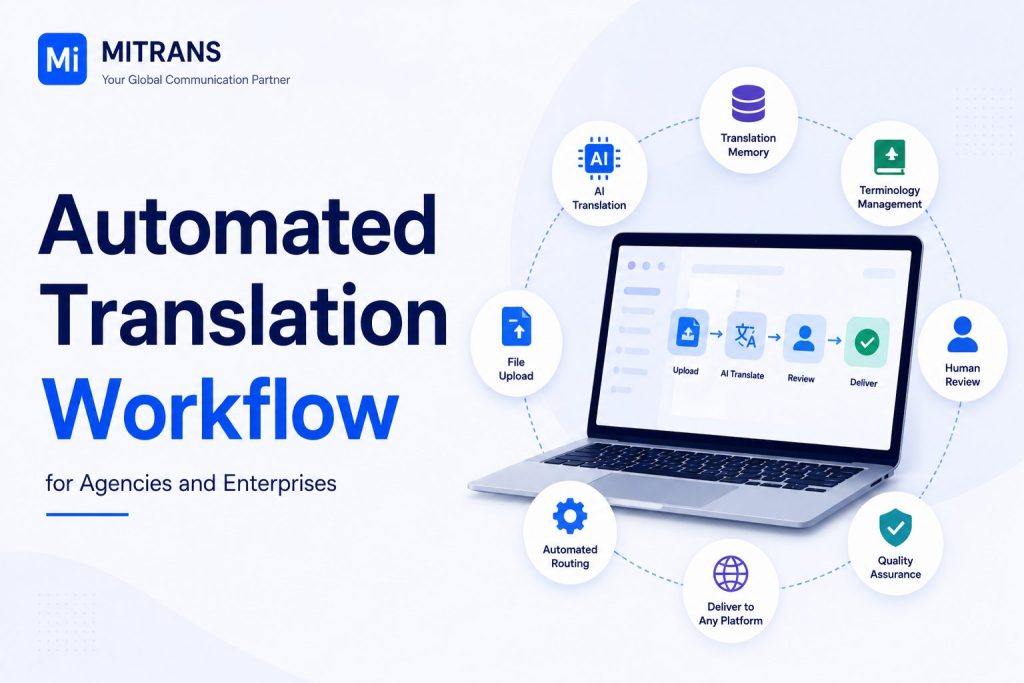
Automated translation workflows help organizations streamline multilingual operations by combining AI translation technologies, translation management systems, terminology databases, and human quality assurance into a unified process.
For agencies and enterprises working across multiple languages and markets, workflow automation improves efficiency, reduces repetitive tasks, and supports large-scale content localization.
What Is an Automated Translation Workflow?
An automated translation workflow is a structured system that helps businesses manage multilingual content more efficiently using automation tools and AI-assisted processes.
These workflows may include:
- AI-assisted translation
- Translation APIs
- Translation memory systems
- Terminology management
- Automated file handling
- Workflow routing
- Human editing and QA review
- CMS integration
- Localization management platforms
Automation helps reduce manual coordination while improving translation scalability and consistency.
Why Agencies and Enterprises Need Workflow Automation
Manage Large Content Volumes
Modern organizations regularly localize:
- Websites
- Marketing campaigns
- Product documentation
- Customer support content
- Internal documents
- Software interfaces
- Training materials
Automated workflows help teams process high volumes of multilingual content more efficiently.
Improve Turnaround Times
Automation reduces delays caused by:
- Manual file transfers
- Repetitive translation tasks
- Content duplication
- Workflow bottlenecks
This helps agencies and enterprises deliver projects faster.
Maintain Terminology Consistency
Translation memory and terminology systems help maintain consistent language across:
- Brands
- Departments
- Products
- Campaigns
- Enterprise documentation
Scale Global Operations
Businesses expanding into international markets require scalable localization infrastructure to support continuous multilingual growth.
Common Components of Automated Translation Workflows
AI Translation Engines
AI-powered translation tools help generate initial draft translations quickly for large-scale content.
Translation Memory Systems
Translation memory stores previously translated segments to:
- Reduce repeated work
- Improve consistency
- Accelerate future projects
Terminology Databases
Glossaries help ensure consistent usage of:
- Brand terms
- Technical terminology
- Product names
- Industry-specific language
Human Editing and QA
Professional linguists review AI-generated translations for:
- Accuracy
- Tone
- Context
- Localization quality
- Cultural adaptation
Workflow Automation Platforms
Translation management systems help automate:
- Project routing
- File handling
- Notifications
- Status tracking
- Team collaboration
Benefits of Automated Translation Workflows
Faster Localization
Automation speeds up multilingual publishing and content delivery.
Lower Operational Workload
Teams spend less time on repetitive manual tasks.
Better Scalability
Businesses can manage larger multilingual projects more efficiently.
Improved Consistency
Centralized terminology systems improve quality across departments and markets.
Continuous Localization Support
Automated workflows support ongoing content updates for websites, apps, software platforms, and enterprise systems.
Common Challenges in Workflow Automation
Quality Control
AI-generated translations still require human review for:
- Context accuracy
- Brand voice
- Cultural nuance
- Technical precision
System Integration Complexity
Large enterprises may need integration across:
- CMS platforms
- CRM systems
- Support platforms
- Product databases
- SaaS environments
Data Security
Confidential business content requires secure workflow infrastructure and controlled document access.
Workflow Customization
Different industries require different localization processes, approval structures, and terminology standards.
Best Practices for Automated Translation Workflows
Combine AI With Human Expertise
Hybrid workflows balance automation efficiency with professional linguistic quality.
Standardize Terminology Management
Consistent glossaries improve translation quality across all projects and teams.
Build Scalable Localization Processes
Workflows should support:
- Continuous updates
- Global expansion
- Multi-department collaboration
- Enterprise growth
Prioritize QA Review
Customer-facing and high-risk content should undergo professional quality assurance review.
Use Centralized Translation Platforms
Centralized systems improve visibility, collaboration, and workflow control.
Industries Using Automated Translation Workflows
Workflow automation is widely used in:
- SaaS and software companies
- Marketing agencies
- E-commerce platforms
- Manufacturing
- Healthcare
- Finance
- Logistics
- Enterprise operations
- Customer support systems
- International media platforms
Each industry requires different levels of automation, compliance review, and localization expertise.
Why Businesses Choose MITRANS
MITRANS Translation Services helps agencies and enterprises build scalable Vietnamese localization workflows using AI-assisted translation and professional human QA processes.
MITRANS supports businesses with:
- Enterprise localization workflows
- AI-assisted translation solutions
- Terminology management
- Translation memory systems
- Multilingual project scaling
- Quality assurance review
- Software and platform localization
- Secure document handling
From global agencies to enterprise organizations, MITRANS helps teams streamline multilingual operations for Vietnamese and international markets.
Frequently Asked Questions
What is an automated translation workflow?
It is a system that combines automation tools, AI translation, and human review to manage multilingual content more efficiently.
Why do enterprises use translation workflow automation?
Automation improves scalability, reduces manual workload, and accelerates multilingual content delivery.
Can AI translation workflows maintain quality?
Yes, especially when combined with human editing, QA review, and terminology management systems.
Which businesses benefit most from workflow automation?
Agencies, SaaS companies, e-commerce businesses, enterprises, and organizations managing large multilingual content volumes benefit most.
Request a Translation Workflow Consultation
Need professional business document translation? Request a quote from MITRANS.
Contact MITRANS for a Translation Quote
MITRANS helps agencies and enterprises scale multilingual operations with professional Vietnamese localization and automated translation workflow solutions.