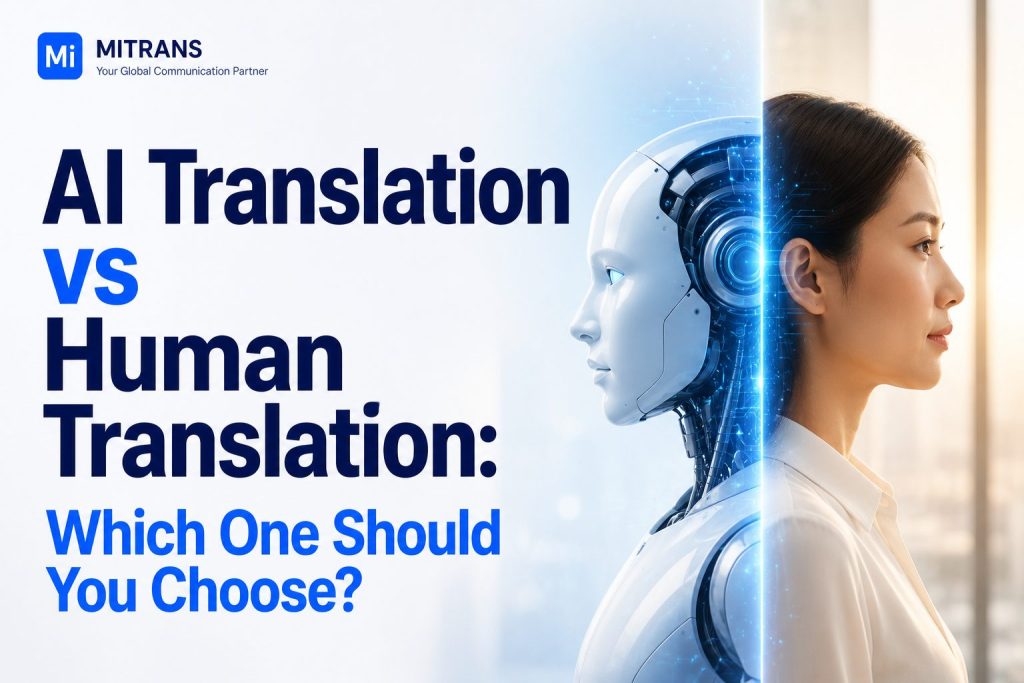
As AI translation technologies continue to improve, businesses now have more options for managing multilingual communication and localization. Many organizations use AI-powered translation tools to increase speed and reduce operational workload, while others continue to rely on professional human translators for accuracy, cultural nuance, and quality assurance.
For companies operating in Vietnam and international markets, choosing between AI translation and human translation depends on content type, business goals, quality expectations, and scalability requirements.
In many cases, the most effective solution is a hybrid workflow that combines AI efficiency with professional human review.
What Is AI Translation?
AI translation uses machine learning and language models to automatically translate text between languages.
Modern AI translation tools can process:
- Websites
- Product descriptions
- Chat systems
- Internal documents
- User-generated content
- Software interfaces
- Customer support messages
AI translation is designed to improve speed and scalability for multilingual workflows.
What Is Human Translation?
Human translation is performed by professional linguists who understand:
- Language nuance
- Context
- Tone
- Cultural adaptation
- Industry terminology
Human translators can localize content naturally while preserving meaning, clarity, and brand communication quality.
Professional human translation is commonly used for:
- Legal documents
- Financial reports
- Marketing content
- Medical translation
- Technical documentation
- Corporate communication
Advantages of AI Translation
Faster Processing Speed
AI translation can process large amounts of content instantly, making it useful for high-volume workflows.
Better Scalability
Businesses managing large multilingual platforms can localize content more efficiently with automation.
Lower Operational Costs
For repetitive or low-risk content, AI translation may help reduce manual translation workload.
Real-Time Translation Support
AI tools are commonly used in:
- Chat systems
- Customer support
- Dynamic websites
- SaaS platforms
- Internal communication tools
Limitations of AI Translation
Context and Tone Challenges
AI systems may struggle with:
- Cultural nuance
- Emotional tone
- Brand voice
- Industry-specific communication
Inconsistent Terminology
Without proper terminology management, AI translation may create inconsistent wording across projects.
Quality Risks
AI-generated translation can still produce:
- Grammar issues
- Unnatural phrasing
- Misinterpretation
- Technical inaccuracies
Confidentiality Concerns
Some businesses avoid uploading sensitive information into public AI systems without secure workflows.
Advantages of Human Translation
Better Accuracy and Context
Professional translators understand meaning beyond literal word conversion.
Natural Localization
Human translators adapt content for local audiences while preserving communication quality.
Industry Expertise
Specialized translators understand technical terminology in industries such as:
- Healthcare
- Finance
- Legal
- Manufacturing
- Technology
Stronger Brand Communication
Marketing and customer-facing content often require human creativity and localization expertise.
Limitations of Human Translation
Slower Turnaround Time
Large projects may require more time compared to automated AI workflows.
Higher Costs for Large Volumes
Fully manual translation can become expensive for high-volume or repetitive content.
Scalability Challenges
Managing continuous multilingual updates manually can be difficult for rapidly growing businesses.
When Businesses Should Use AI Translation
AI translation works best for:
- Large content volumes
- Repetitive content
- Internal communication
- Dynamic platform content
- Real-time workflows
- Fast multilingual updates
When Businesses Should Use Human Translation
Human translation is recommended for:
- Legal contracts
- Financial reports
- Medical documents
- Marketing campaigns
- Corporate branding
- Customer-facing communication
- High-risk technical content
Why Hybrid AI + Human Workflows Are Growing
Many businesses now combine:
- AI-assisted draft translation
- Human editing and QA review
- Terminology management
- Localization optimization
Hybrid workflows help organizations balance:
- Speed
- Scalability
- Accuracy
- Cost efficiency
- Quality assurance
This approach is increasingly popular for enterprise localization and multilingual content operations.
AI Translation vs Human Translation: Quick Comparison
| Factor | AI Translation | Human Translation |
|---|---|---|
| Speed | Very fast | Slower |
| Scalability | High | Moderate |
| Cost Efficiency | Better for large volumes | Higher for complex projects |
| Cultural Nuance | Limited | Strong |
| Brand Voice | Inconsistent | More natural |
| Technical Accuracy | Varies | Higher with specialists |
| Quality Assurance | Requires review | More reliable |
| Best Use Cases | Large-scale automation | High-value content |
Why Businesses Choose MITRANS
MITRANS Translation Services helps businesses combine AI-assisted translation workflows with professional human localization expertise for Vietnamese and international markets.
MITRANS supports organizations with:
- Professional Vietnamese translation
- AI-assisted localization workflows
- Human QA review
- Terminology management
- Enterprise document translation
- Software and platform localization
- Secure multilingual workflows
From business documents to enterprise localization, MITRANS helps companies balance automation efficiency with professional translation quality.
Frequently Asked Questions
Can AI fully replace human translators?
AI improves speed and scalability, but human expertise remains important for accuracy, localization quality, and contextual understanding.
Is AI translation accurate enough for business use?
AI translation can be useful for scalable workflows, but professional review is still recommended for important business content.
Which content should always use human translation?
Legal, medical, financial, technical, and customer-facing content usually requires professional human review.
Why are hybrid workflows becoming popular?
Hybrid workflows combine AI efficiency with human linguistic quality and localization expertise.
Request a Translation Consultation
Need professional business document translation? Request a quote from MITRANS.
Contact MITRANS for a Translation Quote
MITRANS helps businesses combine AI translation efficiency with professional Vietnamese localization and human quality assurance.