
As businesses expand into international markets, the volume of multilingual content they manage continues to grow. From websites and product catalogs to contracts, technical manuals, and marketing materials, organizations often translate similar content repeatedly across multiple projects and languages.
Without a structured system for managing previously translated content, companies may face inconsistent terminology, longer turnaround times, and higher translation costs. This is where Translation Memory (TM) becomes a valuable asset.
Translation Memory is one of the most important technologies used in professional translation and localization projects. It helps businesses improve consistency, reduce costs, and accelerate multilingual content delivery while maintaining high translation quality.
What Is Translation Memory?
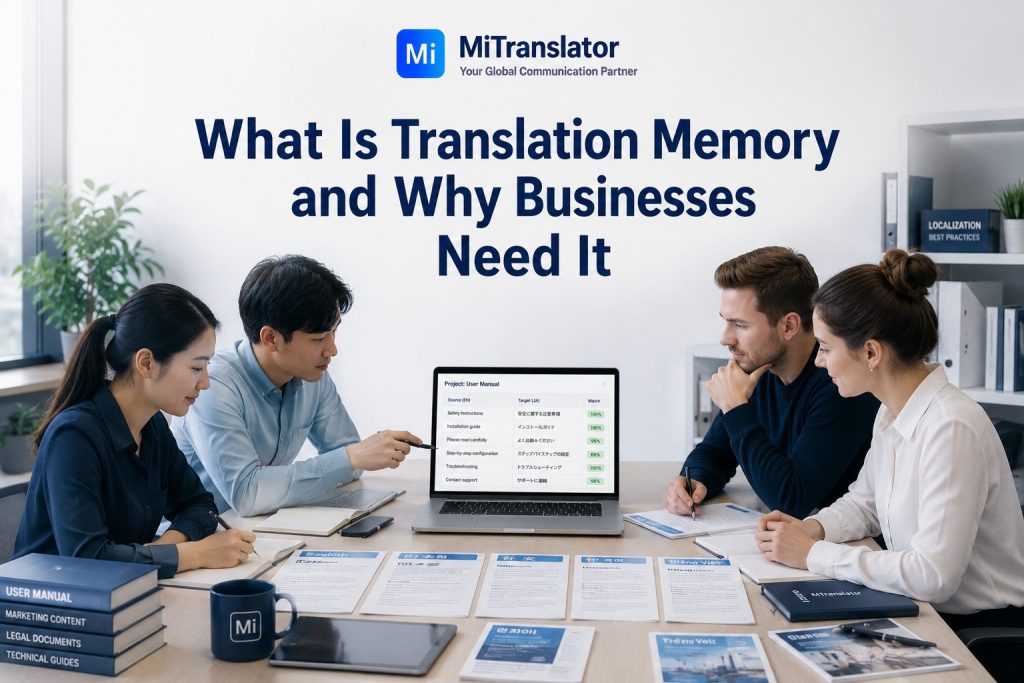
Translation Memory (TM) is a language technology that stores previously translated sentences, phrases, or text segments in a database for future reuse.
When similar or identical content appears in a new translation project, the system automatically suggests existing translations from the memory database.
Each stored entry typically consists of:
- Source text segment
- Corresponding translated segment
- Language pair information
- Contextual metadata
Professional translators can review, edit, and reuse these suggestions, improving both efficiency and consistency.
How Translation Memory Works
Step 1: Content Is Translated
When a translator completes a project, the translated content is saved into the Translation Memory database.
For example:
Source:
“Please submit your application before the deadline.”
Translation:
“Vui lòng nộp hồ sơ trước thời hạn.”
The source and translated segments become part of the translation memory.
Step 2: New Content Is Analyzed
When a new project is uploaded, the Translation Memory system scans the content and compares it against previously stored translations.
Step 3: Matching Segments Are Identified
The system searches for:
- Exact matches
- Partial matches
- Similar sentences
- Repeated phrases
These matches are presented to the translator during the translation process.
Step 4: Translators Review and Reuse Content
Rather than translating identical content repeatedly, translators can reuse approved translations while making adjustments when necessary.
This helps improve efficiency without sacrificing quality.
Types of Translation Memory Matches
Exact Matches
An exact match occurs when a sentence in the new project is identical to a previously translated sentence.
For example:
Previous Translation
“Payment must be completed within 30 days.”
New Project
“Payment must be completed within 30 days.”
The translation can often be reused immediately.
Fuzzy Matches
A fuzzy match occurs when content is similar but not identical.
Example:
Stored Segment
“Payment must be completed within 30 days.”
New Segment
“Payment must be completed within 45 days.”
The translator can modify the existing translation rather than starting from scratch.
Repetitions
Translation Memory also identifies repeated content within the same project.
This is particularly useful for:
- Technical manuals
- Product catalogs
- Legal contracts
- Corporate documentation
Why Businesses Need Translation Memory
Reducing Translation Costs
One of the biggest benefits of Translation Memory is cost savings.
Because previously translated content can be reused, businesses avoid paying repeatedly for the translation of identical or highly similar text.
This is particularly valuable for organizations that regularly update:
- Websites
- Product descriptions
- Technical documentation
- Legal documents
Improving Consistency
Consistency is essential in multilingual communication.
Translation Memory helps ensure that approved terminology and phrasing are used consistently across:
- Marketing materials
- User manuals
- Contracts
- Customer support documentation
- Corporate communications
Consistent language strengthens brand identity and improves user experiences.
Accelerating Turnaround Times
Reusing existing translations significantly reduces the amount of new content that must be translated manually.
This allows projects to be completed faster, helping businesses meet tight deadlines.
Supporting Long-Term Scalability
As organizations create more multilingual content, Translation Memory becomes increasingly valuable.
The database grows over time, improving efficiency and reducing translation effort across future projects.
Enhancing Quality Control
Translation Memory helps reduce human error by providing access to previously approved translations.
This supports quality assurance efforts and helps maintain translation standards.
Industries That Benefit Most from Translation Memory
Technology Companies
Technology organizations frequently update:
- Software interfaces
- Product documentation
- Knowledge bases
- User guides
Translation Memory helps maintain consistency across updates.
Manufacturing and Engineering
Technical documents often contain repetitive terminology and instructions.
Translation Memory improves efficiency when translating:
- Technical manuals
- Product specifications
- Safety documentation
Healthcare and Medical Organizations
Healthcare providers and medical device manufacturers benefit from consistent translation of:
- Medical documentation
- Regulatory materials
- Patient information
Legal Services
Law firms and legal departments often work with recurring clauses and contractual language.
Translation Memory helps ensure accuracy and consistency.
E-Commerce Businesses
Online retailers regularly update:
- Product descriptions
- Promotional content
- Customer support materials
Translation Memory reduces costs while maintaining brand consistency.
Translation Memory vs. Machine Translation
Translation Memory
Translation Memory:
- Reuses human-approved translations
- Maintains consistency
- Supports quality assurance
- Works best with repetitive content
- Requires professional translator review
Machine Translation
Machine Translation:
- Generates new translations automatically
- Uses artificial intelligence algorithms
- May produce inconsistent results
- Requires post-editing for professional use
Many professional translation workflows combine Translation Memory with human expertise to achieve the best results.
Best Practices for Using Translation Memory
Build a Centralized Translation Database
Maintaining a centralized Translation Memory ensures that all departments use consistent language across projects.
Develop Approved Terminology Glossaries
Combining Translation Memory with terminology management improves consistency and translation quality.
Update Translation Memories Regularly
Approved translations should be reviewed and updated as products, services, and terminology evolve.
Work with Professional Translation Providers
Experienced translation partners can help manage Translation Memory databases and maximize long-term benefits.
Integrate Translation Memory into Localization Workflows
Translation Memory works most effectively when incorporated into ongoing multilingual content strategies.
Translation Memory Checklist for Businesses
Before implementing Translation Memory, ensure that you:
✔ Identify frequently translated content
✔ Create approved terminology glossaries
✔ Centralize translation assets
✔ Maintain consistent translation standards
✔ Update translation memories regularly
✔ Use professional translators for review
✔ Monitor quality and consistency
✔ Integrate TM into localization workflows
✔ Protect translation data securely
✔ Measure cost and efficiency improvements
How MITRANS Can Help
MITRANS uses advanced Translation Memory technology to help businesses improve translation efficiency, consistency, and scalability.
Our services include:
- Translation Memory management
- Website localization
- Technical translation
- Legal document translation
- Medical translation
- Marketing content localization
- Software localization
- Multilingual content management
- Terminology development
- Ongoing translation support
By combining professional human translators with industry-leading translation technology, MITRANS helps organizations reduce costs while maintaining the highest standards of quality.
Frequently Asked Questions
What is Translation Memory?
Translation Memory is a database that stores previously translated content so it can be reused in future translation projects.
Does Translation Memory replace human translators?
No. Translation Memory supports translators by providing approved translations, but professional human review remains essential for accuracy and quality.
How does Translation Memory reduce costs?
By reusing previously translated content, businesses avoid paying repeatedly for identical or highly similar translations.
Which industries benefit most from Translation Memory?
Technology, manufacturing, healthcare, legal services, finance, and e-commerce organizations often see significant benefits due to the large volume of repetitive content they manage.
Is Translation Memory the same as machine translation?
No. Translation Memory reuses human-approved translations, while machine translation automatically generates new translations using artificial intelligence.
Conclusion
Translation Memory has become an essential tool for businesses managing multilingual content at scale. By storing and reusing approved translations, organizations can reduce costs, improve consistency, accelerate project delivery, and enhance overall translation quality.
As global communication becomes increasingly important, businesses that invest in Translation Memory technology gain a significant advantage in managing multilingual content efficiently and effectively.
Need Professional Translation Services with Translation Memory Technology?
Looking to reduce translation costs, improve consistency, and streamline multilingual content management across your organization?
Contact MITRANS today to learn how our professional translation services and Translation Memory solutions can help your business communicate effectively across global markets.