

Introduction
As more international businesses expand into Vietnam, the demand for Vietnamese translation and localization continues to grow rapidly. Companies entering the Vietnamese market often need multilingual support for websites, SaaS platforms, marketing campaigns, customer communication, and business documentation.
However, many businesses still confuse translation with localization.
While both are important, they serve different purposes.
Understanding the difference between Vietnamese translation and Vietnamese localization helps businesses:
- Communicate more naturally
- Improve customer experience
- Increase market engagement
- Strengthen brand credibility
- Achieve better results in Vietnam
This guide explains the key differences between translation and localization, why both matter, and how businesses can choose the right strategy for the Vietnamese market.
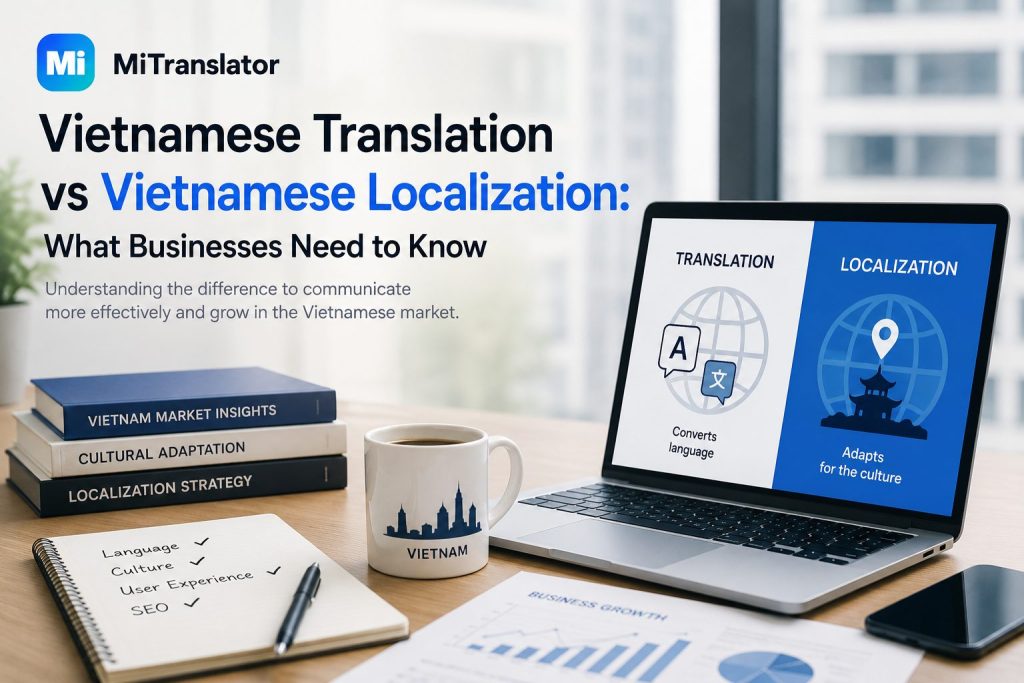
![Vietnamese Translation vs Vietnamese Localization — clean corporate banner with multilingual communication, website localization, and Vietnamese market adaptation theme]
What Is Vietnamese Translation?
Vietnamese translation focuses on converting text from one language into Vietnamese while preserving the original meaning.
The goal is language accuracy.
Translation is commonly used for:
- Contracts
- Technical documentation
- Business reports
- Manuals
- Certificates
- Internal communication
A good translation ensures that the information is:
- Accurate
- Clear
- Understandable
However, translation alone may not fully adapt content for Vietnamese users or customers.
What Is Vietnamese Localization?
Vietnamese localization goes beyond direct translation.
Localization adapts content specifically for Vietnamese culture, communication style, and user expectations.
Localization may include:
- Tone adaptation
- UX communication
- Vietnamese SEO
- Marketing messaging
- Cultural relevance
- UI adjustments
- Local formatting
The goal is to make content feel natural and local to Vietnamese audiences.
Key Differences Between Translation & Localization
| Translation | Localization |
|---|---|
| Converts language accurately | Adapts communication for local audiences |
| Focuses on wording | Focuses on user experience & market relevance |
| Maintains original structure | Adjusts content naturally for Vietnamese users |
| Common for legal & technical documents | Common for websites, SaaS, and marketing |
| Limited SEO adaptation | Includes Vietnamese SEO localization |
Translation ensures accuracy. Localization improves connection and engagement.
Why Businesses Need Localization in Vietnam
Vietnamese Users Expect Natural Communication
Directly translated content may sound:
- Awkward
- Robotic
- Too formal
- Unnatural
Localization helps communication feel more human and user-friendly.
Localization Improves User Experience
Localized websites and software improve:
- Navigation clarity
- Customer understanding
- User engagement
- Conversion rates
Vietnamese SEO Requires Localization
Vietnamese search behavior differs from English-speaking markets.
Localization helps optimize:
- Keywords
- Search intent
- Content structure
- Meta descriptions
Cultural Relevance Matters
Certain phrases, calls-to-action, or marketing messages may need adaptation for Vietnamese audiences.
Localization helps brands communicate more effectively.
When Translation Is Enough
Translation may be sufficient for:
- Internal company documents
- Technical manuals
- Legal contracts
- Compliance paperwork
- Official records
In these cases, the priority is usually:
- Accuracy
- Clarity
- Terminology consistency
When Localization Is More Important
Localization is especially important for:
- Websites
- SaaS platforms
- eCommerce
- Mobile apps
- Marketing campaigns
- Customer-facing communication
These areas directly affect:
- Customer perception
- User experience
- Brand trust
- Business growth
Common Localization Challenges in Vietnam
Literal Translation Issues
Word-for-word translation often creates unnatural Vietnamese phrasing.
Tone & Formality Differences
Vietnamese communication style depends heavily on:
- Context
- Audience
- Industry
- Platform type
UI & Layout Problems
Vietnamese text may affect:
- Menus
- Buttons
- Mobile responsiveness
- Website layouts
SEO Localization Complexity
Direct keyword translation often fails to match Vietnamese search behavior.
Professional localization includes Vietnamese SEO adaptation.
Best Practices for Vietnamese Localization
Work with Native Vietnamese Linguists
Native experts better understand:
- Natural communication
- User expectations
- Cultural nuances
Focus on User Experience
Localization should improve:
- Readability
- UX flow
- Customer engagement
Maintain Brand Consistency
Localization should preserve:
- Brand tone
- Messaging style
- Professional identity
Test Content in Context
Review localization directly inside:
- Websites
- Apps
- SaaS interfaces
- Marketing layouts
Combine Technology with Human Expertise
Translation tools improve efficiency, while human review ensures:
- Accuracy
- Natural phrasing
- Cultural relevance
Why Localization Matters for Long-Term Growth
Businesses that localize effectively often achieve:
- Better customer trust
- Higher engagement
- Improved conversions
- Stronger brand positioning
- Better user retention
As Vietnam’s digital market becomes increasingly competitive, localized communication becomes a major advantage.
How MITRANS Can Help
MITRANS Translation Services provides professional Vietnamese translation and localization services for businesses operating in Vietnam and international markets.
MITRANS supports:
- Website localization
- SaaS localization
- Vietnamese SEO localization
- Marketing localization
- Technical translation
- Legal document translation
- Multilingual business workflows
Languages supported include:
- English
- Vietnamese
- Chinese
- Japanese
- Korean
Why businesses choose MITRANS:
- Native Vietnamese linguists
- Localization-focused workflows
- Human quality assurance
- Industry-specialized expertise
- Consistent terminology management
- Fast turnaround support
MITRANS helps businesses communicate naturally and professionally with Vietnamese audiences.
FAQ
What is the difference between translation and localization?
Translation converts language accurately, while localization adapts communication specifically for local users and culture.
Why is localization important in Vietnam?
Localization improves user experience, trust, SEO performance, and customer engagement for Vietnamese audiences.
Is translation enough for websites and SaaS products?
Usually not. Websites and SaaS platforms often require localization to feel natural and user-friendly for Vietnamese users.
Does localization include Vietnamese SEO?
Yes. Professional localization often includes keyword adaptation and Vietnamese search optimization.
Does MITRANS provide both translation and localization services?
Yes. MITRANS provides professional Vietnamese translation and localization services tailored to business goals and market expansion.
Need Vietnamese Translation or Localization Support?
Looking to communicate more effectively with Vietnamese customers and users?
Contact MITRANS today for professional Vietnamese translation and localization services tailored to your business needs.