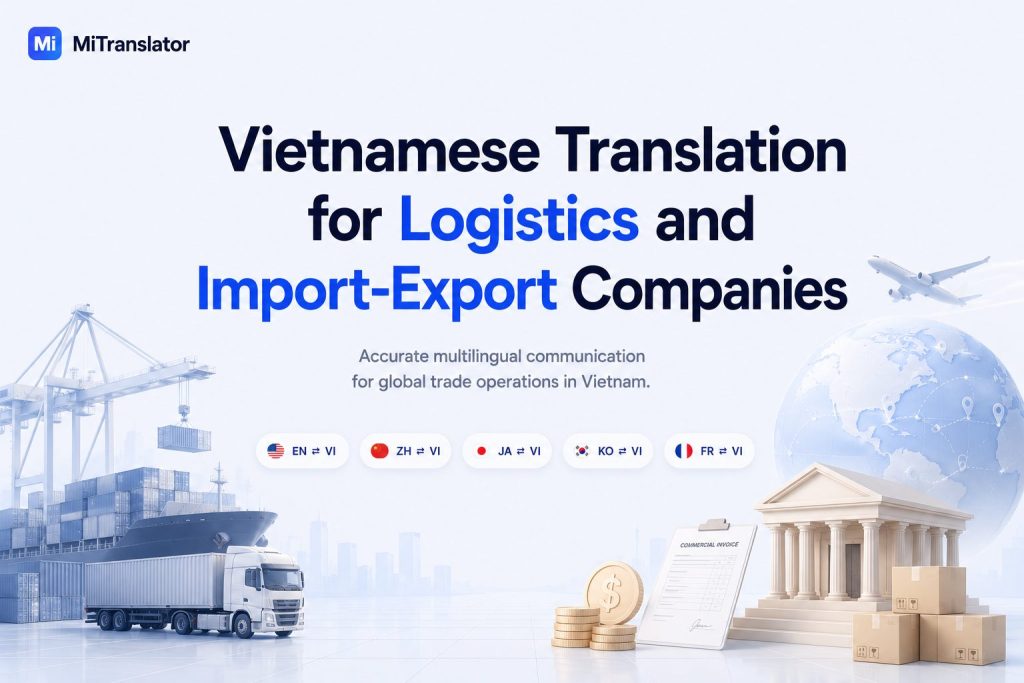
Vietnam has become one of Southeast Asia’s fastest-growing logistics and manufacturing hubs, attracting global import-export businesses, freight forwarders, shipping companies, and supply chain operators. As international trade continues to expand, professional Vietnamese translation services are increasingly essential for ensuring smooth communication, regulatory compliance, and efficient logistics operations.
From customs documentation and shipping contracts to warehouse operations and multilingual supplier communication, accurate translation helps logistics and import-export companies reduce delays, avoid compliance risks, and improve operational coordination across global markets.
In this article, we explore the importance of Vietnamese translation for logistics and import-export businesses, common localization challenges in international trade, and how MITRANS supports multilingual logistics operations in Vietnam.
What Is Vietnamese Translation for Logistics and Import-Export Companies?
Vietnamese translation for logistics and import-export companies refers to the professional translation and localization of trade, transportation, shipping, and supply chain documentation between Vietnamese and other languages such as English, Chinese, Japanese, Korean, and French.
These services may include:
- Shipping documentation
- Customs paperwork
- Commercial invoices
- Bills of lading
- Freight contracts
- Warehouse operation manuals
- Supply chain communication
- Import-export compliance documents
- Logistics software localization
- Packaging and labeling translation
- Procurement documentation
- International trade agreements
Unlike general business translation, logistics translation requires industry-specific terminology, regulatory knowledge, and operational accuracy.
Why Accurate Translation Matters in Logistics and Trade
Preventing Delays in Customs and Shipping
International trade depends heavily on accurate documentation. Translation errors in customs paperwork or shipping documents can lead to:
- Shipment delays
- Customs clearance issues
- Additional costs
- Regulatory penalties
- Supply chain disruptions
Professional Vietnamese translation helps businesses maintain smooth import-export operations and reduce operational risks.
Supporting Global Supply Chain Communication
Logistics operations involve constant communication between:
- Suppliers
- Freight forwarders
- Customs brokers
- Shipping companies
- Warehouses
- Manufacturers
- International clients
Accurate multilingual communication improves coordination and operational efficiency across the supply chain.
Ensuring Compliance With International Trade Regulations
Import-export businesses must comply with both Vietnamese regulations and international trade standards. Professionally translated documentation helps ensure:
- Regulatory accuracy
- Consistent terminology
- Proper legal interpretation
- Efficient communication with authorities
This is especially important for cross-border transactions and customs procedures.
Common Translation Challenges in Logistics and Import-Export
Industry-Specific Terminology
Logistics and shipping documents contain specialized terminology related to:
- Freight forwarding
- Customs procedures
- International shipping
- Incoterms
- Warehouse operations
- Transportation management
Professional translators must understand both the language and operational context behind the terminology.
Fast-Paced Operational Environment
Logistics operations often involve urgent schedules and real-time coordination. Translation workflows must support fast turnaround times without compromising accuracy.
Multilingual Documentation Management
Global logistics companies frequently manage large volumes of multilingual documentation across multiple markets and operational systems.
Maintaining terminology consistency across contracts, shipping forms, invoices, and internal communication is critical.
Regulatory and Compliance Complexity
Import-export regulations vary between countries and industries. Translators must understand local Vietnamese trade procedures and international logistics standards.
Documents Commonly Translated in Logistics and Trade
Logistics and import-export companies often require translation for:
- Bills of lading
- Commercial invoices
- Packing lists
- Customs declarations
- Freight agreements
- Shipping instructions
- Procurement contracts
- Warehouse SOPs
- Logistics software interfaces
- Product labels and packaging
- International trade compliance documents
- Supply chain reports
- Transportation manuals
Certified translation may also be required for legal and customs-related submissions.
Best Practices for Logistics Localization
Work With Logistics-Specialized Translators
Professional logistics translation requires experience in:
- International trade terminology
- Supply chain operations
- Customs procedures
- Shipping documentation
- Freight operations
Industry expertise improves both speed and translation accuracy.
Maintain Terminology Consistency
Consistent terminology across operational documents helps reduce confusion and improve coordination between international teams and partners.
Prioritize Accuracy and Speed
In logistics operations, delays can be costly. Businesses need translation workflows that balance:
- Fast turnaround
- Technical accuracy
- Regulatory compliance
- Operational clarity
Use Scalable Localization Workflows
Modern logistics companies often operate across multiple countries and languages simultaneously. Scalable localization systems help support growing international operations.
How MITRANS Supports Logistics and Import-Export Businesses
MITRANS Translator provides professional Vietnamese translation and localization services for logistics companies, freight forwarders, shipping providers, import-export businesses, and global supply chain operators.
Our services include:
- Logistics document translation
- Import-export localization
- Customs document translation
- Multilingual operational support
- Shipping and freight documentation
- Supply chain communication
- Logistics software localization
MITRANS supports multiple language pairs, including:
- English ↔ Vietnamese
- Chinese ↔ Vietnamese
- Japanese ↔ Vietnamese
- Korean ↔ Vietnamese
- French ↔ Vietnamese
With experienced linguists, industry-focused workflows, and quality-controlled processes, MITRANS helps logistics businesses improve communication, reduce delays, and support efficient international trade operations.
Frequently Asked Questions
Why is translation important in logistics and import-export operations?
Accurate translation helps prevent customs delays, improve supply chain communication, and ensure compliance with international trade regulations.
What logistics documents commonly require translation?
Shipping documents, customs paperwork, freight agreements, invoices, warehouse manuals, and operational communication frequently require professional translation.
Can MITRANS support multilingual logistics operations?
Yes. MITRANS supports multilingual localization projects for logistics companies, shipping providers, freight forwarders, and international trade businesses.
How quickly can logistics documents be translated?
Turnaround time depends on document volume and complexity. MITRANS offers fast and scalable workflows for time-sensitive logistics operations.
Conclusion
As Vietnam continues to strengthen its role in global trade and supply chain operations, professional Vietnamese translation services have become essential for logistics and import-export businesses operating across international markets.
From customs documentation and freight contracts to multilingual supply chain communication, accurate translation helps businesses improve efficiency, reduce operational risks, and support global expansion.
Need Vietnamese Translation or Localization Support?
MITRANS helps global businesses manage multilingual communication, localization, and Vietnamese market operations with quality-controlled translation workflows.
Contact MITRANS Translator today for fast, accurate, and professional language solutions tailored to your business.