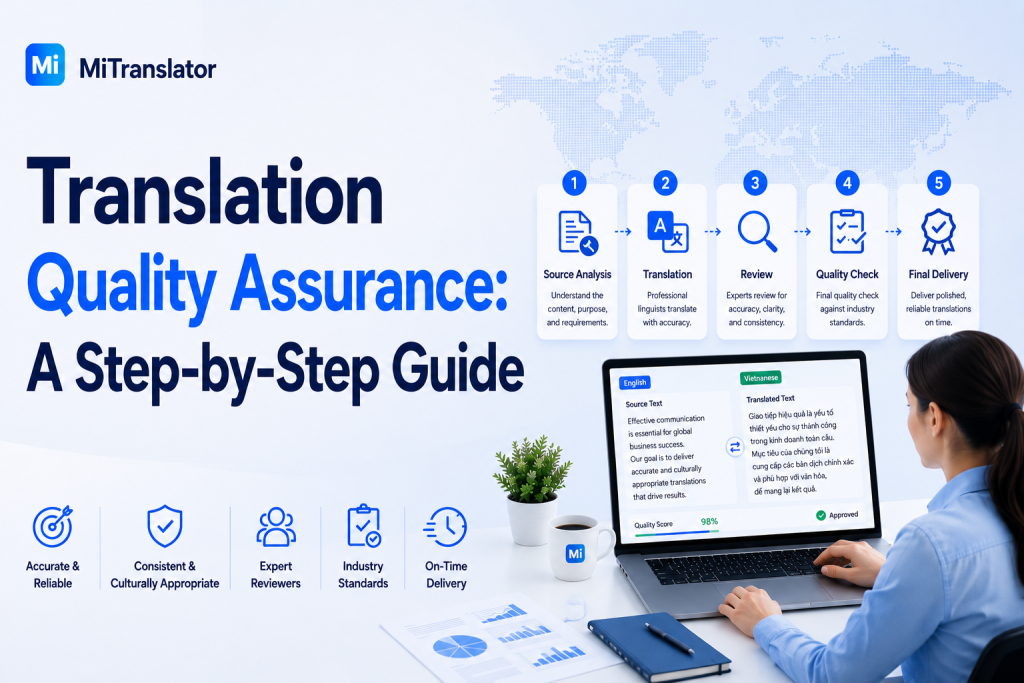
Translation quality assurance is essential for businesses that rely on multilingual content to communicate with customers, partners, employees, regulators, and international stakeholders. Whether a company is translating legal contracts, financial reports, technical manuals, marketing materials, medical records, immigration documents, or corporate policies, quality cannot depend on translation alone.
A structured translation quality assurance process helps ensure that translated content is accurate, consistent, complete, culturally appropriate, and suitable for its intended purpose. For organizations operating across borders, this process reduces communication risks, supports compliance, and protects brand reputation.
What Is Translation Quality Assurance?
Translation quality assurance, often referred to as translation QA, is the systematic process of checking, reviewing, and validating translated content before it is delivered or published.
It goes beyond basic proofreading. Translation QA evaluates whether the translated document accurately reflects the source text, uses correct terminology, follows formatting requirements, and meets the client’s business, legal, or regulatory needs.
A complete translation quality assurance process may include:
- Source file review
- Translator selection
- Terminology preparation
- Translation
- Editing
- Proofreading
- Formatting review
- Final quality control
- Client feedback integration
The goal is to reduce errors and ensure that the final translation is ready for official, business, or public use.
Why Translation Quality Assurance Matters
Accuracy and Meaning Preservation
The most important goal of translation QA is to ensure that the translated content faithfully conveys the meaning of the original text.
This is especially critical for legal, financial, technical, healthcare, and compliance-related documents where even small errors can lead to serious consequences.
Regulatory Compliance
Many translated documents are submitted to government agencies, courts, banks, universities, embassies, or regulatory authorities. These institutions may require translations to follow specific terminology, formatting, certification, or notarization standards.
Terminology Consistency
Businesses often use specialized terminology, brand names, product names, legal terms, and technical expressions. Translation QA ensures consistent use of approved terms across all documents and languages.
Brand and Communication Quality
For customer-facing materials such as websites, brochures, product descriptions, and corporate communications, quality assurance helps maintain a professional and trustworthy brand image.
Risk Reduction
Poor translation quality can result in contract disputes, compliance issues, product misuse, customer complaints, rejected applications, or reputational damage.
A clear QA process helps identify and correct problems before they create business risks.
Step 1: Review the Source Document
The quality assurance process begins before translation starts. The translation team should review the source document to understand its content, purpose, complexity, and intended audience.
Important questions include:
- What type of document is being translated?
- Who will use the translated version?
- Is the translation for internal reference, official submission, publication, or legal use?
- Are there any unclear terms, handwritten notes, stamps, seals, or formatting issues?
- Does the document contain tables, charts, images, or scanned text?
A proper source document review helps prevent misunderstandings and allows the translation team to plan the project accurately.
Step 2: Define Translation Requirements
Before assigning the project, businesses should clarify all translation requirements.
These may include:
- Target language and regional variant
- Required terminology
- File format
- Certification or notarization requirements
- Formatting expectations
- Submission deadline
- Confidentiality requirements
- Intended use of the translation
For example, a translation prepared for a marketing campaign may require localization and cultural adaptation, while a translation for a government agency may require strict accuracy and formatting consistency.
Step 3: Assign Qualified Translators
Translation quality depends heavily on translator expertise. A qualified translator should have strong language skills and subject-matter knowledge relevant to the document type.
Legal documents should be handled by translators familiar with legal terminology and contract structures. Financial reports should be translated by professionals who understand accounting, tax, audit, and investment terminology. Technical manuals require translators who can accurately handle engineering, product, and safety instructions.
Assigning the right translator from the beginning reduces the likelihood of errors during later review stages.
Step 4: Prepare Terminology and Reference Materials
Terminology preparation is one of the most important steps in translation quality assurance.
Before translation begins, the team should collect and review available reference materials such as:
- Company glossaries
- Previous translations
- Brand guidelines
- Product terminology lists
- Legal terminology references
- Industry-specific style guides
- Client instructions
Using consistent terminology is essential for businesses that translate recurring documents, product content, compliance materials, or multilingual websites.
Step 5: Translate the Document
During the translation stage, the translator converts the source content into the target language while preserving meaning, tone, structure, and document purpose.
A professional translator must pay close attention to:
- Accuracy of meaning
- Grammar and syntax
- Legal or technical terminology
- Numbers, dates, names, and addresses
- Units of measurement
- Formatting and layout
- Cultural appropriateness
- Consistency with previous translations
For official documents, translators should also handle stamps, seals, signatures, handwritten notes, and annotations carefully.
Step 6: Edit for Accuracy and Clarity
After translation, the document should be reviewed by an editor or second linguist. Editing focuses on comparing the translation against the source text to confirm that nothing has been omitted, added, mistranslated, or misunderstood.
The editing stage checks:
- Meaning accuracy
- Completeness
- Terminology consistency
- Sentence clarity
- Industry-specific language
- Appropriate tone
- Logical flow
This step is especially important for high-risk documents such as contracts, financial statements, medical records, safety manuals, technical specifications, and regulatory submissions.
Step 7: Proofread for Language Quality
Proofreading focuses on the quality of the target language. Unlike editing, which compares the translation with the source, proofreading checks the final translated text for readability, grammar, spelling, punctuation, and style.
Proofreading helps correct:
- Typographical errors
- Grammar mistakes
- Punctuation issues
- Awkward phrasing
- Inconsistent capitalization
- Formatting inconsistencies
- Repeated or missing words
This stage ensures that the final document reads naturally and professionally.
Step 8: Check Formatting and Layout
Formatting is a critical part of translation quality assurance, especially for official documents, certificates, contracts, reports, manuals, brochures, and website content.
The formatting review should verify:
- Headings and subheadings
- Tables and columns
- Page numbering
- Footnotes and references
- Stamps, seals, and signatures
- Charts and captions
- Fonts and spacing
- Alignment and layout consistency
For documents submitted to authorities, the translated version may need to closely reflect the format of the original document.
Step 9: Perform Final Quality Control
Final quality control is the last review before delivery. This step ensures that the translation meets all client requirements and is ready for use.
The final QA checklist may include:
- Correct language pair
- Complete translation of all content
- Accurate names, dates, numbers, and addresses
- Consistent terminology
- Correct formatting
- Required certification or notarization
- File compatibility
- Proper naming of files
- Compliance with client instructions
A final review helps prevent avoidable errors from reaching the client.
Step 10: Integrate Client Feedback
Translation quality assurance does not end at delivery. For long-term business relationships, client feedback should be recorded and used to improve future projects.
Feedback may relate to:
- Preferred terminology
- Brand tone
- Formatting preferences
- Regional language choices
- Industry-specific expressions
- Internal approval comments
Maintaining feedback records helps improve consistency and efficiency in future translation projects.
Common Translation QA Challenges
Businesses often face several challenges when managing translation quality.
Tight Deadlines
Urgent projects may create pressure to shorten review stages. However, skipping QA increases the risk of errors.
Complex Subject Matter
Legal, financial, medical, technical, and regulatory documents require specialized knowledge. General translators may not be suitable for these projects.
Multiple Languages
When translating into several languages, maintaining consistency across all versions requires clear terminology management and coordinated workflows.
Poor Source File Quality
Scanned documents, handwritten notes, low-resolution images, or incomplete source materials can make translation more difficult and increase the risk of mistakes.
Lack of Reference Materials
Without glossaries, style guides, or previous translations, terminology decisions may become inconsistent.
Best Practices for Effective Translation Quality Assurance
Businesses can improve translation outcomes by following several best practices.
First, provide clear project instructions from the beginning. The translation team should understand the intended use, audience, deadline, formatting requirements, and certification needs.
Second, use translators with relevant subject-matter expertise. Specialized documents require more than general language ability.
Third, maintain terminology databases and translation memories for recurring content. These tools help improve consistency, reduce turnaround time, and support long-term quality.
Fourth, use a multi-step review process for important documents. Translation, editing, proofreading, formatting review, and final QA each serve a different purpose.
Finally, work with a professional translation provider that has established quality assurance procedures, confidentiality controls, and industry-specific experience.
How MITRANS Supports Translation Quality Assurance
MITRANS provides professional translation services supported by structured quality assurance workflows for legal, financial, technical, corporate, immigration, healthcare, education, and regulatory documents.
Our translation quality assurance process includes source document review, qualified translator assignment, terminology management, editing, proofreading, formatting checks, and final quality control.
MITRANS supports businesses and individuals that require accurate, consistent, and reliable translations for official submissions, international operations, cross-border transactions, and multilingual communication.
Our services cover major language pairs, including:
- English ↔ Vietnamese
- Chinese ↔ Vietnamese
- Japanese ↔ Vietnamese
- Korean ↔ Vietnamese
- English ↔ Chinese
- English ↔ Japanese
- English ↔ Korean
By combining experienced linguists, subject-matter knowledge, and careful review procedures, MITRANS helps clients reduce translation risks and maintain professional communication across languages.
Frequently Asked Questions
What is the difference between translation QA and proofreading?
Proofreading focuses mainly on grammar, spelling, punctuation, and readability in the target language. Translation QA is broader and includes accuracy checks, terminology review, formatting verification, compliance with requirements, and final quality control.
Why is terminology consistency important in translation?
Consistent terminology helps avoid confusion, especially in legal, technical, financial, and corporate documents. It also strengthens brand consistency across markets.
Is machine translation enough for business documents?
Machine translation may be useful for understanding simple internal content, but it is not sufficient for legal, financial, technical, immigration, or compliance-sensitive documents without professional human review.
How many review steps should a translation project include?
Important documents should usually include translation, editing, proofreading, formatting review, and final QA before delivery.
Can translation QA reduce regulatory risks?
Yes. A structured QA process helps ensure that translated documents are accurate, complete, properly formatted, and aligned with submission requirements.
Contact MITRANS for Professional Translation Services
Professional translation plays a critical role in ensuring accuracy, compliance, and effective communication across international business activities. Whether you require translation for legal, financial, technical, corporate, immigration, or regulatory documents, MITRANS is ready to help.
Contact MITRANS today for fast, accurate, and professional translation services tailored to your business and documentation requirements.