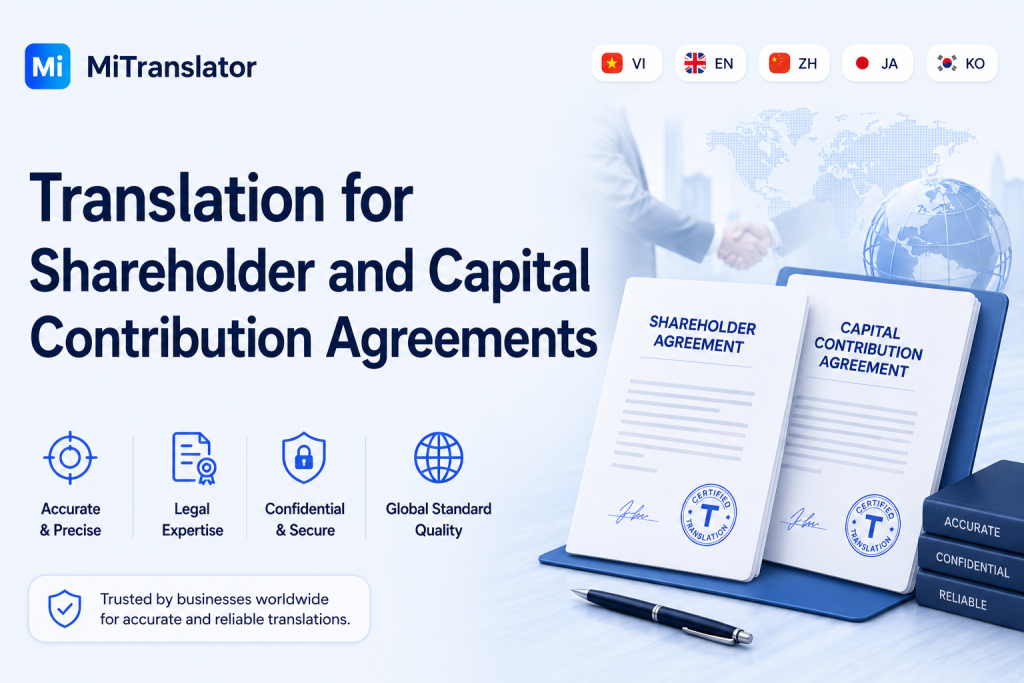
Shareholder and capital contribution agreements are among the most important legal documents governing business ownership, investment relationships, and corporate governance. As businesses increasingly attract foreign investors, establish joint ventures, or expand internationally, these agreements often need to be translated for regulatory filings, due diligence reviews, financing transactions, and cross-border business operations.
Because shareholder rights, voting powers, ownership percentages, capital commitments, and dispute resolution mechanisms are defined within these agreements, translation accuracy is critical. Even minor translation errors can lead to misunderstandings between stakeholders, compliance issues, or disputes that may have significant legal and financial consequences.
Professional translation for shareholder and capital contribution agreements helps businesses, investors, legal advisors, and regulatory authorities work from a clear and consistent understanding of ownership structures and contractual obligations.
What Are Shareholder and Capital Contribution Agreements?
A shareholder agreement is a legal contract that defines the rights, responsibilities, and relationships among shareholders of a company. It establishes how ownership is managed, how decisions are made, and how disputes are resolved.
A capital contribution agreement focuses on the financial commitments made by investors or shareholders to a business. It outlines the amount, form, timing, and conditions of capital contributions and may include provisions regarding ownership interests, profit distribution, and future funding obligations.
These agreements are commonly used in:
- Company formation
- Joint ventures
- Foreign direct investment (FDI)
- Mergers and acquisitions
- Startup fundraising
- Private equity transactions
- Venture capital investments
- Share transfers and restructuring activities
Why Translation of Shareholder Agreements Matters
Supporting International Investment
Foreign investors often require translated shareholder agreements before committing capital to a business. Accurate translation allows investors to fully understand their rights and obligations.
Facilitating Due Diligence
Shareholder and capital contribution agreements are routinely reviewed during investment transactions, acquisitions, and financing activities.
Professional translation enables legal advisors, auditors, and investors to evaluate ownership structures and contractual risks effectively.
Ensuring Regulatory Compliance
Government agencies, investment authorities, and corporate regulators may require translated versions of shareholder-related documents when reviewing foreign investment activities or corporate registrations.
Reducing Legal Risks
Poor translation can alter the meaning of critical provisions relating to ownership, voting rights, dividend distribution, transfer restrictions, and dispute resolution.
Accurate translation helps reduce the risk of misunderstandings and future conflicts.
Supporting Cross-Border Corporate Governance
When shareholders are located in different countries, multilingual documentation helps ensure transparency and effective communication among all parties.
Common Provisions Requiring Careful Translation
Share Ownership Structure
The agreement may specify:
- Share classes
- Ownership percentages
- Issued shares
- Voting rights
- Equity allocation
These provisions must be translated precisely to avoid ambiguity.
Capital Contribution Obligations
Capital contribution clauses often describe:
- Contribution amounts
- Payment schedules
- Funding requirements
- Additional capital calls
- Non-cash contributions
Errors in these sections may lead to financial disputes.
Voting Rights and Decision-Making
Many shareholder agreements establish procedures for:
- Board appointments
- Shareholder meetings
- Voting thresholds
- Reserved matters
- Approval requirements
Accurate translation is essential because these provisions directly affect corporate governance.
Dividend Distribution
The agreement may define how profits are distributed among shareholders and under what conditions dividends may be declared.
Share Transfer Restrictions
Common restrictions include:
- Right of first refusal
- Tag-along rights
- Drag-along rights
- Transfer approvals
- Lock-up periods
These legal concepts require careful translation to preserve their intended effect.
Dispute Resolution Clauses
Many agreements include provisions concerning:
- Governing law
- Arbitration
- Mediation
- Jurisdiction
- Enforcement procedures
Incorrect translation of dispute resolution clauses can create significant legal complications.
Common Challenges in Translating Shareholder Agreements
Complex Legal Terminology
Shareholder agreements contain highly specialized legal language that may not have direct equivalents across different legal systems.
Translators must understand both legal terminology and corporate governance concepts.
Differences Between Legal Systems
Corporate laws vary significantly across jurisdictions.
Concepts commonly used in one country may not exist or may function differently in another legal framework.
Financial and Investment Terminology
These agreements frequently include financial language related to:
- Equity financing
- Share valuation
- Capital structure
- Profit allocation
- Investment rights
Accurate translation requires knowledge of both legal and financial terminology.
Long and Detailed Documents
Shareholder agreements often contain extensive clauses, schedules, annexes, and amendments that must remain internally consistent throughout the translated document.
Confidential Information
These agreements typically contain sensitive information regarding ownership structures, investment terms, business strategies, and financial arrangements.
Maintaining confidentiality is therefore essential.
Risks of Poor Translation
Inaccurate translations can create serious business and legal consequences.
Potential risks include:
- Misinterpretation of ownership rights
- Disputes among shareholders
- Regulatory compliance issues
- Delayed investment transactions
- Contract enforcement challenges
- Incorrect understanding of voting powers
- Financial disagreements regarding capital commitments
- Increased legal costs
Even a single mistranslated clause can affect the interpretation of critical contractual obligations.
Best Practices for Translating Shareholder and Capital Contribution Agreements
Use Specialized Legal Translators
Legal agreements should only be translated by professionals with experience in corporate law, investment transactions, and contract translation.
Maintain Terminology Consistency
Key legal and financial terms should remain consistent throughout the document.
A terminology database can help ensure uniform translation across all clauses and related documents.
Understand the Transaction Context
Translators should understand the nature of the transaction, investment structure, and corporate arrangement to ensure accurate interpretation.
Preserve Legal Meaning
The goal is not simply to translate words but to preserve the legal effect and contractual intent of the original agreement.
Implement Multi-Level Quality Review
A comprehensive quality assurance process should include:
- Translation
- Legal editing
- Proofreading
- Terminology review
- Final quality control
Protect Confidential Information
Secure file handling procedures and confidentiality agreements are essential when working with shareholder and investment documents.
How MITRANS Supports Shareholder Agreement Translation
MITRANS provides professional translation services for shareholder agreements, capital contribution agreements, investment contracts, and corporate legal documentation.
Our services support:
- Foreign direct investment projects
- Joint venture agreements
- Venture capital transactions
- Private equity investments
- Corporate restructuring activities
- Mergers and acquisitions
- Share transfer transactions
- Regulatory submissions
MITRANS combines experienced legal translators, financial terminology expertise, and rigorous quality assurance procedures to ensure accuracy, consistency, and confidentiality throughout every project.
We support major language pairs including:
- English ↔ Vietnamese
- Chinese ↔ Vietnamese
- Japanese ↔ Vietnamese
- Korean ↔ Vietnamese
- English ↔ Chinese
- English ↔ Japanese
- English ↔ Korean
Our team understands the importance of precise legal translation in supporting international investment and corporate governance activities.
Frequently Asked Questions
Why are shareholder agreements commonly translated?
They are frequently translated for foreign investors, regulatory filings, due diligence reviews, financing transactions, and cross-border corporate operations.
Can shareholder agreements be used in legal proceedings after translation?
Acceptance depends on jurisdictional requirements. Certain situations may require certified or notarized translations.
What is the most challenging aspect of translating shareholder agreements?
Complex legal concepts, corporate governance terminology, and differences between legal systems are among the most challenging areas.
How can businesses ensure translation accuracy?
Working with experienced legal translators and implementing a structured quality assurance process helps maintain accuracy and consistency.
Are shareholder agreements confidential?
Yes. These agreements often contain sensitive ownership, investment, and governance information and should be handled under strict confidentiality procedures.
Contact MITRANS for Professional Translation Services
Professional translation plays a critical role in ensuring accuracy, compliance, and effective communication across international business activities. Whether you require translation for legal, financial, technical, corporate, immigration, or regulatory documents, MITRANS is ready to help.
Contact MITRANS today for fast, accurate, and professional translation services tailored to your business and documentation requirements.