AI translation technology has rapidly transformed how businesses manage multilingual content. From websites and mobile apps to technical documentation and customer support materials, AI-powered translation tools now help companies process large volumes of content faster and more efficiently than ever before.
However, while AI translation can significantly improve speed and scalability, it still cannot fully replace professional human review — especially for business-critical communication, localization, and customer-facing content.
In this article, we explore the role of human review in AI translation workflows, the limitations of machine translation, and why businesses still need professional linguistic quality assurance when localizing content for the Vietnamese market.
How AI Translation Is Changing Global Content Workflows
Modern AI translation systems help businesses:
- Translate large content volumes quickly
- Reduce turnaround times
- Improve workflow automation
- Scale multilingual operations
- Support real-time localization needs
AI-powered workflows are now widely used for:
- Website translation
- Product descriptions
- Customer support content
- Internal documentation
- Software localization
- Multilingual communication
For fast-moving global businesses, AI translation offers major operational advantages.
Why AI Translation Alone Is Not Enough
Despite major improvements in machine translation quality, AI systems still struggle with:
- Context
- Tone
- Cultural adaptation
- Brand voice
- Industry nuance
- User experience writing
This becomes especially important in Vietnamese localization, where communication style and wording can significantly affect clarity and customer trust.
Literal Translation Problems
AI systems often translate text too literally.
For example:
- UX writing may sound robotic
- Marketing content may lose emotional impact
- Error messages may feel unnatural
- Business communication may become awkward or unclear
Even when the translation is technically correct, it may not feel natural to Vietnamese users.
Industry-Specific Accuracy Risks
Industries such as:
- Legal
- Finance
- Healthcare
- Manufacturing
- SaaS
- E-commerce
often require terminology precision and contextual understanding that AI alone may not consistently deliver.
Translation errors in these industries can lead to:
- Compliance risks
- Customer confusion
- Brand damage
- Operational misunderstandings
What Human Review Adds to AI Translation
Human review helps transform machine-generated output into professional, user-ready content.
Professional linguists improve:
- Linguistic accuracy
- Natural phrasing
- Cultural relevance
- Brand consistency
- Tone adaptation
- Terminology consistency
This process is often called:
- Machine Translation Post-Editing (MTPE)
- Human QA review
- Linguistic quality assurance
Human Review Is Essential for UX and Customer Experience
Localized user experience depends heavily on natural communication.
Human reviewers help optimize:
- App interfaces
- Push notifications
- Onboarding flows
- Customer support messaging
- Marketing copy
- Website localization
For example:
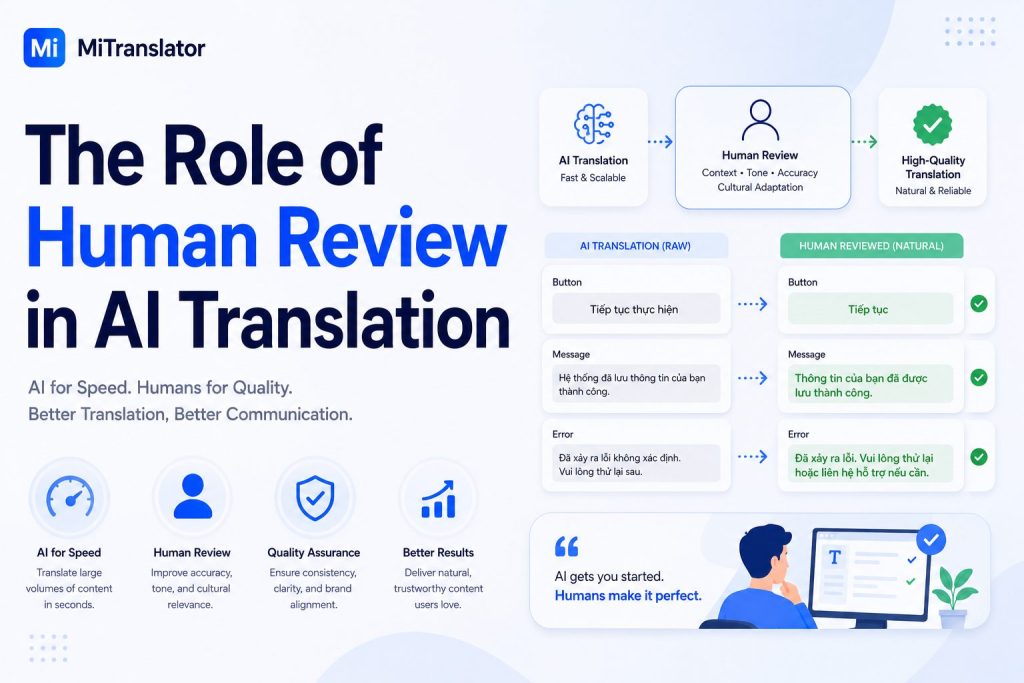
| AI Translation | Human-Reviewed UX Writing |
|---|---|
| Vui lòng nhập thông tin vào ô bên dưới để tiếp tục thực hiện thao tác | Nhập thông tin để tiếp tục |
| Giao dịch của bạn đã được thực hiện thành công | Thanh toán thành công |
| Hệ thống gặp lỗi không xác định | Đã xảy ra lỗi. Vui lòng thử lại |
Human review improves readability, usability, and customer trust.
AI Translation Works Best With Human Collaboration
The most effective localization workflows combine:
- AI speed
- Human expertise
- Quality assurance processes
- Terminology management
- Localization review
This hybrid approach allows businesses to:
- Scale multilingual content faster
- Reduce operational costs
- Maintain translation quality
- Improve consistency across platforms
Modern enterprise localization is no longer about choosing between AI or humans — it is about combining both effectively.
When Human Review Is Most Important
Human review is especially critical for:
- Customer-facing content
- Marketing localization
- Legal documents
- Financial communication
- Technical documentation
- UX writing
- Healthcare content
- Brand messaging
- Enterprise communication
The higher the business impact, the more important professional review becomes.
Best Practices for AI Translation Workflows
Use AI for Speed and Scalability
AI translation works well for:
- Large-scale content processing
- Initial translation drafts
- Internal documentation
- Repetitive multilingual workflows
Use Human Review for Quality Control
Professional linguists should review:
- Tone
- Context
- Industry terminology
- Localization quality
- Customer experience
Maintain Translation Memory and Terminology
Consistent terminology helps businesses:
- Improve brand consistency
- Reduce editing time
- Support scalable localization workflows
Build a Centralized Localization Process
Global businesses benefit from structured workflows that combine:
- AI translation
- Human review
- QA systems
- Localization management
How MITRANS Combines AI Translation and Human Review
MITRANS Translator provides AI-assisted Vietnamese translation and localization services supported by professional human review workflows.
Our services include:
- AI-assisted translation
- Human QA review
- UX writing localization
- Business document translation
- Technical localization
- Multilingual workflow management
- Enterprise localization support
MITRANS supports multiple language pairs, including:
- English ↔ Vietnamese
- Chinese ↔ Vietnamese
- Japanese ↔ Vietnamese
- Korean ↔ Vietnamese
- French ↔ Vietnamese
By combining AI efficiency with expert linguistic review, MITRANS helps businesses scale multilingual content while maintaining professional translation quality.
Frequently Asked Questions
Can AI translation replace human translators?
AI translation improves speed and scalability, but human review is still essential for quality, tone, context, and localization accuracy.
What is machine translation post-editing (MTPE)?
MTPE is the process of reviewing and improving AI-generated translations through professional human editing and quality assurance.
Why is human review important for Vietnamese localization?
Vietnamese communication relies heavily on natural tone, context, and cultural adaptation, which AI systems may not consistently handle well.
Does MITRANS provide AI-assisted translation workflows?
Yes. MITRANS combines AI-assisted translation technology with professional human review to deliver scalable and high-quality localization solutions.
Conclusion
AI translation has become an essential part of modern multilingual workflows, helping businesses scale content faster and more efficiently. However, professional human review remains critical for ensuring localization quality, natural communication, and customer trust.
From UX writing and marketing content to technical documentation and enterprise communication, the best localization results come from combining AI efficiency with human expertise.
Need Vietnamese Translation or Localization Support?
MITRANS helps global businesses manage multilingual communication, localization, and Vietnamese market operations with quality-controlled translation workflows.
Contact MITRANS Translator today for fast, accurate, and professional language solutions tailored to your business.