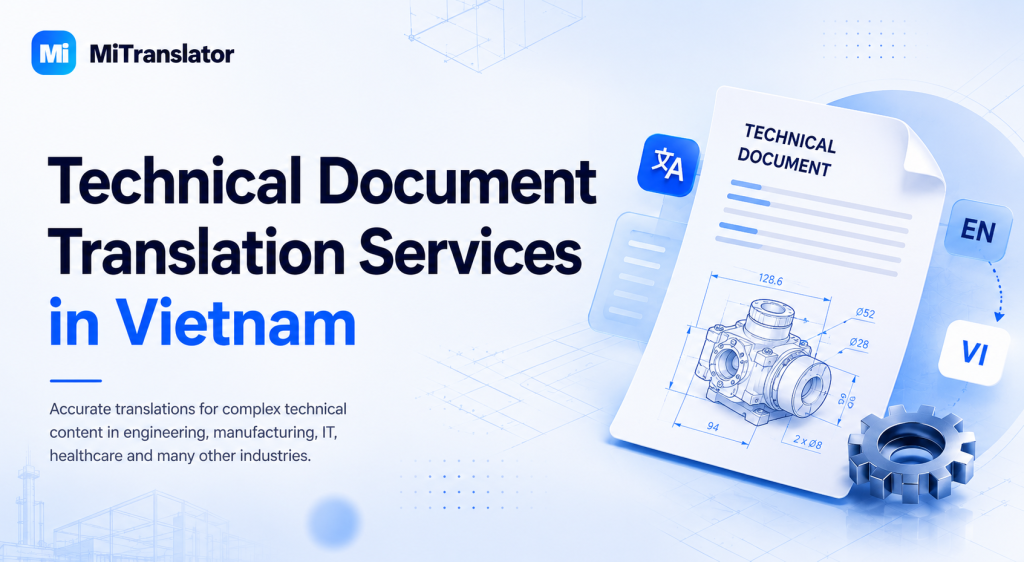
Technical documents contain critical information that supports manufacturing, engineering, technology, healthcare, energy, and industrial operations. When businesses expand into international markets or collaborate with global partners, accurate technical document translation becomes essential for maintaining quality, safety, compliance, and operational efficiency.
Professional technical document translation services in Vietnam help companies communicate complex technical information clearly while ensuring terminology accuracy and industry compliance.
What Are Technical Document Translation Services?
Technical document translation involves converting specialized technical content from one language to another while preserving the original meaning, technical accuracy, formatting, and industry-specific terminology.
Common technical documents include:
- User manuals
- Product specifications
- Engineering drawings
- Standard operating procedures (SOPs)
- Technical reports
- Installation guides
- Maintenance manuals
- Safety documentation
- Manufacturing processes
- Quality control procedures
- Research and development documents
- Software documentation
Unlike general translation, technical translation requires subject matter expertise and a deep understanding of technical terminology.
Why Technical Document Translation Matters
Ensuring Operational Accuracy
Technical documents guide employees, engineers, technicians, and end-users. Even minor translation errors can lead to misunderstandings that affect productivity and performance.
Supporting Product Safety
Many technical documents contain safety instructions and operational guidelines. Accurate translation helps reduce risks and supports workplace safety.
Facilitating Global Expansion
Businesses entering Vietnam or exporting products internationally must ensure technical information is available in the appropriate language for customers, partners, and regulatory authorities.
Meeting Regulatory Requirements
Certain industries require translated technical documentation to comply with local regulations, certifications, and quality standards.
Common Challenges in Technical Document Translation
Complex Technical Terminology
Technical content often contains highly specialized vocabulary that may not have direct equivalents in another language. Translators must understand both the language and the subject matter.
Industry-Specific Knowledge
Different industries use unique terminology and standards. Technical translators must be familiar with the specific sector involved.
Examples include:
- Manufacturing
- Engineering
- Automotive
- Electronics
- Medical devices
- Pharmaceuticals
- Information technology
- Construction
- Renewable energy
Maintaining Consistency
Large technical projects often involve hundreds of pages of documentation. Consistent terminology is essential to ensure clarity and accuracy across all materials.
Preserving Formatting and Structure
Technical documents frequently include tables, diagrams, drawings, charts, and complex formatting. Maintaining the original structure is often just as important as translating the content itself.
Common Technical Translation Mistakes to Avoid
Using General Translators for Technical Content
Without technical expertise, translators may misunderstand industry terminology and produce inaccurate translations.
Inconsistent Terminology
Using multiple translations for the same technical term can create confusion and reduce document reliability.
Ignoring Context
Technical terminology often changes meaning depending on the industry and application. Context is critical for accurate translation.
Failing to Review Technical Content
A quality assurance process should include both linguistic review and terminology verification.
Overreliance on Machine Translation
While machine translation can assist with basic content, technical documents often require human expertise to ensure accuracy and usability.
Best Practices for Technical Document Translation
Work with Subject Matter Experts
Professional technical translators should have experience in the relevant industry and understand technical concepts.
Use Terminology Management
Translation memories and approved glossaries help maintain consistency across projects and future updates.
Implement Multi-Step Quality Assurance
A professional workflow typically includes:
- Translation
- Technical terminology review
- Editing
- Proofreading
- Final quality verification
Preserve Original Formatting
Technical diagrams, tables, specifications, and document structures should remain clear and easy to use after translation.
Maintain Confidentiality
Technical documents often contain proprietary information, intellectual property, and confidential business data that require secure handling.
How MITRANS Supports Technical Document Translation in Vietnam
MITRANS provides professional technical document translation services for manufacturers, engineering firms, technology companies, healthcare organizations, and international businesses operating in Vietnam.
Our technical translation services include:
- User manuals and product guides
- Engineering documentation
- Technical specifications
- Manufacturing procedures
- Quality management documents
- Safety manuals
- Software documentation
- Equipment installation guides
- Research reports
- Industrial and technical contracts
With experienced linguists, industry-specific expertise, and rigorous quality assurance procedures, MITRANS helps businesses communicate technical information accurately across languages.
Frequently Asked Questions
What industries does MITRANS support for technical translation?
MITRANS supports manufacturing, engineering, technology, healthcare, automotive, electronics, construction, energy, logistics, and many other specialized industries.
Why is technical expertise important in translation?
Technical terminology often requires industry knowledge to ensure accuracy and prevent misunderstandings that could affect operations or safety.
Can technical documents be translated into multiple languages?
Yes. MITRANS supports a wide range of language pairs, including English, Vietnamese, Chinese, Korean, Japanese, and many other languages.
How does MITRANS ensure terminology consistency?
We use terminology management tools, translation memories, and quality assurance processes to maintain consistency across projects.
Is confidential technical information protected?
Yes. MITRANS follows strict confidentiality procedures to safeguard proprietary and sensitive technical documents.
Contact MITRANS for Technical Document Translation Services in Vietnam
Accurate technical translation is essential for operational efficiency, product safety, regulatory compliance, and international business success. If your organization needs reliable technical document translation services in Vietnam for manuals, specifications, engineering documents, safety procedures, software documentation, or other technical materials, MITRANS is ready to support you.
Contact MITRANS today for fast, accurate, and professional technical document translation services tailored to your industry and business requirements.