Introduction
As manufacturing companies expand globally, technical document translation becomes essential for maintaining operational efficiency, product quality, workplace safety, and international compliance.
Manufacturers often work with multilingual teams, overseas suppliers, international clients, and global production systems. Clear technical communication across languages is critical to avoid production errors, delays, misunderstandings, and safety risks.
Professional technical document translation helps manufacturing companies ensure accuracy, consistency, and smooth communication across international operations.
This guide explains why technical translation matters in manufacturing, common challenges companies face, and best practices for managing multilingual technical documentation.
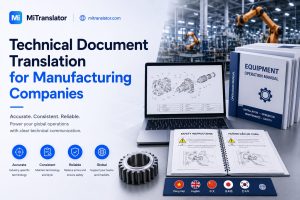
![Technical Document Translation for Manufacturing Companies — clean corporate banner with industrial manufacturing, technical manuals, and multilingual engineering communication theme]
What Is Technical Document Translation?
Technical document translation involves translating specialized industrial and technical materials while preserving:
- Technical accuracy
- Industry terminology
- Formatting consistency
- Operational clarity
Manufacturing companies commonly translate:
- Technical manuals
- SOPs (Standard Operating Procedures)
- Engineering specifications
- Product documentation
- Safety instructions
- Machinery manuals
- Quality control documents
- Training materials
- Maintenance guides
- Compliance documentation
Technical translation requires both language expertise and industry-specific knowledge.
Why Technical Translation Matters in Manufacturing
Reduces Operational Errors
Incorrect translation in technical documents may lead to:
- Production mistakes
- Equipment misuse
- Process failures
- Delays in operations
Clear multilingual communication helps manufacturing teams work more efficiently and safely.
Supports Workplace Safety
Safety instructions and machinery documentation must be translated accurately to reduce workplace risks.
Poor translation may create:
- Safety misunderstandings
- Incorrect equipment handling
- Compliance violations
Technical accuracy is critical in industrial environments.
Improves Global Collaboration
Manufacturing companies often coordinate across:
- International factories
- Suppliers
- Engineers
- Clients
- Logistics teams
Professional translation helps teams communicate consistently across languages and regions.
Helps Meet Regulatory & Compliance Requirements
Manufacturers may need translated technical documentation for:
- Product certification
- Customs procedures
- International compliance
- Government inspections
Accurate documentation supports smoother international operations.
Common Types of Manufacturing Documents That Require Translation
Machinery & Equipment Manuals
Manufacturers often translate:
- User manuals
- Installation guides
- Maintenance procedures
- Troubleshooting instructions
These documents require highly accurate terminology and formatting.
Engineering & Technical Specifications
Technical translation may include:
- CAD documentation
- Product specifications
- Assembly instructions
- Process engineering documents
Precision is essential because small translation errors can affect production quality.
Safety & Compliance Documents
Companies frequently translate:
- Safety guidelines
- Warning labels
- Compliance manuals
- ISO documentation
- Inspection reports
These documents are often subject to strict regulatory standards.
SOPs & Internal Manufacturing Procedures
Global manufacturing teams commonly require multilingual SOPs to standardize operations across facilities.
Training Materials
Manufacturing companies also translate:
- Technical training manuals
- Employee onboarding materials
- Equipment operation guides
Clear training documentation improves workforce efficiency and safety.
Challenges in Technical Translation
Complex Industry Terminology
Technical documents contain specialized terminology that requires subject-matter expertise.
Direct translation without industry knowledge may result in:
- Incorrect terminology
- Operational confusion
- Technical inaccuracies
Maintaining Consistency Across Large Projects
Manufacturers often manage:
- Thousands of pages
- Multiple product lines
- Ongoing updates
- Global documentation systems
Terminology consistency becomes essential.
Formatting & Technical Layout Requirements
Technical documents frequently contain:
- Tables
- Diagrams
- Measurements
- Engineering drawings
Formatting must remain accurate and organized after translation.
Tight Production Timelines
Manufacturing operations often require fast turnaround for:
- Product launches
- Equipment installation
- Compliance submissions
- Factory operations
Translation workflows must balance speed and accuracy.
Best Practices for Technical Document Translation
Work with Specialized Technical Translators
Choose translators experienced in:
- Manufacturing terminology
- Industrial workflows
- Engineering concepts
- Technical documentation standards
Technical expertise is critical for accuracy.
Build Terminology Glossaries
Glossaries help maintain consistent translation across:
- Product lines
- Machinery documentation
- Engineering specifications
- Safety procedures
Terminology management improves long-term efficiency.
Use Human Quality Assurance
Technical translation should include:
- Editing
- Proofreading
- Technical review
- Formatting verification
Quality assurance reduces operational risk.
Avoid Relying Solely on Machine Translation
AI translation tools may struggle with:
- Technical nuance
- Specialized terminology
- Context-sensitive instructions
Human review remains essential for manufacturing documentation.
Maintain Clear Version Control
Manufacturing documents are frequently updated.
Businesses should implement:
- Centralized document management
- Revision tracking
- Translation memory systems
This helps improve consistency and efficiency across future projects.
Technical Translation vs General Translation
| General Translation | Technical Translation |
|---|---|
| Focuses on general communication | Focuses on technical precision |
| Flexible wording | Strict terminology consistency |
| Suitable for everyday content | Suitable for industrial documentation |
| Lower operational risk | High operational and safety impact |
| Less specialized expertise required | Requires subject-matter expertise |
Technical manufacturing translation requires significantly higher precision and industry understanding.
How MITRANS Can Help
MITRANS Translation Services provides professional technical document translation services for manufacturing companies operating in Vietnam and international markets.
MITRANS supports translation across:
- English
- Vietnamese
- Chinese
- Japanese
- Korean
Technical translation services include:
- Machinery manual translation
- Engineering document translation
- SOP translation
- Safety document translation
- Compliance documentation
- Technical training materials
- Manufacturing process documentation
Why manufacturing companies choose MITRANS:
- Experienced technical translators
- Industry-specialized expertise
- Consistent terminology management
- Human quality assurance
- Fast turnaround times
- Confidential workflows
- Nationwide support across Vietnam
MITRANS helps manufacturers maintain accurate, professional, and efficient multilingual communication across global operations.
FAQ
Why is technical document translation important for manufacturers?
Technical translation helps manufacturers reduce operational errors, improve safety, support compliance, and improve communication across international teams.
Can machine translation handle technical documents accurately?
Machine translation may assist with basic understanding, but technical manufacturing documents require professional human review for accuracy and safety.
What technical documents are commonly translated?
Common documents include machinery manuals, SOPs, engineering specifications, safety instructions, and compliance documentation.
Why is terminology consistency important in manufacturing translation?
Consistent terminology helps reduce confusion, improve operational efficiency, and maintain quality across global manufacturing processes.
Does MITRANS provide technical translation services for manufacturers?
Yes. MITRANS provides professional technical document translation services tailored for manufacturing and industrial companies.
Need Professional Technical Translation Support for Manufacturing Operations?
Looking for accurate and reliable technical document translation services for your manufacturing business?
Contact MITRANS today for professional multilingual technical translation support tailored to your industry needs.