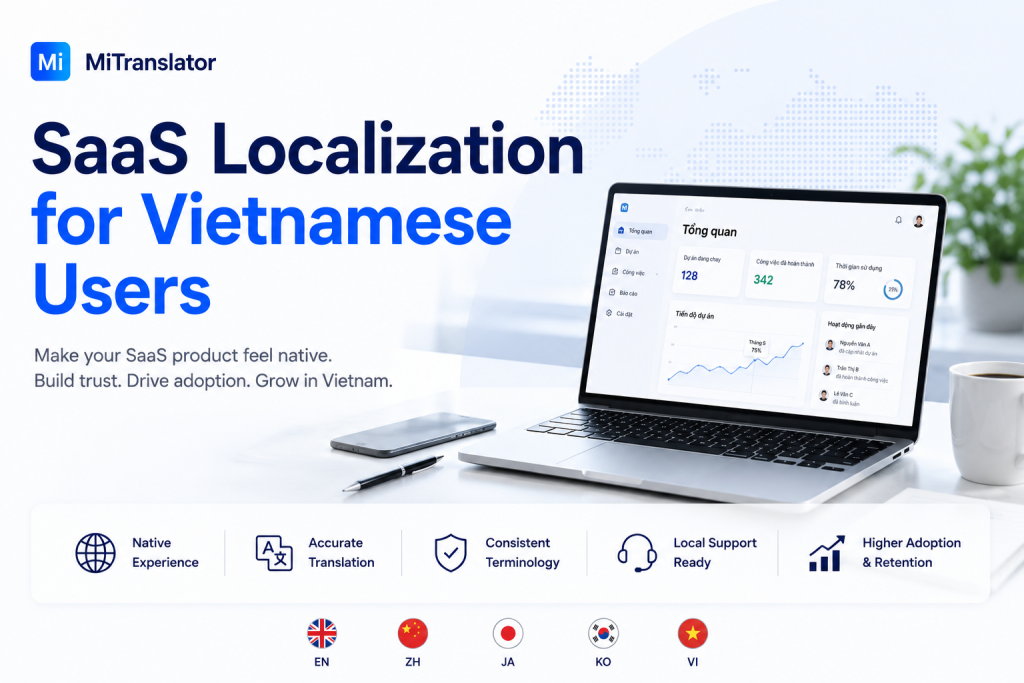
As Vietnam’s digital economy continues growing rapidly, more SaaS companies are expanding into the Vietnamese market to reach local businesses, consumers, and enterprise users. However, entering Vietnam successfully requires more than simply translating a product interface into Vietnamese.
Vietnamese users expect digital products to feel natural, localized, and culturally relevant. Poor localization can create:
- Confusing user experiences
- Lower product adoption
- Reduced customer trust
- Higher churn rates
- Support and onboarding problems
For SaaS companies expanding into Vietnam, localization has become a critical part of product growth and international expansion strategy.
In this article, we explore why SaaS localization matters for Vietnamese users, common localization challenges, and how businesses can build more effective multilingual product experiences.
What Is SaaS Localization?
SaaS localization is the process of adapting a software platform for users in a specific language and market.
Localization goes beyond direct translation and includes:
- UI translation
- UX writing adaptation
- Cultural localization
- Terminology consistency
- Customer support localization
- Product onboarding adaptation
- Documentation translation
The goal is to create a product experience that feels natural for Vietnamese users.
Why SaaS Localization Matters in Vietnam
Vietnam Has a Fast-Growing Digital Market
Vietnam continues seeing rapid growth in:
- SaaS adoption
- E-commerce
- Mobile applications
- Online business tools
- Digital transformation
- Startup ecosystems
Vietnamese businesses and consumers increasingly expect localized digital experiences.
Localized Products Build More Trust
Users are more likely to trust and adopt software when:
- Navigation feels natural
- Instructions are easy to understand
- Terminology is localized correctly
- Customer support is available in Vietnamese
Localization improves user confidence and onboarding success.
Vietnamese UX Expectations Are Different
Vietnamese users may interact differently with:
- Navigation structure
- CTA wording
- Form layouts
- Customer messaging
- Support communication
Direct English translation often creates awkward or unnatural user experiences.
Localization Improves Conversion and Retention
Well-localized SaaS products can improve:
- User onboarding
- Customer engagement
- Product adoption
- Retention rates
- Conversion performance
Localization directly impacts business growth in new markets.
Common SaaS Localization Challenges
Literal Translation Problems
Direct translation often creates:
- Unnatural UI wording
- Confusing navigation
- Poor onboarding experiences
- Inconsistent terminology
Effective localization focuses on clarity and usability.
Terminology Inconsistency
SaaS products frequently contain:
- Feature names
- Technical terms
- Workflow labels
- System notifications
Without terminology management, products may feel inconsistent and unprofessional.
UI Space and Layout Issues
Vietnamese text may:
- Be longer than English
- Require different formatting
- Affect UI spacing and readability
Localization should consider both language and interface design.
AI Translation Limitations
AI-assisted translation improves speed, but raw machine translation may:
- Miss UX context
- Create awkward phrasing
- Misinterpret product terminology
- Reduce usability
Human QA review remains important for product localization quality.
What SaaS Localization Typically Includes
SaaS localization often covers:
- Web applications
- Mobile apps
- User dashboards
- Onboarding flows
- Help centers
- Knowledge bases
- Product notifications
- Marketing websites
- Customer support content
- Technical documentation
A consistent multilingual experience across all touchpoints is essential.
Best Practices for SaaS Localization
Localize UX Writing, Not Just Text
Good UX localization focuses on:
- Clarity
- Simplicity
- User flow
- Natural communication
- Cultural expectations
The goal is usability, not literal translation accuracy.
Maintain Terminology Consistency
SaaS companies should standardize:
- Feature names
- Technical terminology
- Product workflows
- UI labels
- Brand communication
Consistency improves user trust and product clarity.
Combine AI Translation With Human Review
Modern SaaS localization workflows often combine:
- AI-assisted translation
- Translation memory systems
- Terminology management
- Human QA review
This improves both efficiency and localization quality.
Test Localization Inside the Product
Localization should be reviewed within the actual UI to check:
- Text overflow
- Layout consistency
- UX clarity
- Mobile responsiveness
- Product usability
Context matters in software localization.
Industries That Frequently Need SaaS Localization
SaaS localization is especially important for:
- Project management platforms
- CRM systems
- HR software
- E-commerce platforms
- Fintech applications
- Customer support systems
- Productivity tools
- Enterprise software
- AI platforms
- Mobile applications
These products rely heavily on user experience and clear multilingual communication.
How MITRANS Supports SaaS Localization
MITRANS Translator provides SaaS localization and multilingual workflow solutions for businesses expanding into Vietnam and Southeast Asia.
Our services include:
- SaaS UI localization
- UX writing localization
- Mobile app localization
- AI-assisted translation
- Human QA review
- Translation memory management
- Terminology management
- Enterprise localization workflows
MITRANS supports multiple language pairs, including:
- English ↔ Vietnamese
- Chinese ↔ Vietnamese
- Japanese ↔ Vietnamese
- Korean ↔ Vietnamese
- French ↔ Vietnamese
By combining professional linguists, scalable localization systems, and quality-controlled review workflows, MITRANS helps SaaS companies deliver more natural and effective user experiences for Vietnamese audiences.
Frequently Asked Questions
What is SaaS localization?
SaaS localization is the process of adapting software products, interfaces, and user experiences for specific languages and markets.
Why is localization important for Vietnamese users?
Localized products improve usability, customer trust, onboarding success, and user retention in the Vietnamese market.
Is AI translation enough for SaaS localization?
AI translation improves efficiency, but professional human review remains important for UX quality, terminology consistency, and contextual accuracy.
Does MITRANS support SaaS localization for Vietnam?
Yes. MITRANS provides SaaS localization services for websites, mobile apps, enterprise platforms, and multilingual software workflows.
Conclusion
As Vietnam’s digital market continues expanding, SaaS localization has become essential for businesses looking to improve user experience, customer trust, and product growth in the Vietnamese market.
From UI translation and onboarding flows to multilingual support and UX writing adaptation, professional localization helps SaaS companies create more natural and scalable experiences for Vietnamese users.
Need Vietnamese Translation or Localization Support?
MITRANS helps global businesses manage multilingual communication, localization, and Vietnamese market operations with quality-controlled translation workflows.
Contact MITRANS Translator today for fast, accurate, and professional language solutions tailored to your business.