
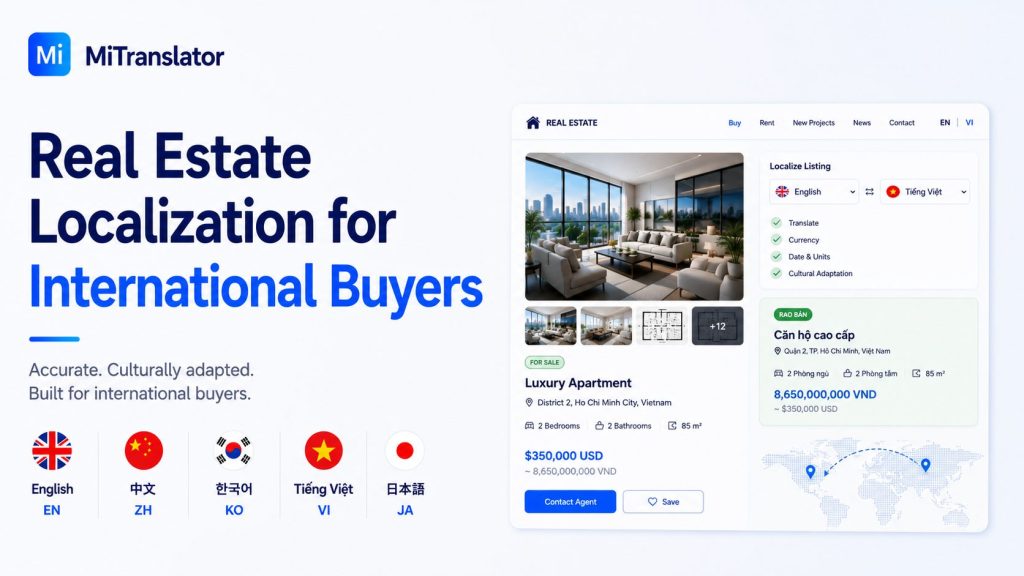

The real estate market has become increasingly global, with investors, expatriates, retirees, and overseas buyers actively searching for properties beyond their home countries. From luxury apartments and vacation homes to commercial developments and investment properties, international buyers now represent a significant segment of the real estate industry.
However, attracting international buyers requires more than simply translating property information into another language. Buyers from different countries have unique expectations, purchasing behaviors, legal concerns, and cultural preferences. To effectively engage these audiences, real estate companies must invest in localization.
Real estate localization helps developers, agencies, and property platforms adapt their content, communication, and marketing strategies to meet the needs of international buyers. This article explores what real estate localization means, why it matters, common challenges businesses face, and best practices for successfully reaching global property investors.
What Is Real Estate Localization for International Buyers?
Real estate localization is the process of adapting property-related content, marketing materials, websites, and customer communications to suit the language, cultural expectations, and market preferences of specific international audiences.
Localization goes beyond translation. While translation focuses on converting text from one language into another, localization ensures that content feels natural and relevant to buyers in different regions.
Real estate localization may include:
- Property listing localization
- Real estate website localization
- Property brochure translation
- Investment guide localization
- Multilingual marketing campaigns
- Localized property descriptions
- Currency and measurement conversion
- Legal document adaptation
- Customer support localization
- Multilingual SEO optimization
For example, a property developer marketing luxury apartments in Vietnam to Japanese investors may need to adapt messaging differently than when targeting buyers from South Korea, Singapore, Australia, or Europe.
Localization helps ensure that property information is understandable, culturally appropriate, and aligned with buyer expectations.
Why Real Estate Localization Matters for Businesses
Attracts More International Buyers
International buyers are more likely to engage with property information presented in their native language and adapted to their market expectations.
Localized content helps remove barriers and improves accessibility.
Builds Trust and Credibility
Purchasing real estate is a major financial decision.
When property information is professionally localized, buyers gain greater confidence in the developer, agency, or investment opportunity.
Trust is often a critical factor in international property transactions.
Improves Buyer Experience
International buyers frequently conduct extensive research before making inquiries.
Localized content helps buyers understand:
- Property features
- Ownership structures
- Investment opportunities
- Pricing information
- Location benefits
This creates a smoother purchasing journey.
Increases Lead Generation
Buyers are more likely to contact sales teams when property information is clear and relevant.
Localization improves engagement and helps generate more qualified inquiries.
Supports International Expansion
Real estate companies seeking global growth need marketing strategies tailored to different regions.
Localization enables businesses to enter new markets more effectively and compete with local providers.
Enhances Marketing Performance
Localized content often performs better in search engines, advertising campaigns, and social media channels because it aligns with local language and search behavior.
This can significantly improve return on marketing investment.
Common Challenges in Real Estate Localization
Cultural Differences in Property Preferences
Different buyers prioritize different property features.
For example:
- Investors may focus on rental yields and long-term appreciation.
- Families may prioritize schools and community amenities.
- Luxury buyers may seek exclusivity and lifestyle benefits.
- Retirees may value accessibility and healthcare services.
Localization helps emphasize the factors most important to each audience.
Complex Real Estate Terminology
Property terminology varies significantly between countries.
Terms such as:
- Condominium
- Penthouse
- Townhouse
- Leasehold
- Freehold
- Mixed-use development
may not have direct equivalents in every language.
Accurate localization is necessary to avoid misunderstandings.
Legal and Regulatory Differences
Property ownership laws differ between jurisdictions.
International buyers often require explanations regarding:
- Ownership rights
- Foreign ownership regulations
- Tax obligations
- Purchase procedures
Localized content helps communicate these concepts clearly.
Maintaining Consistency Across Markets
Real estate companies often market projects in multiple languages simultaneously.
Ensuring consistency across websites, brochures, advertising campaigns, and property listings can be challenging without structured localization processes.
Currency and Measurement Differences
Buyers expect information in familiar formats.
Localization may require adapting:
- Currency displays
- Area measurements
- Date formats
- Numerical conventions
This improves usability and understanding.
Frequent Content Updates
Property availability, pricing, promotions, and project information frequently change.
Keeping localized content current across multiple markets requires efficient workflows.
Best Practices for Real Estate Localization
Research Target Markets
Understand the needs and expectations of your target audience before localizing content.
Consider:
- Buyer demographics
- Investment goals
- Cultural preferences
- Property purchasing behaviors
Market research improves localization effectiveness.
Focus on Buyer-Centric Messaging
Property descriptions should highlight benefits that matter most to the target audience.
Different markets may respond to different selling points.
Standardize Real Estate Terminology
Develop multilingual glossaries covering:
- Property types
- Legal terminology
- Investment language
- Amenities
- Construction terminology
Consistency improves professionalism and clarity.
Localize Websites and Property Listings
Property websites and listings should be fully adapted to local audiences.
This includes:
- Language localization
- Currency conversion
- Area measurements
- Search functionality
- Contact information
A localized user experience encourages engagement.
Optimize for Multilingual SEO
International buyers often search for properties using local language keywords.
SEO localization should include:
- Localized keywords
- Region-specific search terms
- Multilingual metadata
- Market-specific content
This helps attract qualified traffic from target regions.
Provide Multilingual Customer Support
Localization should extend beyond marketing materials.
Offering multilingual support through email, chat, and sales consultations improves communication and buyer confidence.
Real Estate Localization Checklist
Before launching localized property marketing materials, verify that:
- Property information is accurate.
- Content reflects local buyer preferences.
- Terminology is consistent.
- Currency and measurements are localized.
- Legal concepts are clearly explained.
- SEO content is optimized.
- Quality assurance reviews have been completed.
How MITRANS Can Help
Successful real estate localization requires more than language translation. It requires cultural adaptation, market understanding, and industry expertise.
MITRANS provides professional translation and localization services for real estate developers, agencies, property portals, investment firms, and international property marketers.
Our services include:
- Property listing localization
- Real estate website translation
- Property brochure localization
- Investment guide translation
- Multilingual SEO localization
- Real estate marketing translation
- Customer support localization
- Legal real estate document translation
- Property platform localization
- Linguistic review and quality assurance
Our experienced linguists understand both real estate terminology and international buyer behavior, helping businesses communicate effectively across global markets.
With expertise in English, Vietnamese, Chinese, Japanese, Korean, German, French, and many other languages, MITRANS helps real estate companies attract international buyers and expand their global reach.
Frequently Asked Questions About Real Estate Localization
What is real estate localization?
Real estate localization is the process of adapting property content, marketing materials, and customer communications to suit the language and cultural expectations of international buyers.
How is localization different from translation?
Translation converts text into another language, while localization adapts content to reflect local market preferences, cultural expectations, and buyer behaviors.
Why is localization important for international property sales?
Localization helps buyers better understand property information, improves trust, enhances customer experience, and increases lead generation.
Which real estate materials should be localized?
Property listings, websites, brochures, investment guides, marketing campaigns, customer support materials, and legal documents are commonly localized.
Can localization improve real estate marketing performance?
Yes. Localized content often achieves higher engagement, better search visibility, stronger lead generation, and improved conversion rates.
Need Real Estate Localization Support for International Buyers?
Looking to attract overseas investors and international property buyers with localized real estate content that builds trust and drives inquiries?
Contact MITRANS today for fast, accurate, and professional real estate translation and localization services tailored to developers, agencies, property portals, and global real estate brands.