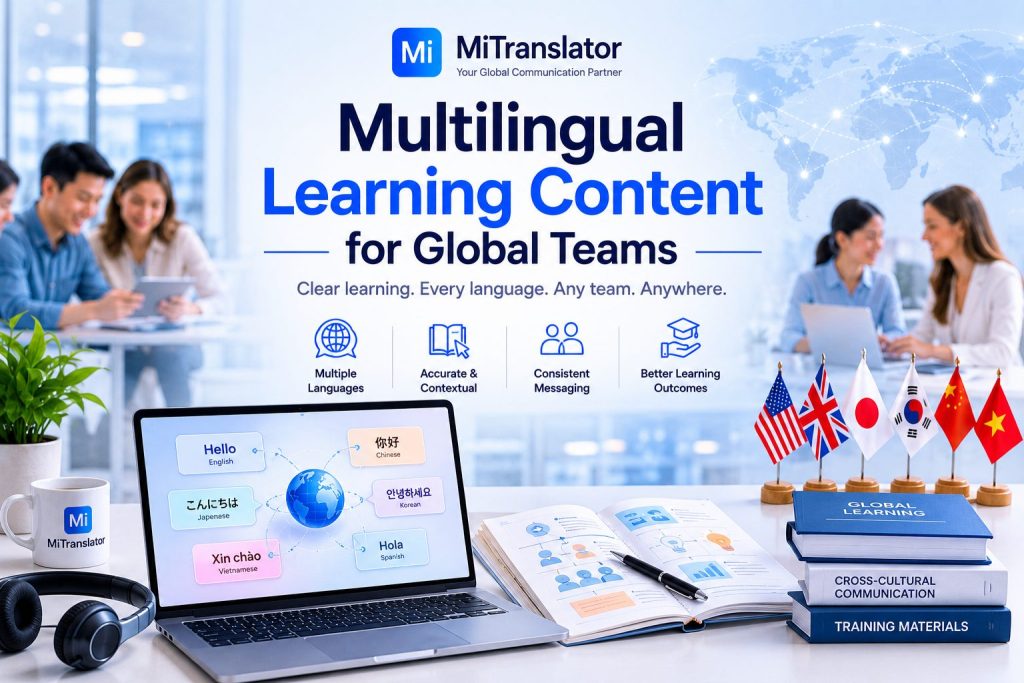
As businesses expand across international markets, organizations increasingly rely on geographically dispersed teams to drive growth, innovation, and operational success. Employees may work from different countries, speak different languages, and come from diverse cultural backgrounds. While this diversity brings valuable perspectives, it can also create challenges when delivering training and learning programs.
To ensure that all employees receive consistent knowledge and development opportunities, organizations must provide learning materials that are accessible to everyone. Multilingual learning content helps global teams understand training materials, comply with company policies, and develop the skills needed to perform effectively.
By investing in professional translation and localization services, organizations can create engaging learning experiences that support workforce development on a global scale.
What Is Multilingual Learning Content?
Multilingual learning content refers to training and educational materials that have been translated and localized into multiple languages for international audiences.
Examples include:
- Employee onboarding programs
- Corporate training courses
- E-learning modules
- Compliance training materials
- Leadership development programs
- Technical training documentation
- Learning management system (LMS) content
- Training videos and webinars
- Employee handbooks
- Internal knowledge resources
The objective is to ensure that employees across different regions receive the same information and learning experience regardless of language.
Why Multilingual Learning Content Matters for Global Teams
Improving Learning Outcomes
Employees learn more effectively when training materials are presented in their native language.
Clear and accessible content helps learners:
- Understand concepts faster
- Retain information more effectively
- Complete training with greater confidence
- Apply knowledge accurately in the workplace
Multilingual training reduces misunderstandings and improves overall learning effectiveness.
Creating Consistent Training Experiences
Global organizations often need to ensure that employees receive the same information regardless of location.
Multilingual learning content helps maintain consistency across:
- Company policies
- Operational procedures
- Compliance requirements
- Product knowledge
- Customer service standards
This consistency supports organizational alignment and performance.
Enhancing Employee Engagement
Employees are more likely to participate in training when content feels relevant and easy to understand.
Providing localized learning materials demonstrates a commitment to inclusion and helps employees feel valued within the organization.
Supporting Global Growth
As companies enter new markets, they must quickly train employees, partners, and distributors across different regions.
Multilingual learning programs enable organizations to scale training initiatives efficiently and support international expansion.
Common Challenges in Developing Multilingual Learning Content
Language Complexity
Training materials often contain technical terminology, industry-specific language, and company-specific concepts.
Accurate translation is essential to preserve the meaning and effectiveness of the original content.
Cultural Differences
Examples, references, visuals, and communication styles may not resonate equally across cultures.
Content that works well in one market may require adaptation to remain relevant and engaging elsewhere.
Maintaining Consistency Across Languages
Large organizations often manage training content in multiple languages simultaneously.
Without proper terminology management, inconsistencies can occur across courses, manuals, and learning platforms.
Multimedia Localization
Modern learning content frequently includes:
- Videos
- Interactive exercises
- Simulations
- Audio recordings
- Infographics
These elements require specialized localization to ensure a seamless learning experience.
Frequent Content Updates
Training materials are regularly updated to reflect changes in products, policies, technologies, and regulations.
Organizations must ensure that translated versions remain synchronized with the original content.
Best Practices for Multilingual Learning Content
Start with International Audiences in Mind
Design learning content that can be easily adapted for different languages and cultures.
Avoid overly localized references that may be difficult to translate effectively.
Use Professional Translation and Localization Services
Professional linguists with expertise in corporate training and instructional content can ensure both linguistic accuracy and educational effectiveness.
Localization helps make content feel natural and relevant to target audiences.
Develop Standardized Terminology
A centralized glossary of approved terminology helps maintain consistency across all learning materials.
This is especially important for technical, compliance, and industry-specific training.
Adapt Multimedia Content
Learning videos, graphics, captions, voiceovers, and interactive elements should be localized alongside written content.
Comprehensive localization creates a more engaging learning experience.
Implement Quality Assurance Processes
All multilingual learning content should undergo review for:
- Translation accuracy
- Terminology consistency
- Cultural appropriateness
- User experience
- Functional performance
Quality assurance helps maximize training effectiveness.
Multilingual Learning Content Checklist
Before launching multilingual training programs, ensure that you:
✔ Translate all learning materials professionally
✔ Localize examples and cultural references
✔ Maintain terminology consistency
✔ Adapt multimedia components
✔ Review content for cultural appropriateness
✔ Test e-learning functionality across languages
✔ Update translated content regularly
✔ Ensure accessibility for global learners
✔ Conduct quality assurance reviews
✔ Gather learner feedback for continuous improvement
How MITRANS Can Help
Creating multilingual learning content requires more than translation. It requires careful localization that preserves educational value, cultural relevance, and learner engagement.
MITRANS provides professional translation and localization services for:
- Corporate training programs
- Employee onboarding materials
- E-learning courses
- Compliance training modules
- Learning management systems
- Technical training documentation
- Training videos and subtitles
- Employee handbooks
- Knowledge base content
- Leadership development programs
Our experienced linguists help organizations deliver consistent, engaging, and effective learning experiences for employees across global markets.
Frequently Asked Questions
What is multilingual learning content?
Multilingual learning content refers to training and educational materials that have been translated and localized into multiple languages to support international learners.
Why is multilingual training important for global teams?
It improves understanding, increases engagement, supports consistency, and helps employees learn more effectively in their preferred language.
What types of learning materials can be localized?
Organizations commonly localize e-learning modules, onboarding programs, training manuals, videos, compliance courses, and learning management system content.
What is the difference between translation and localization?
Translation converts text from one language to another, while localization adapts content to fit cultural, linguistic, and regional expectations.
Can machine translation be used for training content?
Machine translation may assist with basic understanding, but professional human translation is recommended to ensure accuracy, engagement, and instructional effectiveness.
Conclusion
As organizations continue to build international workforces, multilingual learning content has become a critical component of successful employee development. By providing training materials in multiple languages, companies can improve learning outcomes, strengthen employee engagement, and maintain consistency across global operations.
Investing in professional translation and localization services enables organizations to deliver meaningful learning experiences that support business growth and workforce success worldwide.
Need Multilingual Learning Content for Your Global Teams?
Looking to localize training materials, e-learning courses, onboarding programs, or employee development resources for international audiences?
Contact MITRANS today for fast, accurate, and professional translation and localization services tailored to multinational companies, training providers, corporate learning teams, and global workforce development programs.