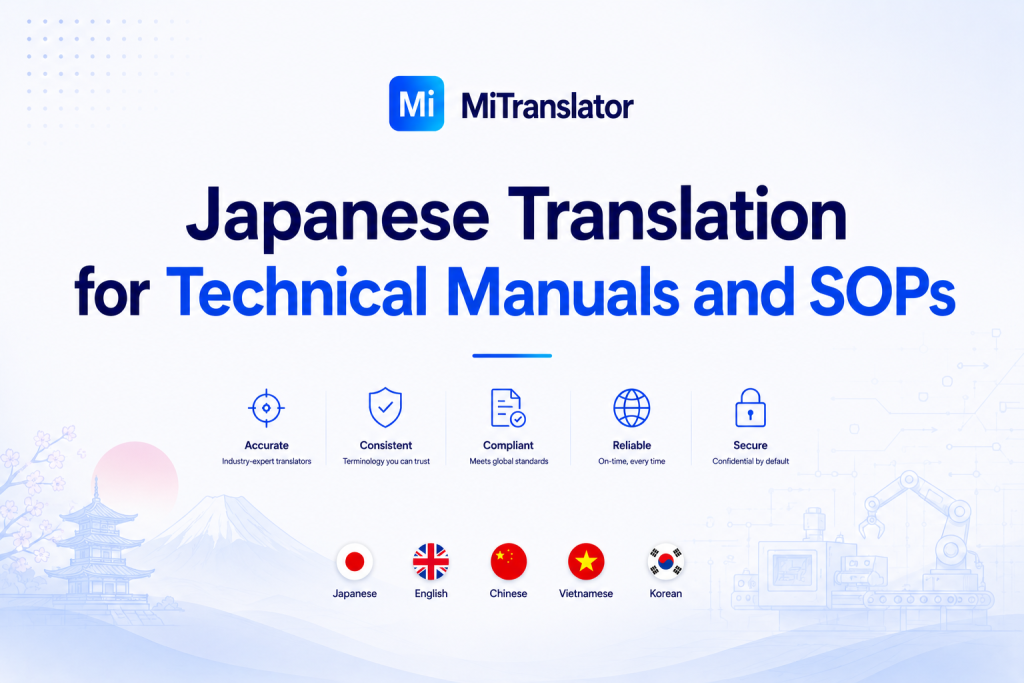
Japan remains one of Vietnam’s largest sources of foreign direct investment, particularly in manufacturing, automotive, electronics, machinery, and industrial production. As Japanese companies establish factories and supply chains in Vietnam, the need for accurate translation of technical manuals and Standard Operating Procedures (SOPs) continues to grow.
Technical manuals and SOPs are essential documents that support equipment operation, employee training, quality control, workplace safety, and regulatory compliance. Professional Japanese translation for technical manuals and SOPs helps organizations ensure that critical information is communicated clearly across multilingual teams while maintaining operational consistency and product quality.
Why Japanese Technical Document Translation Matters
Japanese manufacturers are known for their strict quality standards, detailed operational procedures, and continuous improvement methodologies. Technical documentation often forms the backbone of these systems.
Accurate translation helps companies:
- Maintain production consistency
- Improve employee understanding
- Support quality management systems
- Reduce operational errors
- Improve workplace safety
- Facilitate technology transfer
- Support international collaboration
When technical documents are translated incorrectly, the consequences can include production defects, equipment damage, safety incidents, and audit findings.
What Are Technical Manuals?
Technical manuals provide detailed information about equipment, machinery, systems, and production processes. These documents help operators, technicians, and engineers understand how equipment should be installed, operated, maintained, and repaired.
Common technical manuals requiring Japanese translation include:
- Machinery operation manuals
- Equipment installation guides
- Maintenance manuals
- Troubleshooting guides
- Technical specifications
- User manuals
- Service manuals
- Parts catalogs
- Equipment calibration procedures
- Engineering documentation
These materials often contain highly specialized terminology that requires both linguistic and technical expertise.
What Are SOPs?
Standard Operating Procedures (SOPs) are documents that describe how specific tasks and processes should be performed within an organization.
SOPs help ensure that operations are carried out consistently and according to established standards.
Common manufacturing SOPs include:
- Production procedures
- Assembly instructions
- Quality control processes
- Inspection procedures
- Safety procedures
- Equipment operating instructions
- Maintenance procedures
- Warehouse operations guidelines
- Environmental management procedures
- Employee training instructions
For Japanese-invested factories in Vietnam, SOP translation plays a critical role in maintaining operational consistency between headquarters and local production facilities.
Industries That Commonly Require Japanese Technical Translation
Automotive Manufacturing
Japanese automotive manufacturers rely on extensive documentation covering:
- Production processes
- Quality standards
- Equipment operation
- Inspection procedures
- Supplier requirements
Accurate translation helps maintain the high quality standards expected within the automotive industry.
Electronics Manufacturing
Vietnam hosts numerous Japanese electronics manufacturers requiring translation of:
- Technical specifications
- Production manuals
- Assembly procedures
- Testing protocols
- Quality documentation
Industrial Equipment and Machinery
Machinery suppliers often provide technical documentation in Japanese that must be translated for local operators and maintenance teams.
Precision Engineering
Precision manufacturing requires detailed instructions and exact terminology to ensure product quality and process consistency.
Medical Device Manufacturing
Medical device facilities frequently require multilingual SOPs, technical manuals, and quality management documentation.
Common Challenges in Japanese Technical Manual and SOP Translation
Specialized Technical Terminology
Japanese technical documentation often contains highly specialized vocabulary related to:
- Manufacturing processes
- Engineering systems
- Industrial automation
- Electronics
- Mechanical equipment
- Quality management
Translators must understand the technical meaning behind each term rather than simply translating words literally.
Industry-Specific Language
Many Japanese manufacturers use terminology unique to their production systems and internal processes.
Maintaining consistency across documents is essential for operational accuracy.
Complex Process Descriptions
Japanese technical documents frequently include detailed explanations of workflows, inspection procedures, and quality requirements.
These instructions must remain clear and actionable after translation.
Formatting and Visual Elements
Technical manuals and SOPs often contain:
- Process flowcharts
- Equipment diagrams
- Tables
- Checklists
- Technical illustrations
- Safety warnings
Translations should preserve both content and usability.
Risks of Poor Technical Translation
Production Errors
Misunderstood instructions can lead to process deviations, defects, and inconsistent product quality.
Workplace Safety Issues
Incorrectly translated safety procedures may increase the risk of accidents and equipment damage.
Increased Downtime
Maintenance teams may struggle to diagnose and resolve problems if troubleshooting documentation is unclear.
Audit Findings
Translation inconsistencies can create non-conformities during customer audits, ISO audits, and internal reviews.
Higher Training Costs
Employees often require additional supervision and retraining when documentation is difficult to understand.
Best Practices for Translating Japanese Technical Manuals and SOPs
Use Specialized Technical Translators
Technical documentation should be translated by professionals familiar with manufacturing terminology and industrial processes.
Maintain Terminology Consistency
Translation memories and approved glossaries help ensure consistent terminology across manuals, SOPs, work instructions, and quality documents.
Implement Multi-Level Quality Assurance
A professional technical translation workflow should include:
- Translation
- Technical terminology review
- Editing and proofreading
- Formatting verification
- Final quality assurance review
Preserve Original Structure
Document numbering, diagrams, process flows, and visual references should remain consistent with the source materials.
Protect Confidential Information
Technical manuals and SOPs often contain proprietary manufacturing knowledge that requires secure handling and confidentiality protection.
How Japanese Technical Translation Supports Manufacturing Operations in Vietnam
Accurate Japanese translation helps Vietnamese factories:
- Improve communication between Japanese and Vietnamese teams
- Reduce operational misunderstandings
- Accelerate employee training
- Improve quality control
- Support ISO compliance
- Enhance workplace safety
- Facilitate technology transfer
These benefits contribute directly to operational efficiency and long-term business success.
How MITRANS Supports Japanese Technical Manual and SOP Translation
MITRANS provides professional Japanese translation services for manufacturers, engineering companies, industrial facilities, and multinational organizations operating in Vietnam.
Our services include translation of:
- Technical manuals
- Equipment documentation
- SOPs
- Work instructions
- Quality manuals
- Process specifications
- Maintenance procedures
- Safety documentation
- Technical drawings
- Manufacturing documentation
Our translators combine language expertise with technical knowledge to ensure accurate and reliable translations for industrial environments.
Frequently Asked Questions
Why is technical expertise important for Japanese manual translation?
Technical documentation contains specialized terminology that requires industry knowledge to ensure accuracy and usability.
Can MITRANS translate manufacturing SOPs from Japanese to Vietnamese?
Yes. MITRANS regularly supports Japanese-Vietnamese translation projects involving SOPs, work instructions, quality manuals, and production documentation.
How does MITRANS ensure terminology consistency?
We use terminology databases, translation memories, and multi-step review processes to maintain consistency across large documentation sets.
Can technical diagrams and formatting be preserved?
Yes. We preserve tables, diagrams, flowcharts, illustrations, and document structures whenever possible.
Is confidential manufacturing information protected?
Absolutely. MITRANS follows strict confidentiality procedures and secure document management practices to protect client information.
Contact MITRANS for Japanese Translation of Technical Manuals and SOPs
Accurate translation of technical manuals and SOPs is essential for maintaining quality standards, workplace safety, production efficiency, and successful collaboration between Japanese and Vietnamese teams. If your organization requires professional Japanese translation services for manufacturing documentation, technical manuals, work instructions, or SOPs, MITRANS is ready to support you.
Contact MITRANS today for fast, accurate, and professional Japanese technical translation services tailored to the needs of manufacturing and engineering companies.