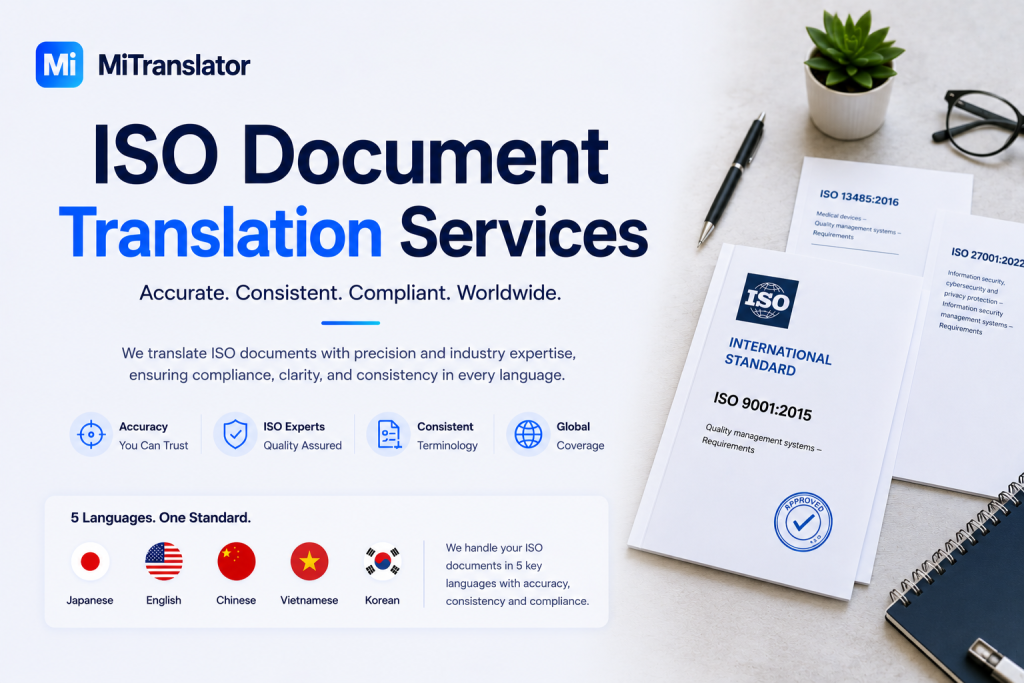
ISO standards play a vital role in helping organizations improve quality, safety, efficiency, and operational consistency. Companies seeking ISO certification or managing international operations often need their ISO documentation translated into multiple languages to support employees, auditors, customers, and regulatory authorities.
Accurate ISO document translation is essential because these documents define critical processes, procedures, and management systems that directly impact compliance and business performance. Professional ISO document translation services help organizations maintain consistency across multilingual environments while ensuring compliance with international standards.
What Are ISO Document Translation Services?
ISO document translation involves translating management system documentation, procedures, policies, manuals, and audit-related materials associated with International Organization for Standardization (ISO) standards.
Unlike general business translation, ISO document translation requires a strong understanding of quality management systems, compliance terminology, and industry-specific requirements.
Common ISO-related documents that require translation include:
- Quality manuals
- Standard Operating Procedures (SOPs)
- Work instructions
- Quality policies
- Process documentation
- Internal audit reports
- Corrective action reports
- Risk assessment documents
- Compliance records
- Employee training materials
- Certification documents
- Management review reports
These documents must be translated accurately to ensure employees and stakeholders understand and follow the same requirements regardless of language.
Why Accurate ISO Document Translation Matters
Supporting ISO Certification and Audits
Many organizations operate across multiple countries and require multilingual documentation during certification audits and compliance reviews.
Accurate translations help ensure that auditors, employees, and management teams have access to consistent information throughout the certification process.
Maintaining Process Consistency
ISO standards emphasize standardized procedures and continuous improvement. Poorly translated documents can lead to inconsistent implementation across departments and locations.
Professional translation helps organizations maintain uniform processes and quality standards.
Improving Employee Understanding
Many companies employ multilingual workforces. Providing ISO documentation in employees’ native languages improves understanding, training effectiveness, and compliance with established procedures.
Supporting Global Business Expansion
As companies expand into international markets, translated ISO documentation helps establish operational consistency across subsidiaries, factories, offices, and business partners.
Common ISO Standards That Require Document Translation
ISO 9001 – Quality Management Systems
ISO 9001 is one of the most widely adopted standards worldwide. Organizations frequently translate:
- Quality manuals
- Process procedures
- Quality objectives
- Audit documentation
- Corrective action reports
ISO 14001 – Environmental Management Systems
Environmental compliance often requires multilingual documentation, including:
- Environmental policies
- Waste management procedures
- Environmental impact assessments
- Compliance records
ISO 45001 – Occupational Health and Safety Management Systems
Safety-related documentation is particularly important for multilingual workforces.
Common documents include:
- Safety procedures
- Risk assessments
- Incident reporting procedures
- Emergency response plans
ISO 22000 – Food Safety Management Systems
Food manufacturers and processors often require translation of:
- HACCP documentation
- Food safety procedures
- Inspection records
- Compliance manuals
IATF 16949 and Industry-Specific Standards
Manufacturers serving automotive, aerospace, medical device, and electronics industries often require specialized documentation translation to meet customer and regulatory requirements.
Common Challenges in ISO Document Translation
Technical and Compliance Terminology
ISO documentation contains specialized terminology related to quality management, risk management, auditing, corrective actions, and compliance systems.
Translators must understand both the language and the management system context.
Consistency Across Large Document Sets
Organizations may maintain hundreds of interconnected procedures, forms, policies, and records.
Consistent terminology is critical to avoid confusion and maintain compliance.
Preserving Document Structure
ISO documents often contain:
- Process flowcharts
- Procedures
- Tables
- Forms
- Checklists
- Risk matrices
These elements must remain clear and functional after translation.
Industry-Specific Requirements
Different industries apply ISO standards differently. A pharmaceutical company, electronics manufacturer, and logistics provider may all use ISO systems but require different terminology and documentation approaches.
Risks of Poorly Translated ISO Documents
Audit Findings and Non-Conformities
Inaccurate documentation can create inconsistencies that auditors may identify during certification or surveillance audits.
Operational Confusion
Employees may misunderstand procedures, resulting in inconsistent implementation across departments or locations.
Increased Compliance Risks
Translation errors may affect compliance with internal requirements, customer expectations, or regulatory obligations.
Reduced Training Effectiveness
Employees cannot effectively follow procedures they do not fully understand. Clear translation supports successful training programs.
Quality and Safety Issues
Misunderstood instructions can affect product quality, workplace safety, and customer satisfaction.
Best Practices for ISO Document Translation
Work with ISO Documentation Specialists
Professional translators with experience in management systems understand compliance terminology and documentation structures.
Develop Approved Terminology Glossaries
Terminology management helps maintain consistency across procedures, manuals, forms, and audit records.
Implement Comprehensive Quality Assurance
A professional ISO translation workflow should include:
- Translation
- Terminology review
- Editing and proofreading
- Formatting verification
- Final quality assurance review
Preserve Original Formatting
Document numbering, revision controls, process maps, and forms should remain consistent with the original version.
Maintain Confidentiality
ISO documentation often contains sensitive operational information that requires secure handling and confidentiality protection.
How MITRANS Supports ISO Document Translation
MITRANS provides professional ISO document translation services for manufacturers, service providers, healthcare organizations, logistics companies, educational institutions, and multinational corporations.
We support the translation of:
- ISO quality manuals
- SOPs and work instructions
- Audit reports
- Corrective action documentation
- Risk assessments
- Training materials
- Compliance procedures
- Certification documents
- Environmental management documentation
- Health and safety procedures
MITRANS supports multiple language pairs commonly used by international businesses, including:
- English ↔ Vietnamese
- Korean ↔ Vietnamese
- Japanese ↔ Vietnamese
- Chinese ↔ Vietnamese
Our experienced translators combine linguistic expertise with knowledge of quality management systems to deliver accurate, consistent, and professional ISO document translations.
Frequently Asked Questions
Why is ISO document translation important?
ISO document translation helps organizations maintain compliance, support audits, improve employee understanding, and ensure consistent implementation of management systems across multilingual operations.
Can MITRANS translate ISO 9001 documentation?
Yes. MITRANS regularly supports the translation of quality manuals, procedures, audit reports, corrective action records, and other ISO 9001 documentation.
How does MITRANS ensure terminology consistency?
We use terminology databases, translation memories, and multi-step quality control processes to maintain consistency across all ISO documents.
Can translated ISO documents retain their original formatting?
Yes. We preserve document structure, numbering systems, tables, forms, and process diagrams whenever possible.
Is confidential company information protected?
Absolutely. MITRANS follows strict confidentiality procedures and secure document handling practices to protect all client information.
Contact MITRANS for ISO Document Translation Services
Accurate ISO document translation is essential for maintaining compliance, supporting certification audits, improving employee understanding, and ensuring operational consistency across multilingual organizations. If your company requires professional translation of ISO manuals, procedures, audit reports, work instructions, training materials, or other management system documentation, MITRANS is ready to support you.
Contact MITRANS today for fast, accurate, and professional ISO document translation services tailored to your industry and compliance requirements.