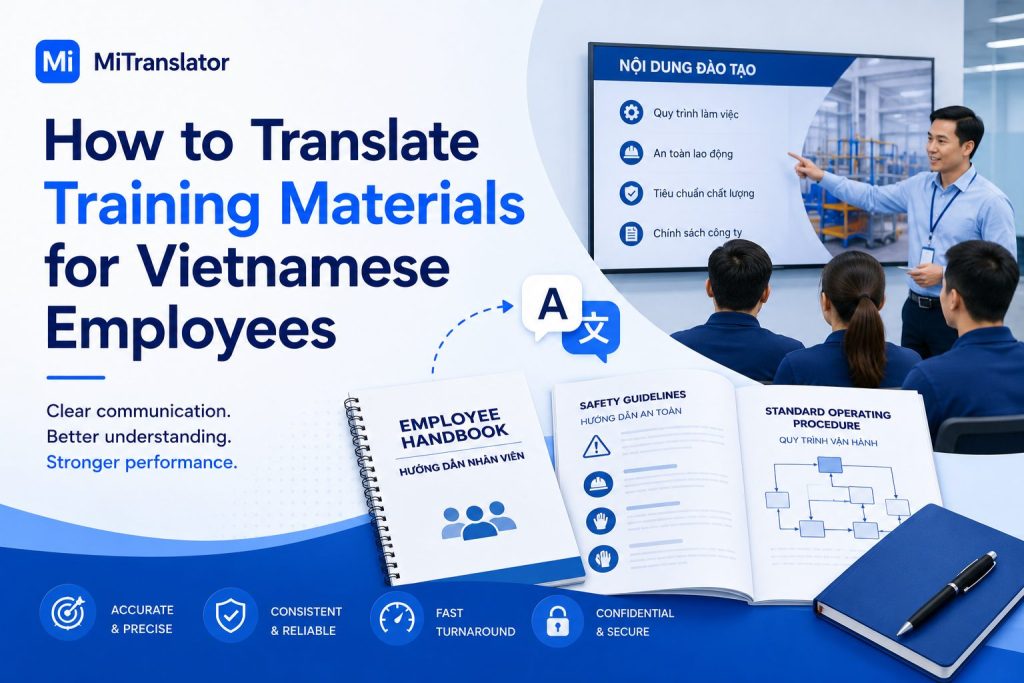
As more international companies expand operations in Vietnam, the need for effective employee training translation continues to grow. Businesses must ensure that Vietnamese employees fully understand workplace procedures, safety guidelines, technical instructions, compliance requirements, and company policies.
Professional training material translation helps organizations improve communication, reduce operational risks, and create a more productive workforce.
Poorly translated training content can lead to misunderstandings, reduced employee engagement, safety incidents, and compliance problems. That is why training translation requires not only language accuracy but also cultural adaptation and clear communication.
Why Training Material Translation Matters
Training materials play a critical role in helping employees understand:
- Workplace procedures
- Operational standards
- Safety protocols
- Technical instructions
- HR policies
- Compliance requirements
- Product knowledge
- Customer service processes
For multinational companies operating in Vietnam, translating training content into Vietnamese helps employees learn more effectively and perform their roles with greater confidence.
Common Types of Training Materials
Businesses often need translation for:
- Employee handbooks
- Safety manuals
- SOPs (Standard Operating Procedures)
- E-learning modules
- Manufacturing instructions
- Technical training guides
- HR onboarding materials
- Compliance training documents
- Presentation slides
- Video subtitles and voiceovers
- Software training content
Training materials may also require localization for different industries and workforce environments.
Challenges in Translating Training Materials
Maintaining Clarity
Training content must be easy to understand for employees with different educational and technical backgrounds. Literal translation often creates confusing or unnatural instructions.
Professional translators adapt content to ensure clarity and usability in Vietnamese.
Technical and Industry Terminology
Industries such as manufacturing, logistics, healthcare, construction, and IT often use specialized terminology that requires subject-matter expertise.
Consistent terminology is essential for operational accuracy and employee understanding.
Cultural Adaptation
Some workplace examples, communication styles, or references may not translate naturally into Vietnamese workplace culture.
Localization helps make training materials more relevant and practical for local employees.
Multimedia and Formatting
Modern training materials often include:
- Infographics
- Presentation slides
- E-learning platforms
- Video subtitles
- Interactive content
Professional translation providers help preserve formatting and learning structure across different formats.
Best Practices for Translating Training Materials
Use Simple and Clear Language
Training content should prioritize comprehension over overly formal or complicated wording.
Maintain Terminology Consistency
Companies should use approved glossaries and terminology databases to ensure consistency across departments and training sessions.
Work With Industry-Specialized Translators
Technical training requires translators who understand both the language and the operational context.
Localize Examples and Instructions
Adapting content for Vietnamese workplace culture improves engagement and training effectiveness.
Include Quality Assurance Review
Proofreading and QA checks help ensure that translated instructions remain accurate, clear, and consistent.
Why Businesses Choose Professional Translation Services
Professional training translation helps companies:
- Improve employee understanding
- Reduce operational mistakes
- Support workplace safety
- Maintain compliance standards
- Standardize internal communication
- Increase training effectiveness
- Support international workforce management
High-quality training translation directly impacts workforce performance and operational efficiency.
Why Businesses Choose MITRANS
MITRANS Translation Services supports companies in translating and localizing training materials for Vietnamese employees across multiple industries.
MITRANS provides:
- Professional Vietnamese translation
- Industry-specialized translators
- Terminology management
- E-learning and multimedia localization
- Fast turnaround support
- Quality assurance processes
- Confidential document handling
From manufacturing SOPs to HR onboarding materials, MITRANS helps businesses deliver clear and effective employee training content in Vietnam.
Industries That Frequently Need Training Translation
Training material translation is commonly used in:
- Manufacturing
- Electronics
- Logistics
- Construction
- Healthcare
- Retail
- Hospitality
- IT and software
- Automotive
- Food production
Each industry requires different terminology, operational knowledge, and compliance standards.
Frequently Asked Questions
Why is training translation different from normal document translation?
Training translation focuses heavily on clarity, usability, employee comprehension, and operational accuracy.
Can training videos also be translated?
Yes. Training videos can be localized through subtitles, voiceovers, and multilingual video adaptation.
How do companies maintain consistent terminology?
Professional translation providers often use glossaries, translation memories, and terminology databases.
Is employee training content confidential?
Yes. Professional translation companies implement confidentiality agreements and secure workflows to protect internal company information.
Request a Quote for Training Material Translation
Need professional business document translation? Request a quote from MITRANS.
Contact MITRANS for a Translation Quote
MITRANS helps businesses translate training materials accurately and effectively for Vietnamese employees and international workforce operations.