The translation industry has undergone significant transformation in recent years, driven by advances in cloud technology, automation, artificial intelligence, and digital collaboration tools. Today, businesses and individuals no longer need to visit a translation office or exchange countless emails to manage translation projects.
Online translation platforms have streamlined the entire process, allowing users to upload documents, request quotes, track project progress, communicate with translators, and receive completed translations through a centralized digital system.
As demand for multilingual communication continues to grow, understanding how online translation platforms work can help businesses and individuals choose the right solution for their translation needs.
What Is an Online Translation Platform?
An online translation platform is a digital system that enables users to submit, manage, and receive translation services through a web-based interface.
These platforms connect clients with professional translators, project managers, editors, and quality assurance teams while automating many administrative processes.
Common users include:
- Businesses
- International organizations
- E-commerce companies
- Law firms
- Healthcare providers
- Educational institutions
- Government agencies
- Individual customers
Online platforms simplify translation management and improve project efficiency.
Why Online Translation Platforms Are Growing in Popularity
Faster Project Management
Traditional translation workflows often involve multiple emails, phone calls, and manual processes.
Online platforms centralize communication and project tracking, allowing users to manage everything from a single location.
Convenient Document Submission
Clients can upload files directly through a secure online portal without needing to visit a physical office.
This improves convenience and accelerates project initiation.
Greater Transparency
Most platforms provide visibility into:
- Project status
- Deadlines
- Pricing
- Communication history
- Delivery schedules
Clients can monitor progress in real time.
Support for Global Customers
Online translation platforms enable businesses to access professional translation services regardless of location.
This makes multilingual communication more accessible worldwide.
How Online Translation Platforms Typically Work
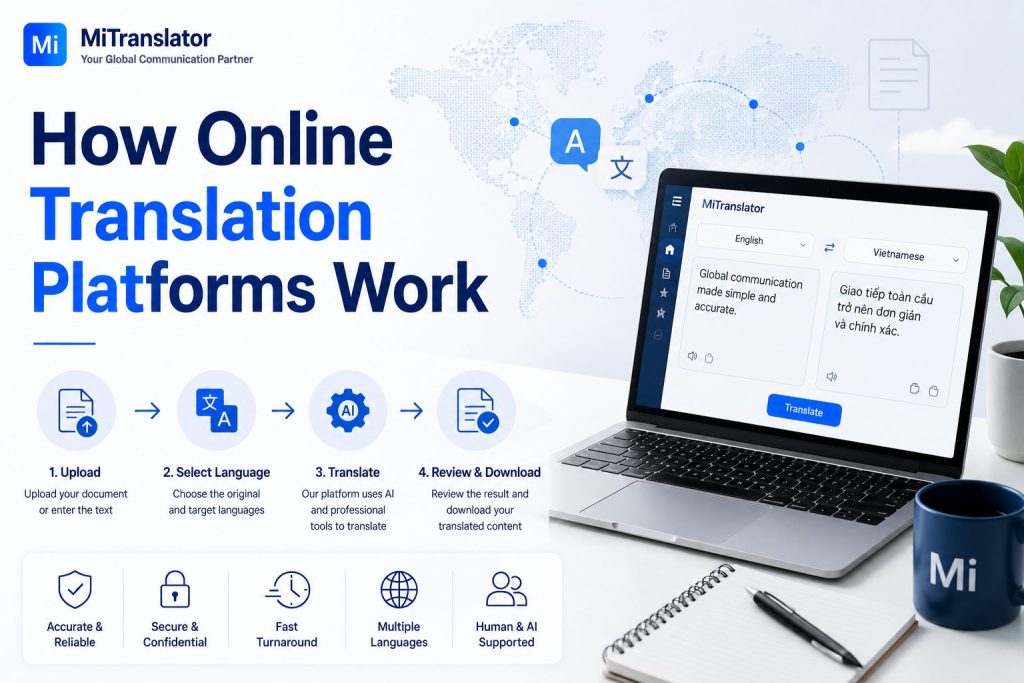
Step 1: Document Upload
The process usually begins when a client uploads one or more files to the platform.
Common file formats include:
- DOCX
- XLSX
- PPTX
- TXT
- HTML
- Image files
Many platforms automatically analyze the files to estimate project requirements.
Step 2: Project Evaluation
After submission, the platform evaluates factors such as:
- Language pair
- Word count
- Subject matter
- File format
- Delivery deadline
This information helps determine project scope and pricing.
Step 3: Quote Generation
Depending on the platform, pricing may be:
- Automatically generated
- Reviewed by a project manager
- Customized based on project complexity
Clients can review costs and approve the project before work begins.
Step 4: Translator Assignment
Once approved, the project is assigned to qualified translators based on:
- Language expertise
- Industry specialization
- Subject matter knowledge
- Availability
Specialized projects often require translators with experience in fields such as:
- Legal translation
- Medical translation
- Financial translation
- Technical translation
- Marketing localization
Step 5: Translation and Review
Professional translation workflows typically include:
- Initial translation
- Editing
- Proofreading
- Quality assurance review
This multi-step process helps improve accuracy and consistency.
Step 6: Delivery and Download
Completed files are uploaded to the platform for client review and download.
Some platforms also provide:
- Revision requests
- Project archives
- Translation memory storage
- Ongoing support
Key Features of Modern Translation Platforms
Translation Memory Technology
Translation memory (TM) stores previously translated content for reuse in future projects.
Benefits include:
- Faster turnaround times
- Improved consistency
- Reduced translation costs
- Better terminology management
This technology is particularly valuable for recurring business content.
Terminology Management
Many platforms maintain glossaries containing approved terminology.
This helps ensure consistency across:
- Corporate communications
- Technical manuals
- Legal documents
- Marketing materials
Real-Time Project Tracking
Users can often track project progress through dashboards that display:
- Project status
- Estimated completion times
- Team assignments
- Communication updates
This improves transparency and client confidence.
Collaboration Tools
Modern platforms frequently support collaboration among:
- Translators
- Editors
- Project managers
- Clients
Centralized communication helps reduce misunderstandings and improve efficiency.
Secure Document Management
Translation projects often involve sensitive information.
Professional platforms typically include:
- Secure file transfer
- Access controls
- Data encryption
- Confidentiality protections
Security is particularly important for legal, financial, and healthcare documents.
Challenges Faced by Online Translation Platforms
Maintaining Translation Quality
Automation can improve efficiency, but human expertise remains essential for accuracy and cultural appropriateness.
Platforms must balance technology with professional linguistic review.
Managing Large-Scale Projects
Organizations often require translation into multiple languages simultaneously.
Coordinating large multilingual projects requires strong workflow management.
Handling Specialized Content
Certain industries require highly specialized knowledge.
Platforms must carefully match projects with qualified translators to ensure quality.
Protecting Confidential Information
Data security remains a critical concern, especially when handling sensitive business, legal, or personal documents.
Best Practices When Using an Online Translation Platform
Choose a Platform with Professional Human Translators
While automation can assist workflows, professional human translators remain essential for high-quality results.
Verify Industry Expertise
Select providers with experience in your industry and document type.
Review Security Measures
Ensure that the platform follows appropriate confidentiality and data protection standards.
Use Terminology Resources
Providing glossaries and reference materials helps improve translation consistency.
Communicate Project Requirements Clearly
Sharing context, target audience information, and formatting requirements can improve translation quality.
Online Translation Platform Checklist
Before selecting an online translation platform, ensure that it offers:
✔ Professional human translators
✔ Industry-specific expertise
✔ Translation memory technology
✔ Terminology management tools
✔ Secure document handling
✔ Quality assurance processes
✔ Real-time project tracking
✔ Multilingual support
✔ Revision and feedback options
✔ Reliable customer support
How MITRANS Can Help
MITRANS provides a modern online translation platform designed to simplify multilingual communication for businesses and individuals worldwide.
Our platform supports:
- Secure document uploads
- Fast project quotations
- Professional human translation
- Multilingual localization
- Certified translation services
- Translation memory management
- Project tracking
- Quality assurance workflows
- Business document translation
- Legal, medical, financial, and technical translation projects
With support for English, Chinese, Japanese, Korean, Vietnamese, and many other languages, MITRANS helps clients manage translation projects efficiently while maintaining the highest standards of quality and accuracy.
Frequently Asked Questions
What is an online translation platform?
An online translation platform is a web-based system that allows users to submit, manage, track, and receive translation services digitally.
Are online translation platforms suitable for businesses?
Yes. Many businesses use online platforms to manage multilingual content, streamline workflows, and coordinate translation projects efficiently.
Can online translation platforms handle specialized documents?
Professional platforms often provide access to translators specializing in legal, medical, technical, financial, and other industry-specific fields.
Is document security important when using a translation platform?
Absolutely. Sensitive documents should only be handled through secure platforms that implement confidentiality and data protection measures.
Do online translation platforms use machine translation?
Some platforms incorporate machine translation technology to assist workflows, but professional human review remains essential for high-quality translations.
Conclusion
Online translation platforms have transformed the way businesses and individuals access language services. By combining digital convenience, project automation, and professional linguistic expertise, these platforms make multilingual communication faster, more transparent, and more efficient.
As global business and international communication continue to expand, online translation platforms will play an increasingly important role in helping organizations connect with audiences across languages and cultures.
Need a Reliable Online Translation Platform?
Looking for a secure and efficient way to manage document translation, localization, certified translation, or multilingual content projects?
Contact MITRANS today to discover how our online translation platform can help businesses and individuals streamline translation workflows while ensuring accuracy, confidentiality, and professional quality.