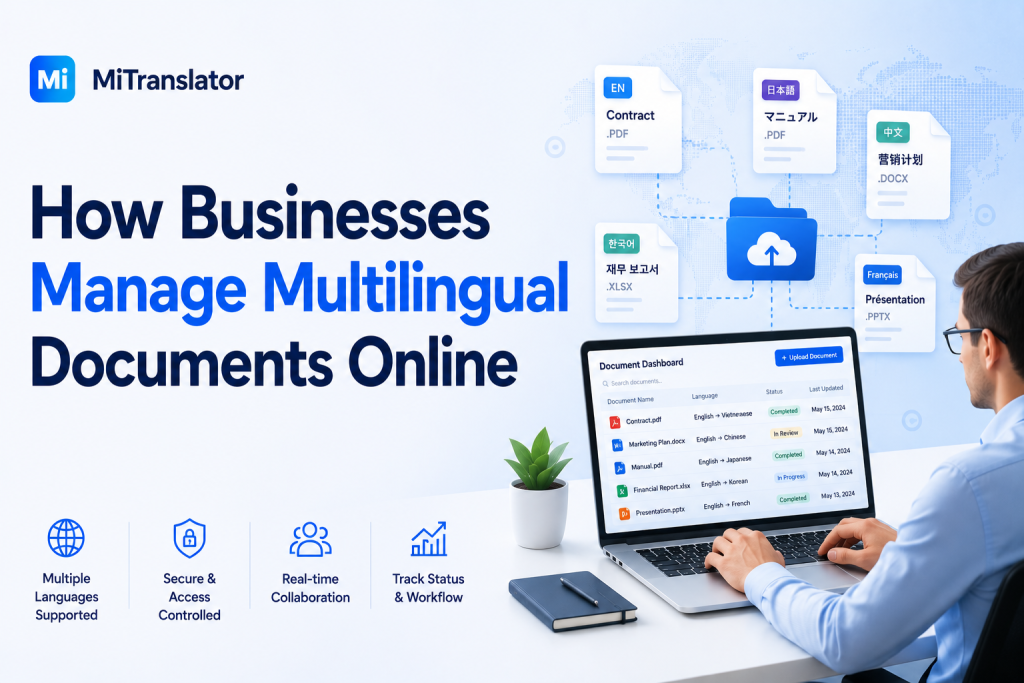
As businesses expand into international markets, managing multilingual documents has become an essential part of daily operations. Contracts, compliance records, employee documents, marketing materials, technical manuals, financial reports, and customer communications often need to be created, stored, translated, and shared in multiple languages.
Traditional document management methods are no longer sufficient for organizations operating across borders. Businesses today increasingly rely on digital platforms and online document management systems to handle multilingual content efficiently, maintain consistency, and ensure compliance with international regulations.
Effective multilingual document management helps organizations improve collaboration, reduce operational risks, accelerate global growth, and deliver a consistent experience to customers, partners, and regulatory authorities worldwide.
What Is Multilingual Document Management?
Multilingual document management refers to the process of organizing, storing, updating, sharing, translating, and maintaining documents in multiple languages through digital platforms and online systems.
A multilingual document management strategy typically covers:
- Document storage and organization
- Version control
- Translation workflows
- Terminology management
- Access permissions
- Collaboration across teams
- Regulatory compliance
- Data security
The goal is to ensure that employees, customers, partners, and stakeholders can access accurate and up-to-date information in their preferred language.
Why Multilingual Document Management Matters
Supporting Global Business Operations
International organizations routinely work with teams, customers, suppliers, and regulators located in different countries. Managing multilingual documentation helps facilitate seamless communication across regions.
Maintaining Regulatory Compliance
Many industries require businesses to maintain records and submit documentation in specific languages. Proper document management helps ensure that translated versions remain accurate and compliant.
Improving Operational Efficiency
Centralized online systems reduce time spent searching for files, coordinating updates, and managing multiple language versions manually.
Enhancing Customer Experience
Providing accurate documentation in local languages helps improve customer satisfaction, trust, and engagement.
Protecting Brand Consistency
A structured multilingual document management process helps maintain consistent messaging, terminology, and branding across all markets.
Common Types of Multilingual Documents
Businesses manage a wide variety of multilingual content, including:
Legal Documents
- Contracts
- Agreements
- Corporate policies
- Compliance documents
- Intellectual property records
Financial Documents
- Financial statements
- Audit reports
- Tax documents
- Investor reports
- Banking documentation
Human Resources Documents
- Employment contracts
- Employee handbooks
- Training materials
- Performance evaluation forms
- Benefits documentation
Technical Documents
- User manuals
- Product specifications
- Engineering documentation
- Safety instructions
- Technical reports
Marketing Materials
- Websites
- Brochures
- Product catalogs
- Advertising content
- Social media materials
Customer Support Documents
- FAQs
- Service agreements
- Knowledge base articles
- Product guides
- Customer communications
Key Challenges in Managing Multilingual Documents Online
Version Control Issues
One of the most common challenges is maintaining synchronization between source documents and translated versions.
When updates are made to the original document, organizations must ensure that all language versions are updated accordingly.
Inconsistent Terminology
Different translators or departments may use varying terminology for the same concept, leading to confusion and inconsistency.
This issue is particularly critical for legal, technical, and regulatory documentation.
Large Document Volumes
Global businesses often manage thousands of documents across multiple languages and regions.
Without a centralized system, locating and updating information can become difficult and time-consuming.
Security and Access Control
Multilingual documents frequently contain confidential business information, customer data, financial records, or intellectual property.
Organizations must ensure that only authorized users have access to sensitive content.
Regulatory Requirements
Many jurisdictions impose specific rules regarding document retention, language requirements, privacy protection, and record management.
Failure to manage multilingual documentation properly may result in compliance risks.
Best Practices for Managing Multilingual Documents Online
Centralize Document Storage
Businesses should use a centralized document management platform where all language versions can be securely stored and accessed.
Centralized storage improves visibility, reduces duplication, and simplifies document retrieval.
Establish Clear Version Control Procedures
Organizations should implement processes that track revisions, approvals, and updates across all language versions.
This helps prevent outdated translations from being used in business operations.
Maintain Terminology Databases
A centralized glossary ensures consistency across departments, translators, and markets.
Terminology management is especially important for:
- Legal terms
- Technical terminology
- Product names
- Regulatory language
- Corporate branding
Implement Translation Workflows
Structured translation workflows help organizations manage document requests, approvals, quality reviews, and publication schedules more effectively.
Define User Permissions
Role-based access controls help protect sensitive information while ensuring that employees can access the documents they need.
Conduct Regular Audits
Periodic reviews help identify outdated content, inconsistent terminology, missing translations, and compliance issues.
Technologies Businesses Use for Multilingual Document Management
Cloud-Based Document Management Systems
Cloud platforms allow organizations to access and manage multilingual documents from anywhere while supporting collaboration among global teams.
Translation Management Systems (TMS)
A Translation Management System helps automate translation workflows, monitor project status, and manage multilingual content more efficiently.
Translation Memory Tools
Translation memory technology stores previously translated content and suggests approved translations for future projects.
Benefits include:
- Faster turnaround times
- Improved consistency
- Reduced translation costs
Optical Character Recognition (OCR)
OCR technology converts scanned documents and images into editable text, making multilingual content easier to manage and translate.
Secure File Sharing Platforms
Businesses increasingly use encrypted file-sharing systems to exchange multilingual documents securely with clients, partners, and translation providers.
The Importance of Professional Translation in Multilingual Document Management
While technology can streamline document management processes, human expertise remains essential for ensuring linguistic accuracy and regulatory compliance.
Professional translation services help organizations:
- Maintain translation quality
- Ensure terminology consistency
- Meet regulatory requirements
- Protect brand reputation
- Reduce legal and compliance risks
This is particularly important for legal, financial, technical, healthcare, immigration, and corporate documentation where accuracy is critical.
How MITRANS Supports Multilingual Document Management
MITRANS helps businesses manage multilingual documentation through professional translation and localization services tailored to international operations.
Our services support:
- Legal document translation
- Corporate document translation
- Financial document translation
- Technical document translation
- Compliance documentation
- HR documentation
- Marketing localization projects
MITRANS combines experienced linguists, industry specialists, and rigorous quality assurance processes to help organizations maintain consistency, accuracy, and compliance across multilingual document portfolios.
We support major language pairs including:
- English ↔ Vietnamese
- Chinese ↔ Vietnamese
- Japanese ↔ Vietnamese
- Korean ↔ Vietnamese
- English ↔ Chinese
- English ↔ Japanese
- English ↔ Korean
Frequently Asked Questions
What is the biggest challenge in managing multilingual documents?
Version control and terminology consistency are among the most common challenges, particularly for organizations operating in multiple countries.
Why should businesses centralize multilingual documents?
Centralized systems improve collaboration, reduce duplication, enhance security, and make document retrieval more efficient.
Can machine translation replace professional translation?
Machine translation may assist with basic content, but professional human review remains essential for legal, financial, technical, and compliance-sensitive documents.
How can businesses ensure translation consistency?
Organizations should maintain terminology databases, use translation memory tools, and work with experienced translation providers.
Why is multilingual document management important for compliance?
Many regulations require accurate documentation, proper record retention, and language-specific reporting. Effective document management helps organizations meet these requirements.
Contact MITRANS for Professional Translation Services
Professional translation plays a critical role in ensuring accuracy, compliance, and effective communication across international business activities. Whether you require translation for legal, financial, technical, corporate, immigration, or regulatory documents, MITRANS is ready to help.
Contact MITRANS today for fast, accurate, and professional translation services tailored to your business and documentation requirements.