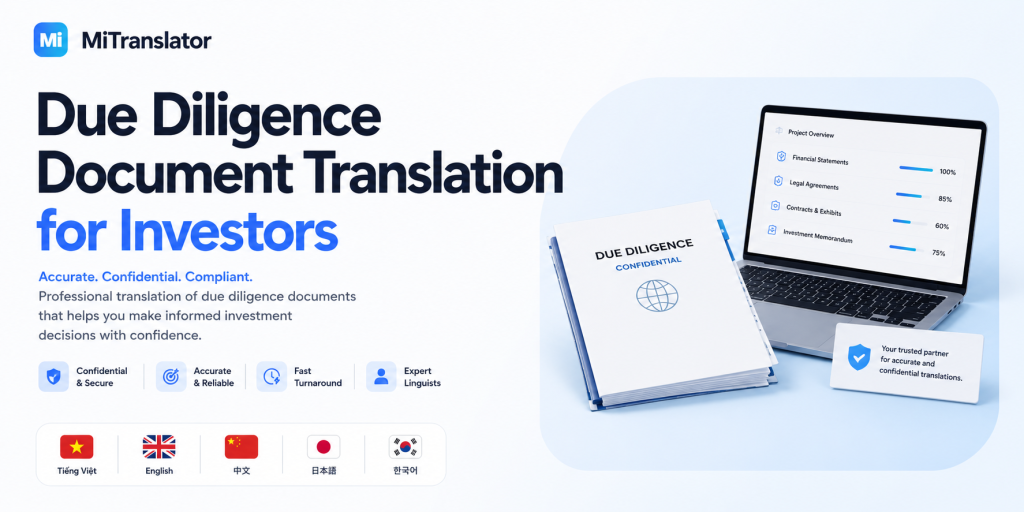
Investors conducting mergers and acquisitions (M&A), venture capital investments, private equity transactions, or international partnerships rely heavily on due diligence to assess risks and opportunities. When target companies operate across different countries, critical due diligence documents are often prepared in multiple languages, making accurate translation an essential component of the investment process.
Errors, omissions, or inconsistencies in translated due diligence materials can lead to misunderstandings, compliance issues, financial losses, and failed transactions. Professional due diligence document translation ensures that investors have a clear and accurate understanding of the target company’s legal, financial, operational, and regulatory status before making investment decisions.
What Is Due Diligence Document Translation?
Due diligence document translation refers to the professional translation of documents reviewed during an investment, acquisition, merger, partnership, or financing process. These documents help investors evaluate the viability, risks, and value of a target company.
The translation process requires not only linguistic expertise but also a deep understanding of legal, financial, tax, and corporate terminology to preserve the meaning and accuracy of the original documents.
Why Due Diligence Translation Matters for Investors
Risk Identification
Investors depend on translated documents to identify potential liabilities, contractual obligations, litigation risks, compliance issues, and operational weaknesses.
Regulatory Compliance
Cross-border investments often involve regulatory reviews by government agencies, financial regulators, and industry authorities. Accurate translations help ensure compliance with local and international requirements.
Investment Decision-Making
Translation quality directly impacts an investor’s ability to evaluate:
- Financial performance
- Business operations
- Intellectual property assets
- Corporate governance
- Legal obligations
- Market position
Transaction Efficiency
Well-translated due diligence documents facilitate smoother communication among investors, legal advisors, auditors, and management teams, reducing delays during negotiations and transaction closing.
Common Documents Requiring Due Diligence Translation
Corporate Documents
- Articles of incorporation
- Business registration certificates
- Shareholder agreements
- Board resolutions
- Corporate governance documents
- Organizational charts
Financial Documents
- Audited financial statements
- Income statements
- Balance sheets
- Cash flow statements
- Tax filings
- Financial projections
- Loan agreements
Legal Documents
- Commercial contracts
- Licensing agreements
- Litigation records
- Compliance reports
- Regulatory filings
- Insurance policies
Human Resources Documents
- Employment agreements
- Labor policies
- Compensation plans
- Collective bargaining agreements
- Employee benefit programs
Intellectual Property Documents
- Patent registrations
- Trademark certificates
- Copyright registrations
- Technology licensing agreements
- Research and development documentation
Operational Documents
- Supplier contracts
- Customer agreements
- Manufacturing records
- Quality control reports
- Environmental compliance documents
Common Challenges in Due Diligence Document Translation
Complex Industry Terminology
Many due diligence documents contain highly specialized terminology related to finance, law, taxation, healthcare, technology, energy, manufacturing, or other regulated industries.
Large Document Volumes
Investment transactions frequently involve thousands of pages of documentation that must be translated within tight deadlines.
Confidentiality Requirements
Due diligence materials often contain sensitive information such as:
- Financial data
- Trade secrets
- Strategic plans
- Customer information
- Proprietary technologies
Translation providers must implement strict confidentiality and data protection measures.
Jurisdiction-Specific Concepts
Legal and regulatory frameworks vary significantly across countries. Translators must understand how corporate structures, tax obligations, and legal concepts differ between jurisdictions.
Consistency Across Documents
Inconsistencies in terminology, entity names, financial terms, or legal references can create confusion during the review process and undermine investor confidence.
Risks of Poor Due Diligence Translation
Inaccurate translations may result in:
- Misinterpretation of financial information
- Failure to identify legal liabilities
- Regulatory non-compliance
- Incorrect valuation assessments
- Delayed transaction timelines
- Increased legal exposure
- Disputes during negotiations
- Failed investment transactions
Even a minor translation error involving contractual obligations, tax liabilities, or ownership structures can have significant financial consequences.
Best Practices for Due Diligence Translation Projects
Engage Subject-Matter Experts
Use translators with expertise in:
- Corporate law
- Finance and accounting
- Taxation
- Regulatory compliance
- Industry-specific terminology
Establish Terminology Management
Create glossaries and translation memories to maintain consistency across large document sets.
Implement Multi-Level Quality Control
A robust quality assurance process should include:
- Translation
- Editing
- Proofreading
- Terminology verification
- Legal and financial review when required
Prioritize Confidentiality
Ensure that all translators and project managers operate under strict confidentiality agreements and secure data management protocols.
Use Secure File Transfer Systems
Sensitive investment documents should be exchanged through secure platforms that comply with international data security standards.
Plan for Tight Timelines
Early engagement with a professional translation provider helps manage large document volumes and transaction deadlines efficiently.
How MITRANS Supports Due Diligence Document Translation
MITRANS provides professional due diligence translation services for investors, law firms, private equity funds, venture capital firms, financial institutions, and multinational corporations.
Our services include:
- Legal document translation
- Financial statement translation
- Corporate governance document translation
- Contract translation
- Intellectual property document translation
- Regulatory filing translation
- Certified and notarized translations where required
MITRANS combines experienced linguists, subject-matter specialists, and rigorous quality assurance procedures to deliver accurate, confidential, and timely translations that support informed investment decisions.
We support major language pairs including:
- English ↔ Vietnamese
- Chinese ↔ Vietnamese
- Japanese ↔ Vietnamese
- Korean ↔ Vietnamese
- English ↔ Chinese
- English ↔ Japanese
- English ↔ Korean
Frequently Asked Questions
How quickly can due diligence documents be translated?
Turnaround times depend on document volume, language pair, technical complexity, and required certification. Large-scale projects can often be handled through dedicated translation teams to meet transaction deadlines.
Are due diligence documents kept confidential?
Yes. Professional translation providers should operate under strict confidentiality agreements and secure document handling procedures.
Can financial and legal documents be translated simultaneously?
Yes. Large due diligence projects often involve multiple specialist translators working under centralized terminology management and quality control systems.
Do investors require certified translations?
In some jurisdictions, regulatory filings, corporate registrations, or court-related documents may require certified or notarized translations. Requirements vary by country and transaction type.
What languages are most commonly requested for investment due diligence?
Common language pairs include English, Vietnamese, Chinese, Japanese, Korean, German, French, and other languages depending on the target company’s location and investor base.
Contact MITRANS
Accurate due diligence translation is essential for successful cross-border investments. MITRANS helps investors and professional advisors access reliable multilingual information for informed decision-making, risk management, and regulatory compliance.
Contact MITRANS today to discuss your due diligence document translation requirements and receive a customized solution tailored to your transaction timeline and industry needs.