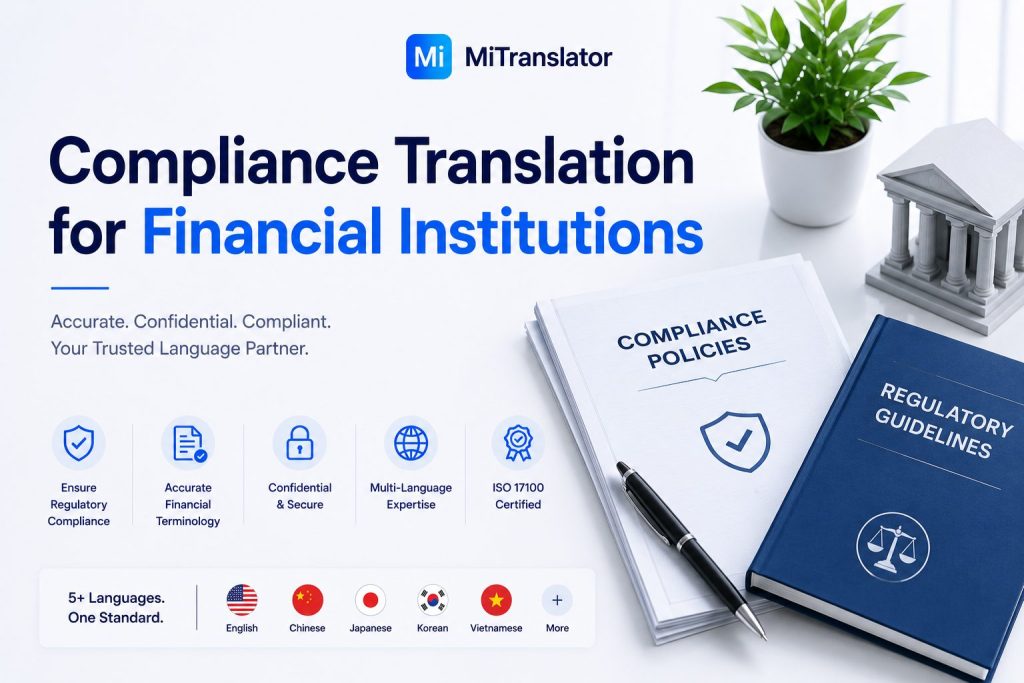
Financial institutions operate in one of the most heavily regulated industries in the world. Banks, insurance companies, investment firms, payment service providers, and FinTech organizations must comply with a wide range of local and international regulations while communicating effectively with regulators, customers, investors, and business partners.
As financial services become increasingly global, organizations frequently need to translate compliance-related documents into multiple languages. Whether preparing regulatory filings, anti-money laundering policies, risk management reports, or customer disclosures, accuracy is essential.
Compliance translation for financial institutions ensures that critical regulatory information is communicated clearly, consistently, and in accordance with applicable legal requirements. Professional translation helps organizations reduce risk, maintain compliance, and support international business operations.
What Is Compliance Translation for Financial Institutions?
Compliance translation refers to the translation of regulatory, legal, and policy-related documents used by financial institutions to meet industry requirements and regulatory obligations.
Common compliance documents include:
- Regulatory filings
- Anti-Money Laundering (AML) policies
- Know Your Customer (KYC) documentation
- Risk management reports
- Internal compliance manuals
- Financial crime prevention procedures
- Customer disclosures
- Privacy policies
- Corporate governance documentation
- Audit reports
Because these documents often contain specialized legal and financial terminology, they require professional translation by subject matter experts.
Why Compliance Translation Matters
Supporting Regulatory Compliance
Financial institutions must comply with regulations across multiple jurisdictions.
Accurate translation helps ensure that regulatory documents maintain their intended meaning and satisfy the requirements of local authorities.
Translation errors can create compliance gaps that may lead to investigations, penalties, or delayed approvals.
Reducing Legal and Financial Risks
Compliance documents establish policies, procedures, and reporting obligations that organizations must follow.
Incorrect translations can result in:
- Regulatory violations
- Financial penalties
- Legal disputes
- Operational disruptions
- Reputational damage
Professional compliance translation helps mitigate these risks.
Facilitating Cross-Border Operations
Many financial institutions operate internationally and must communicate with regulators, employees, partners, and customers in different languages.
Accurate multilingual compliance documentation supports consistent operations across global markets.
Enhancing Transparency and Trust
Regulators, investors, and customers expect clear and reliable information.
Professional compliance translation promotes transparency by ensuring that critical information is communicated accurately and consistently across all languages.
Common Compliance Documents That Require Translation
Anti-Money Laundering (AML) Documentation
AML regulations require financial institutions to establish policies and procedures designed to prevent financial crime.
Documents often requiring translation include:
- AML policies
- Suspicious activity reporting procedures
- Employee training materials
- Risk assessment reports
Accurate translation is essential to ensure consistent compliance practices.
Know Your Customer (KYC) Materials
KYC procedures help organizations verify customer identities and assess risk profiles.
Translated KYC materials may include:
- Customer onboarding documents
- Identity verification forms
- Due diligence procedures
- Compliance questionnaires
Clear communication helps improve compliance and customer experiences.
Regulatory Filings and Reports
Financial institutions regularly submit reports to regulatory authorities.
Examples include:
- Compliance reports
- Risk management reports
- Financial disclosures
- Audit findings
- Regulatory submissions
Professional translation helps ensure that regulators receive accurate information.
Privacy and Data Protection Policies
Financial organizations collect and process sensitive customer information.
Privacy notices, data protection policies, and consent forms must often be translated to meet regulatory requirements and inform customers effectively.
Common Challenges in Compliance Translation
Complex Regulatory Terminology
Compliance documents contain highly specialized terminology related to:
- Banking regulations
- Financial crime prevention
- Risk management
- Data protection
- Corporate governance
- Securities regulation
Translators must understand both the language and the underlying regulatory concepts.
Differences Between Regulatory Frameworks
Financial regulations vary significantly across countries.
Certain legal concepts may not have direct equivalents in other jurisdictions, requiring careful adaptation while preserving legal intent.
Maintaining Consistency
Large financial institutions often produce extensive volumes of compliance documentation.
Inconsistent terminology can create confusion, increase regulatory risk, and weaken internal controls.
Frequent Regulatory Updates
Regulations evolve regularly as governments introduce new compliance requirements.
Translated documents must be updated promptly to reflect regulatory changes and maintain accuracy.
Best Practices for Compliance Translation
Work with Financial Compliance Experts
Compliance translation should be performed by translators with expertise in financial regulations, legal documentation, and industry terminology.
Subject matter expertise is critical for ensuring accuracy.
Develop Regulatory Terminology Glossaries
Centralized terminology databases help maintain consistency across policies, reports, and regulatory communications.
They also improve efficiency for future translation projects.
Implement Rigorous Quality Assurance
Compliance documents should undergo multiple review stages, including:
- Linguistic review
- Regulatory terminology verification
- Legal review
- Proofreading
- Final quality control
A structured quality assurance process reduces risk and improves reliability.
Protect Confidential Information
Compliance documents often contain sensitive corporate and customer information.
Translation providers should follow strict confidentiality protocols and secure data management practices.
Monitor Regulatory Developments
Financial institutions should regularly review translated compliance materials to ensure alignment with evolving regulatory requirements.
Compliance Translation Checklist
Before publishing or submitting translated compliance documents, ensure that you:
✔ Verify all regulatory terminology
✔ Maintain consistency across documents
✔ Review legal and compliance language
✔ Validate references to applicable regulations
✔ Conduct professional proofreading
✔ Implement multi-level quality assurance reviews
✔ Protect confidential information
✔ Update translations when regulations change
✔ Ensure clarity for regulators and stakeholders
✔ Perform final compliance checks before submission
How MITRANS Can Help
Compliance translation requires precision, confidentiality, and deep expertise in financial regulations.
MITRANS provides professional translation services for:
- AML and KYC documentation
- Regulatory filings
- Compliance reports
- Risk management materials
- Audit documentation
- Privacy policies
- Corporate governance documents
- Internal compliance manuals
- Financial crime prevention procedures
- Customer disclosure documents
Our experienced financial and legal translators deliver accurate, secure, and compliant translations that support regulatory obligations and international business operations.
Frequently Asked Questions
What is compliance translation?
Compliance translation involves translating regulatory, legal, and policy-related documents while maintaining accuracy, consistency, and compliance with applicable laws and regulations.
Why is compliance translation important for financial institutions?
Accurate translation helps organizations meet regulatory requirements, reduce risk, avoid penalties, and communicate effectively with regulators and stakeholders.
Which compliance documents commonly require translation?
Examples include AML policies, KYC procedures, regulatory filings, audit reports, risk assessments, privacy policies, and customer disclosures.
Can machine translation be used for compliance documents?
Machine translation may assist with preliminary understanding, but professional human translation is strongly recommended for compliance materials where accuracy and legal precision are essential.
How can financial institutions maintain consistency in compliance translations?
Organizations can use terminology glossaries, translation memory tools, and specialized review processes to ensure consistent language across all documentation.
Conclusion
As financial institutions continue to expand globally, compliance translation has become a critical component of risk management and regulatory success. Accurate translation of compliance documents helps organizations meet legal requirements, support international operations, and maintain trust with regulators, customers, and stakeholders.
By investing in professional compliance translation services, financial institutions can reduce risk, improve operational efficiency, and confidently navigate complex regulatory environments across multiple markets.
Need Compliance Translation Support for Your Financial Institution?
Looking to translate regulatory filings, AML policies, KYC documentation, audit reports, or compliance manuals with accuracy and confidence?
Contact MITRANS today for fast, accurate, and professional compliance translation services tailored to banks, insurance companies, investment firms, payment providers, FinTech organizations, and multinational financial institutions.