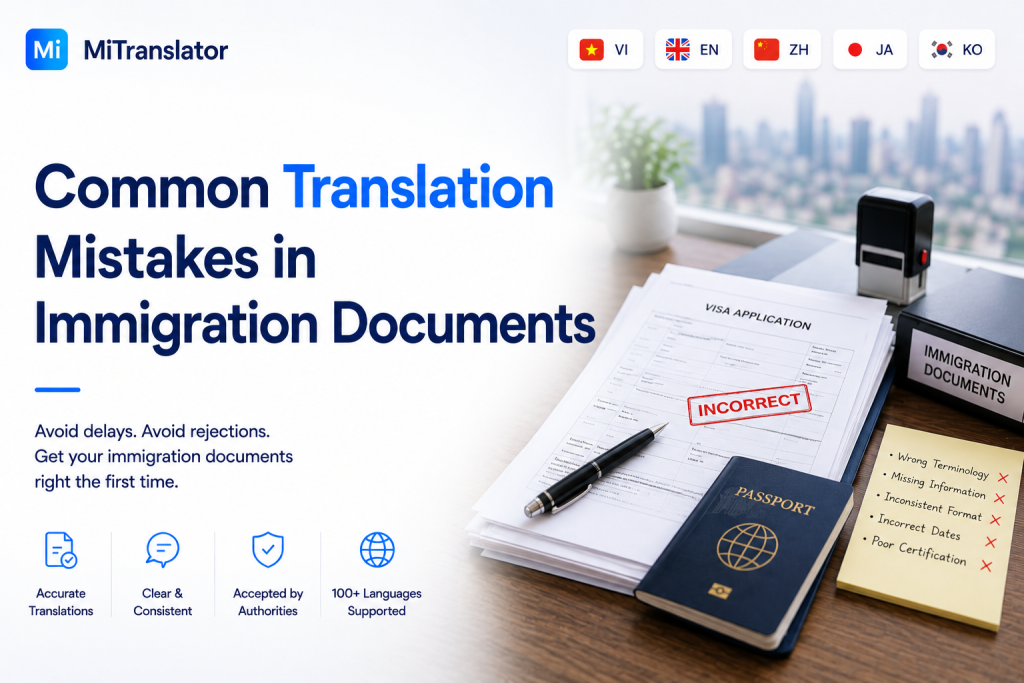
Immigration applications often involve extensive documentation that must be submitted to government agencies, embassies, consulates, universities, licensing bodies, and immigration authorities. Birth certificates, marriage certificates, educational records, police clearances, financial documents, passports, and employment records frequently require translation before they can be reviewed and accepted.
Because immigration decisions rely heavily on documentary evidence, translation accuracy is critical. Even seemingly minor mistakes can create inconsistencies, delay processing, trigger requests for additional information, or lead to application rejection.
Understanding the most common translation mistakes in immigration documents can help applicants, immigration consultants, employers, and educational institutions avoid unnecessary complications during the immigration process.
Why Accuracy Matters in Immigration Document Translation
Immigration authorities use translated documents to verify:
- Personal identity
- Family relationships
- Educational qualifications
- Employment history
- Financial capacity
- Criminal background
- Legal status
- Eligibility for visas or residency
Unlike general business communications, immigration documents are often reviewed under strict legal and administrative standards.
A translation that contains errors, omissions, inconsistencies, or formatting issues may raise concerns about the authenticity or reliability of the information provided.
As a result, professional translation is often essential for ensuring smooth immigration processing.
Common Documents Requiring Immigration Translation
Immigration applications may require translation of:
- Birth certificates
- Marriage certificates
- Divorce certificates
- Passports
- National identity cards
- Household registration records
- Educational transcripts
- Diplomas and degrees
- Employment verification letters
- Tax records
- Bank statements
- Police clearance certificates
- Court documents
- Medical records
- Immigration records
Because these documents serve as official evidence, they must be translated with a high degree of precision.
Mistake #1: Incorrect Translation of Names
One of the most common and serious mistakes involves personal names.
Names must remain consistent across all documents submitted during the immigration process.
Problems often occur when:
- Different transliteration systems are used
- Middle names are omitted
- Family names and given names are reversed
- Nicknames replace legal names
- Diacritical marks are inconsistently represented
For example, if a passport, birth certificate, educational transcript, and employment letter show different versions of an applicant’s name, immigration authorities may request clarification or additional documentation.
Professional translators carefully verify name consistency across all records.
Mistake #2: Errors in Dates
Immigration applications frequently rely on important dates, including:
- Birth dates
- Marriage dates
- Graduation dates
- Employment dates
- Visa issue dates
- Residence history
A common problem occurs when date formats are incorrectly converted.
Examples include:
- DD/MM/YYYY
- MM/DD/YYYY
- YYYY/MM/DD
Confusion between formats can significantly alter the meaning of a document.
An incorrectly translated date may create inconsistencies that affect eligibility assessments or trigger further investigation.
Mistake #3: Mistranslation of Civil Status Information
Civil status plays a major role in many immigration applications.
Common categories include:
- Single
- Married
- Divorced
- Widowed
- Separated
Inaccurate translation of civil status information may affect:
- Family sponsorship applications
- Dependent visas
- Marriage-based immigration programs
- Permanent residency applications
These terms must be translated precisely according to the legal definitions used by the receiving jurisdiction.
Mistake #4: Inconsistent Translation Across Documents
Applicants often submit multiple documents translated at different times by different providers.
Without proper terminology management, inconsistencies may appear in:
- Names of institutions
- Employer names
- Addresses
- Government agencies
- Educational qualifications
- Job titles
Although the differences may seem minor, inconsistencies can create confusion and delay application processing.
Maintaining consistency across the entire application package is essential.
Mistake #5: Incorrect Translation of Educational Credentials
Educational records are frequently used to support:
- Student visas
- Skilled migration programs
- Professional licensing applications
- Employment-based immigration
Problems may occur when translators incorrectly interpret:
- Degree titles
- Academic qualifications
- Grading systems
- Course names
- Educational institutions
For example, educational systems vary significantly between countries, and direct equivalents may not always exist.
Professional translators understand how to accurately present academic credentials without misrepresenting their meaning.
Mistake #6: Omitting Stamps, Seals, and Annotations
Official immigration documents often contain:
- Government seals
- Official stamps
- Registration marks
- Handwritten notes
- Endorsements
- Marginal annotations
Some inexperienced translators focus only on the main text and fail to include these elements.
However, immigration authorities may rely on these markings to verify document authenticity.
A complete translation should account for all relevant information appearing on the original document.
Mistake #7: Errors in Employment History Documents
Employment records are commonly submitted for:
- Work visas
- Skilled worker programs
- Permanent residency applications
- Employer-sponsored immigration pathways
Common translation mistakes include:
- Incorrect job titles
- Misinterpreted employment dates
- Inaccurate descriptions of responsibilities
- Omitted employer information
These errors can affect how immigration officers evaluate an applicant’s professional qualifications and work experience.
Mistake #8: Inaccurate Translation of Financial Documents
Financial documents often help demonstrate that an applicant has sufficient resources to support themselves during their stay.
Common documents include:
- Bank statements
- Income certificates
- Tax records
- Sponsorship letters
- Financial guarantees
Errors involving amounts, currency references, dates, or account details can create concerns regarding financial eligibility.
Financial information must be translated with exceptional care.
Mistake #9: Using Machine Translation for Official Documents
Machine translation tools have improved significantly in recent years, but they remain unsuitable for many immigration documents.
Machine-generated translations may struggle with:
- Legal terminology
- Government-issued documents
- Handwritten content
- Context-specific language
- Cultural nuances
- Administrative terminology
Even when the overall meaning appears understandable, small errors can affect document acceptance.
Official immigration documents generally require professional human translation.
Mistake #10: Ignoring Certification Requirements
Many immigration authorities require translations to meet specific standards.
Depending on the destination country, requirements may include:
- Certified translations
- Sworn translations
- Notarized translations
- Translator declarations
- Official seals
Applicants sometimes submit accurate translations that nevertheless fail to meet procedural requirements.
This can result in rejection or requests for resubmission.
Verifying translation requirements before submission is therefore essential.
Mistake #11: Formatting Errors
Formatting may seem unimportant, but many immigration authorities expect translated documents to closely resemble the original.
Common formatting problems include:
- Missing page numbers
- Incorrect section headings
- Altered document structure
- Omitted tables
- Missing signatures
- Poor document organization
Maintaining formatting consistency helps reviewers compare the translated document with the original more easily.
Mistake #12: Failure to Translate Entire Documents
Some applicants only translate portions of a document they believe are relevant.
However, immigration authorities may require complete translations of all visible content.
Missing information can create uncertainty regarding document authenticity or completeness.
A professional translator will ensure that all required content is included in the translated version.
How to Avoid Immigration Translation Mistakes
Applicants can reduce risks by following several best practices.
Use Professional Translators
Experienced translators understand immigration documentation requirements and official terminology.
Prepare Clear Document Copies
High-quality scans improve translation accuracy and reduce the risk of transcription errors.
Verify Country-Specific Requirements
Each immigration authority may have unique translation and certification requirements.
Maintain Consistency Across Documents
All personal information, dates, addresses, and institutional names should remain consistent throughout the application package.
Allow Time for Quality Review
Even urgent applications benefit from proper editing, proofreading, and final quality assurance.
How MITRANS Supports Immigration Document Translation
MITRANS provides professional translation services for immigration, visa, residency, education, and international mobility applications.
Our services include translation of:
- Birth certificates
- Marriage certificates
- Divorce certificates
- Passports
- Identity cards
- Educational records
- Employment documents
- Financial documents
- Police clearance certificates
- Medical records
- Immigration supporting documents
MITRANS follows rigorous quality assurance procedures to help ensure that translations are accurate, complete, and suitable for official submission.
We support major language pairs including:
- English ↔ Vietnamese
- Chinese ↔ Vietnamese
- Japanese ↔ Vietnamese
- Korean ↔ Vietnamese
- English ↔ Chinese
- English ↔ Japanese
- English ↔ Korean
Our team understands the importance of precise document translation for successful immigration outcomes.
Frequently Asked Questions
What is the most common immigration translation mistake?
Inconsistent names, incorrect dates, and missing information are among the most frequent issues encountered in immigration document translations.
Can a translation mistake cause visa rejection?
While not every mistake leads directly to rejection, translation errors can delay processing, trigger requests for clarification, or negatively affect application reviews.
Are machine translations acceptable for immigration applications?
Many immigration authorities require professional human translations and may not accept machine-generated translations.
Why are stamps and seals important in translations?
Official stamps and seals often help verify the authenticity of documents and may contain important legal information.
Should immigration documents be certified?
Certification requirements vary by country and application type. Applicants should verify requirements with the receiving authority before submission.
Contact MITRANS for Professional Translation Services
Professional translation plays a critical role in ensuring accuracy, compliance, and effective communication across international business activities. Whether you require translation for legal, financial, technical, corporate, immigration, or regulatory documents, MITRANS is ready to help.
Contact MITRANS today for fast, accurate, and professional translation services tailored to your business and documentation requirements.