Introduction
English to Vietnamese translation plays an important role in international business communication, website localization, legal documentation, marketing, and multilingual operations in Vietnam.
However, translating between English and Vietnamese is not always straightforward. Differences in grammar, tone, culture, sentence structure, and business communication styles can easily create mistakes that affect clarity and professionalism.
Even small translation errors may lead to:
- Miscommunication
- Poor customer experience
- Brand credibility issues
- Legal or compliance risks
- Lower marketing performance
This guide explains the most common English to Vietnamese translation mistakes businesses should avoid and how professional localization helps improve translation quality.
![Common English to Vietnamese Translation Mistakes — clean corporate banner with multilingual communication, translation quality, and localization theme]
Why English to Vietnamese Translation Can Be Challenging
English and Vietnamese differ significantly in:
- Grammar structure
- Sentence flow
- Formality levels
- Cultural communication style
- Technical terminology usage
Direct word-for-word translation often creates unnatural or confusing results.
Professional translation requires both:
- Language accuracy
- Cultural and contextual understanding
Common English to Vietnamese Translation Mistakes
Direct Word-for-Word Translation
One of the most common mistakes is translating English sentences literally into Vietnamese.
This may create:
- Awkward phrasing
- Unnatural wording
- Confusing meaning
Good translation focuses on meaning and natural communication — not just individual words.
Incorrect Tone & Formality
Vietnamese communication style often depends on:
- Context
- Audience
- Business relationship
- Professional level
Using the wrong tone may sound:
- Too casual
- Too aggressive
- Unprofessional
- Unnatural
Localization helps adapt communication appropriately for Vietnamese readers.
Misunderstanding Technical Terminology
Industries such as:
- Manufacturing
- Legal
- Finance
- SaaS
- Healthcare
often require specialized terminology.
Incorrect technical translation may:
- Confuse users
- Create compliance risks
- Reduce credibility
Professional terminology management is important for consistency and accuracy.
Ignoring Cultural Context
Certain English expressions or marketing messages may not work naturally in Vietnamese culture.
Examples include:
- Idioms
- Humor
- Slang
- Marketing slogans
Localization helps adapt messaging appropriately for Vietnamese audiences.
Poor UI & Software Translation
Software and app translation often suffers from:
- Inconsistent terminology
- Long UI text
- Context misunderstanding
- Unclear navigation labels
Poor localization may reduce user experience significantly.
Inconsistent Translation Across Documents
Businesses often translate:
- Websites
- Marketing materials
- Product documentation
- Support content
- Internal communication
Without terminology consistency, translations may feel fragmented and confusing.
Glossaries and translation memory systems help maintain consistency.
Over-Reliance on Machine Translation
AI translation tools can help with basic drafts, but they may still struggle with:
- Context
- Tone
- Cultural nuance
- Technical accuracy
Human review remains essential for professional communication.
Incorrect Vietnamese SEO Translation
Directly translating English keywords may not match how Vietnamese users actually search online.
Poor SEO localization may reduce:
- Search visibility
- Website traffic
- Marketing performance
Vietnamese SEO requires localized keyword research and search intent understanding.
Formatting & Layout Problems
English and Vietnamese text lengths may differ significantly.
Translation projects sometimes face:
- Broken layouts
- UI overflow
- Formatting inconsistencies
- Misaligned documents
Professional localization workflows should include formatting review.
How Businesses Can Avoid Translation Mistakes
Work with Native Vietnamese Linguists
Native translators better understand:
- Natural phrasing
- Business tone
- Local communication style
Use Human Quality Assurance
Professional QA helps identify:
- Grammar issues
- Terminology inconsistencies
- Context errors
- Formatting problems
Build Translation Glossaries
Glossaries improve consistency across:
- Websites
- SaaS platforms
- Technical documentation
- Marketing content
Focus on Localization — Not Just Translation
Localization adapts:
- Tone
- UX communication
- Cultural context
- Vietnamese SEO
The goal is natural communication for Vietnamese audiences.
Test Content in Real Context
Translation should be reviewed within:
- Websites
- Software interfaces
- Marketing layouts
- Mobile apps
Context testing improves usability and accuracy.
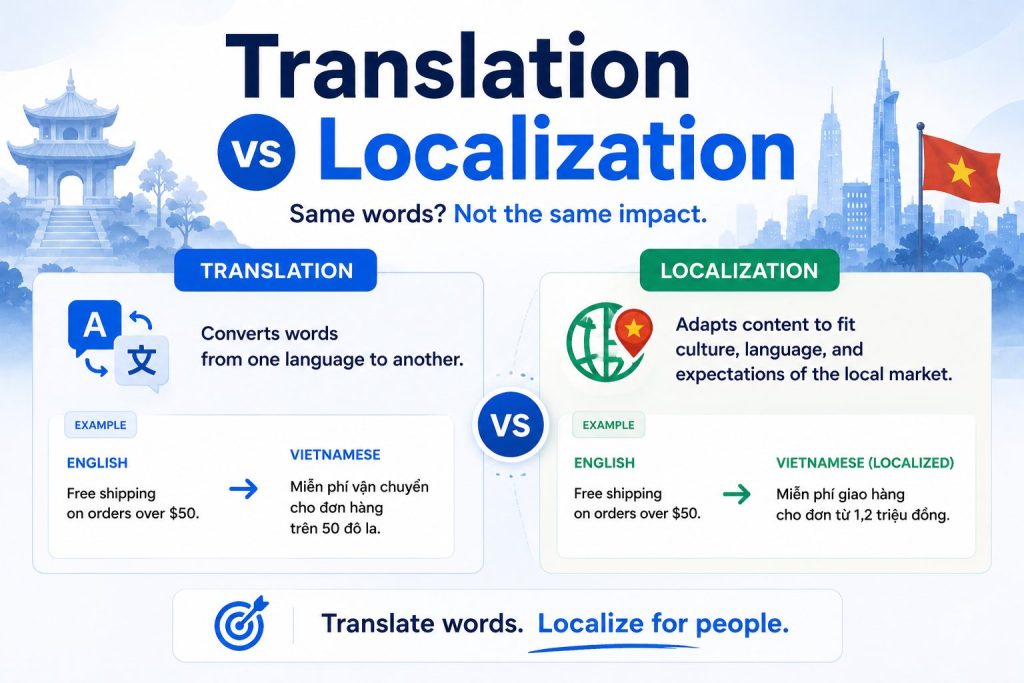
Translation vs Localization
| Translation | Localization |
|---|---|
| Converts language | Adapts communication for local audiences |
| Focuses on wording | Focuses on user experience & cultural relevance |
| Basic multilingual support | Strategic market adaptation |
| Limited SEO adaptation | Includes Vietnamese SEO localization |
Localization helps businesses communicate more naturally and effectively in Vietnam.
Why Translation Quality Matters for Businesses
Poor translation may:
- Reduce customer trust
- Damage brand image
- Create operational confusion
- Lower conversion rates
- Affect international partnerships
High-quality Vietnamese translation improves:
- Professional communication
- Customer engagement
- Market credibility
- Business growth opportunities
How MITRANS Can Help
MITRANS Translation Services provides professional English to Vietnamese translation and localization services for businesses across multiple industries.
MITRANS supports:
- Website localization
- SaaS localization
- Technical translation
- Legal translation
- Marketing localization
- Vietnamese SEO localization
- Business document translation
Languages supported include:
- English
- Vietnamese
- Chinese
- Japanese
- Korean
Why businesses choose MITRANS:
- Native Vietnamese linguists
- Human quality assurance
- Industry-specialized expertise
- Consistent terminology management
- Localization-focused workflows
- Fast turnaround times
MITRANS helps businesses avoid common translation mistakes and build professional multilingual communication for the Vietnamese market.
FAQ
Why is English to Vietnamese translation difficult?
English and Vietnamese differ significantly in grammar, tone, sentence structure, and cultural communication style.
What is the most common translation mistake?
Literal word-for-word translation is one of the most common issues and often creates unnatural wording.
Why is localization important?
Localization helps adapt communication naturally for Vietnamese audiences, improving user experience and engagement.
Can machine translation fully replace human translation?
Machine translation may assist with drafts, but human review remains important for accuracy, tone, and cultural adaptation.
Does MITRANS provide English to Vietnamese localization services?
Yes. MITRANS provides professional translation and localization services tailored for businesses operating in Vietnam.
Need Professional English to Vietnamese Translation Support?
Looking for accurate, natural, and business-focused Vietnamese translation services?
Contact MITRANS today for professional multilingual translation and localization support tailored to your business goals.