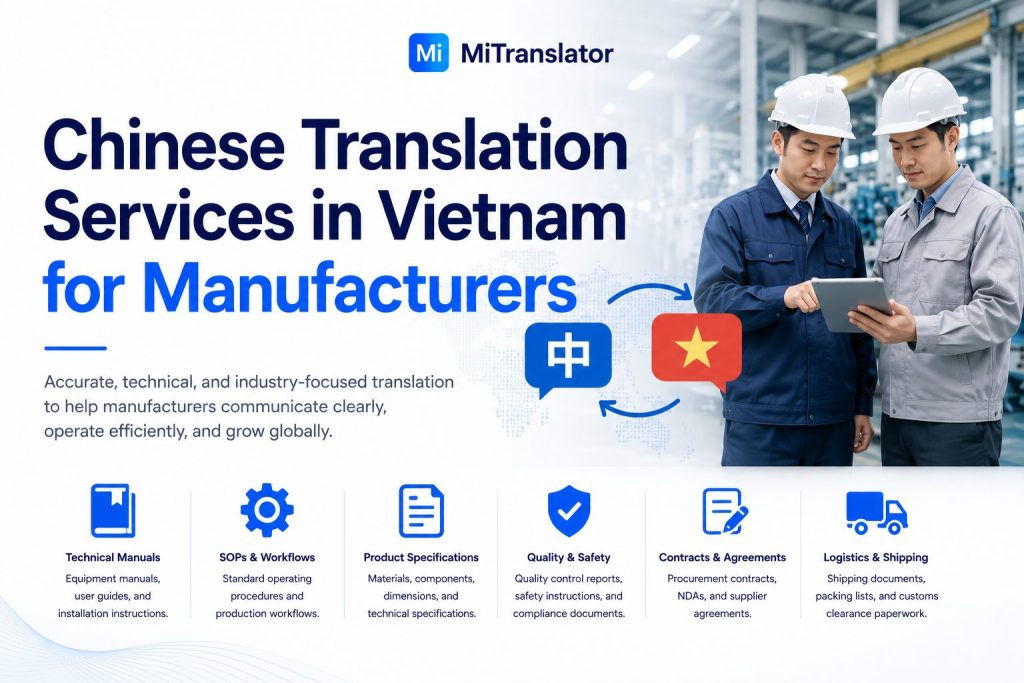
As manufacturing businesses in Vietnam continue expanding partnerships with Chinese suppliers, investors, factories, and industrial partners, professional Chinese translation services have become essential for daily operations and international business communication.
From technical documentation and production workflows to contracts and supplier communication, manufacturers rely on accurate multilingual communication to maintain operational efficiency, reduce risks, and support cross-border collaboration.
However, manufacturing translation requires more than basic language conversion. Technical terminology, production context, and industry-specific language all require specialized expertise.
In this article, we explore why Chinese translation matters for manufacturers in Vietnam, common challenges in industrial localization, and how professional translation workflows improve communication across manufacturing operations.
Why Manufacturers in Vietnam Need Chinese Translation Services
Vietnam–China Manufacturing Collaboration Is Growing
Many manufacturers in Vietnam work closely with:
- Chinese suppliers
- Factory partners
- Machinery providers
- Industrial contractors
- Logistics companies
- OEM manufacturers
This creates ongoing demand for accurate Chinese ↔ Vietnamese translation across operational workflows.
Manufacturing Operations Require Technical Accuracy
Industrial communication often includes:
- Technical specifications
- SOPs
- Equipment manuals
- Product documentation
- Production instructions
- Safety procedures
- Quality control materials
Translation errors in manufacturing environments can create:
- Operational delays
- Production mistakes
- Compliance issues
- Safety risks
Supply Chain Communication Depends on Clear Translation
Manufacturers regularly coordinate with Chinese partners regarding:
- Procurement
- Shipping
- Quality inspection
- Production schedules
- Material specifications
- Packaging requirements
Professional translation helps reduce misunderstandings and improve operational efficiency.
International Manufacturing Requires Multilingual Coordination
Global manufacturers often manage multilingual teams across:
- Vietnam
- China
- Southeast Asia
- International supply chains
Consistent communication is essential for scalable operations.
Common Manufacturing Documents That Require Translation
Manufacturing businesses frequently translate:
- Technical manuals
- Machinery documentation
- Production workflows
- Product specifications
- Quality control reports
- Safety instructions
- Compliance documents
- Factory SOPs
- Procurement contracts
- Logistics documentation
- Training materials
These materials require highly accurate terminology and contextual understanding.
Common Challenges in Chinese Manufacturing Translation
Technical Terminology Complexity
Manufacturing industries use specialized terminology across:
- Engineering
- Electronics
- Industrial automation
- Machinery
- Supply chain management
- Quality control
Incorrect terminology may lead to operational confusion or production issues.
Simplified Chinese and Industry Variations
Different manufacturing sectors may use varying terminology conventions depending on:
- Region
- Industry
- Supplier standards
- Technical systems
Professional translators must understand both language and manufacturing context.
Literal Translation Problems
Direct translation often creates:
- Unnatural wording
- Technical ambiguity
- Misinterpreted instructions
- Workflow confusion
Industrial translation requires contextual localization, not just word-for-word conversion.
Inconsistent Multilingual Communication
Without terminology management systems, manufacturers may face:
- Inconsistent documentation
- Repeated corrections
- Cross-team confusion
- Operational inefficiencies
Consistency is critical in manufacturing environments.
What Professional Manufacturing Translation Services Include
Technical Translation Expertise
Professional manufacturing translation focuses on:
- Technical terminology accuracy
- Industry-specific language
- Workflow clarity
- Operational usability
This is essential for factory communication and production systems.
Translation Memory and Terminology Management
Manufacturing workflows benefit from:
- Translation memory systems
- Approved glossaries
- Terminology databases
- Standardized multilingual communication
These systems improve consistency across recurring documentation.
Human QA Review
Human review helps ensure:
- Technical accuracy
- Contextual understanding
- Safety clarity
- Natural localization
- Terminology consistency
Manufacturing translation should always include professional QA review.
Scalable Localization Workflow Management
Large manufacturing businesses often require:
- Continuous translation support
- Multi-department collaboration
- Ongoing document updates
- Centralized localization systems
Structured workflows improve operational scalability.
Industries That Commonly Need Chinese Manufacturing Translation
Chinese translation services are widely used in:
- Electronics manufacturing
- Industrial equipment production
- Automotive manufacturing
- Textile manufacturing
- Packaging industries
- Logistics and warehousing
- Chemical manufacturing
- Industrial automation
- Construction materials
- Consumer goods production
These industries frequently operate across Vietnam–China supply chains.
Best Practices for Manufacturing Translation
Use Industry-Specialized Translators
Technical manufacturing translation requires:
- Industry expertise
- Engineering terminology knowledge
- Operational understanding
General translation may not be sufficient for industrial documentation.
Standardize Technical Terminology
Manufacturers should maintain:
- Approved glossaries
- Product terminology systems
- Technical naming standards
- Translation memory databases
Consistency improves production communication.
Combine AI Translation With Human Expertise
AI-assisted translation improves speed, but human review remains critical for:
- Technical accuracy
- Operational safety
- Contextual clarity
- Terminology consistency
The best workflows combine automation with professional QA review.
Centralize Multilingual Documentation
Manufacturers benefit from centralized localization workflows that support:
- Cross-team collaboration
- Document version control
- Workflow efficiency
- International scalability
How MITRANS Supports Manufacturers in Vietnam
MITRANS Translator provides Chinese translation and localization services for manufacturers, factories, and industrial businesses operating in Vietnam and international markets.
Our services include:
- Technical document translation
- Manufacturing localization
- SOP translation
- Machinery documentation translation
- AI-assisted translation
- Human QA review
- Translation memory management
- Terminology management
- Enterprise multilingual workflows
MITRANS supports multiple language pairs, including:
- Chinese ↔ Vietnamese
- English ↔ Vietnamese
- Japanese ↔ Vietnamese
- Korean ↔ Vietnamese
- French ↔ Vietnamese
By combining professional linguistic expertise with structured localization workflows and quality-controlled review systems, MITRANS helps manufacturers improve multilingual communication across production and supply chain operations.
Frequently Asked Questions
Why do manufacturers in Vietnam need Chinese translation services?
Manufacturers often work with Chinese suppliers, factories, and industrial partners, requiring accurate multilingual communication for operations, production, and supply chain management.
What manufacturing documents commonly require translation?
Technical manuals, SOPs, machinery documentation, contracts, safety materials, quality reports, and logistics documents commonly require translation.
Is AI translation enough for technical manufacturing content?
AI translation improves speed, but professional human review remains important for technical accuracy, safety clarity, and terminology consistency.
Does MITRANS support manufacturing translation workflows?
Yes. MITRANS provides Chinese translation and localization services for manufacturers, factories, and industrial businesses operating across Vietnam and global supply chains.
Conclusion
As Vietnam continues growing as a global manufacturing hub, professional Chinese translation services have become essential for industrial communication, production efficiency, and international collaboration.
From technical documentation and supplier coordination to multilingual factory operations, accurate localization helps manufacturers reduce risks and improve operational performance across global supply chains.
Need Vietnamese Translation or Localization Support?
MITRANS helps global businesses manage multilingual communication, localization, and Vietnamese market operations with quality-controlled translation workflows.
Contact MITRANS Translator today for fast, accurate, and professional language solutions tailored to your business.